


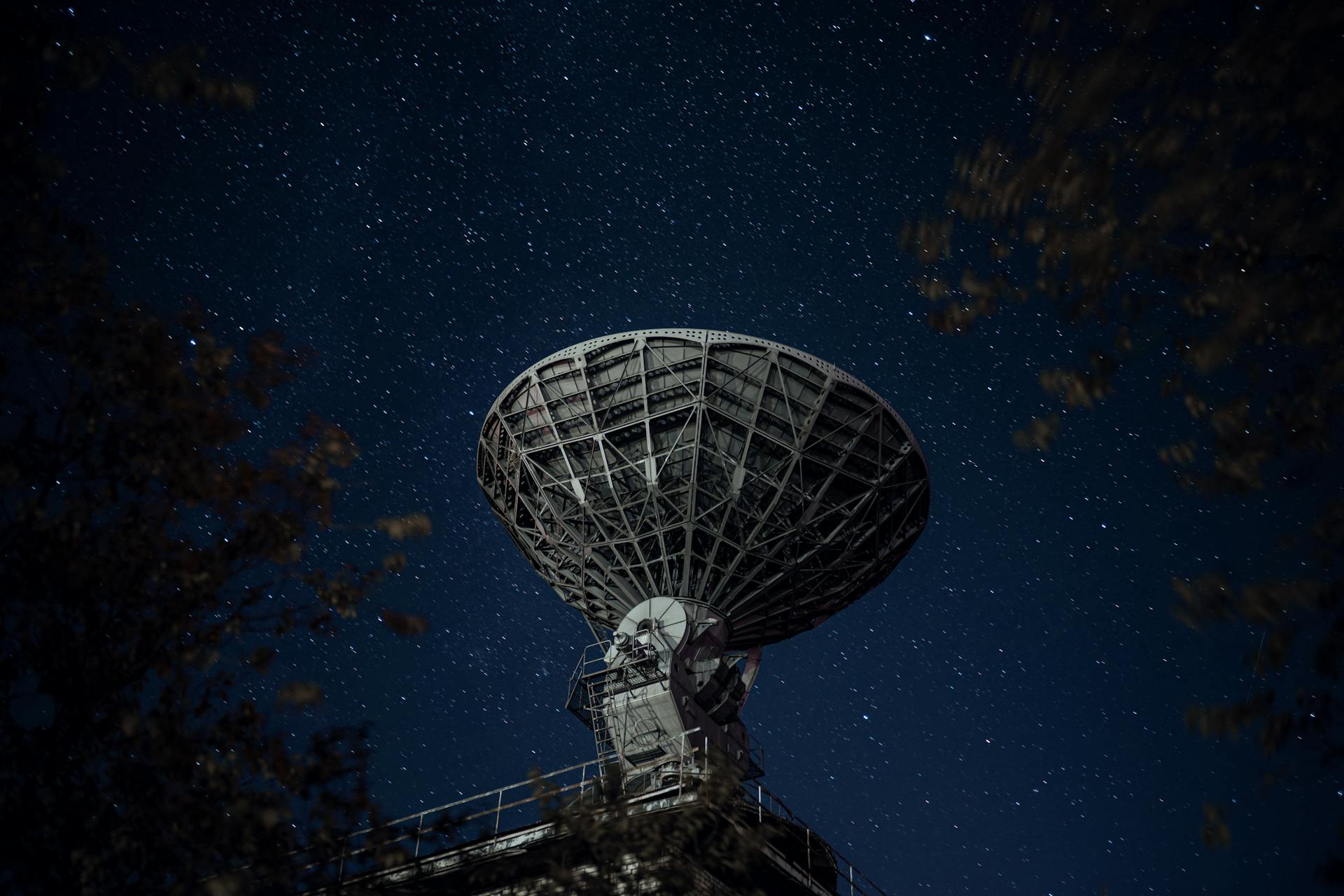
Something out there fires on a schedule.
The Earth receives a strong radio energy burst from a source that exists billions of light-years away because it generates repeating signals that have such exact timing that they force astronomers to change their understanding of the universe’s strongest violent events. The signal pulses for approximately four days before it goes silent for twelve hours, which it then repeats. The system operates with three four-day cycles followed by three twelve-day periods, which continue to repeat at metronome speed.
This phenomenon has no known functioning astrophysical mechanism because it operates with complete certainty across its full spectrum of behavior.
Astronomers refer to this event as a fast radio burst or FRB. These are brief radio energy bursts which last only milliseconds yet produce such intense radiation that they temporarily exceed the brightness of entire galaxies. Most signals emit a single transmission, which never occurs again. The few signals that repeat do so in an unpredictable manner, which lacks any established sequence and shows no defined pattern. This one is different. This particular source, catalogued and studied by radio telescope arrays including facilities in North America and Europe, doesn’t just repeat. The system operates in a repeating pattern that appears to follow an actual schedule according to specific observational points.
Scientists use the term “deliberate” to explain the background of their scientific work, which studies this signal, yet it serves as an active research target that scientists need to eliminate from their findings.
What Makes a 16 Day Cycle So Difficult to Explain
Source: Pexels
The leading natural candidates have all run into trouble. One possibility is a binary star system, where two massive objects orbit each other, and the geometry of that orbit periodically blocks or beams the signal toward Earth. The math can work, in theory. But the orbital period required to produce a 16-day cycle doesn’t match cleanly with the kinds of systems we know produce radio bursts. The numbers are awkward.
Another candidate is a precessing neutron star, a rapidly spinning stellar remnant whose rotational axis wobbles over time, sweeping its radio beam across our line of sight in a regular pattern. This model has gained traction among researchers, but it requires the precession rate to be extraordinarily stable over the observation window. Neutron stars can wobble. Getting one to wobble on a 16-day clock, consistently, across years of observation, is harder to arrange on paper than it sounds.
A third explanation involves a massive companion object, perhaps a star with a powerful wind that periodically absorbs or scatters the signal as it passes between the source and Earth. This one is tidier geometrically, but it demands a very specific configuration that hasn’t been directly confirmed through other observations of the source’s environment.
None of these is impossible. None has been ruled out entirely. That’s almost the problem.
What the Signal Is Actually Doing
The bursts themselves arrive in tight clusters during the active window. They’re not evenly spaced within those four days; they fire in groups, sometimes multiple in a short period, sometimes with longer gaps. The energy in each burst is staggering by any terrestrial measure. A single flash releases more energy in a millisecond than the Sun emits in days. The source is so far away that the signal has been traveling for a significant fraction of the age of the universe before reaching our instruments.
What makes the 16-day period particularly striking is that it implies a physical process operating on a timescale of weeks. Most things in astrophysics that repeat do so on timescales of milliseconds, seconds, or years. Weeks is an unusual middle ground. It suggests something large, large enough that its relevant physical dimensions correspond to a cycle measured in days rather than moments. Orbital mechanics, stellar rotation, geometric alignment: all of these scale with size. Whatever is producing this pattern is, in some sense, big.
The detection itself is a product of increasingly sensitive radio telescope infrastructure. Modern arrays can scan large swaths of sky simultaneously and catch transient events that older single-dish telescopes would have missed entirely. The fact that periodic FRBs are being found at all is partly a story about better instruments. How many similar signals have been firing for decades, undetected, is an open question.
Why This One Won’t Leave Scientists Alone
Most anomalies in astronomy get explained eventually. A strange signal turns out to be instrument noise, or a known class of object seen from an unusual angle, or a phenomenon that fits neatly into existing models once someone does the calculation correctly. This one has resisted that resolution longer than is comfortable.
Part of the difficulty is distance. The source is so remote that direct follow-up observations, the kind that would let astronomers characterize the environment around it, identify companion objects, and measure precise velocities, are at the edge of current capability. Researchers are essentially trying to diagnose a patient they can only observe from billions of light-years away, using a single symptom: the rhythm.
What’s left, after the natural candidates have been proposed and stress-tested, is a set of models that all work in principle and none that work perfectly. That’s a specific kind of scientific frustration. It doesn’t mean the explanation is exotic. It means the constraints of the problem haven’t been tight enough yet to eliminate the noise.
But it also means the question stays open. And an open question about a signal that fires on a precise 16-day schedule from deep space is, by any measure, one of the more interesting open questions in modern astronomy.
This article was created with AI assistance and reviewed by the author. The review included fact-checking, clarity edits, references, and sourcing of images