

During the autumn of 1942, thousands of citizens in the valley of the Appalachian mountains in eastern Tennessee were instructed to pack up what they could and relocate. It wasn’t due to floods. It wasn’t due to any natural catastrophe. The United States Army required all of their property, and they had anywhere from two weeks to a few days to relocate. There was no bargaining. There was no public discussion. There was only a knocking on the front door and a check from the government that most people felt to be grossly insufficient.
The farms, churches, and crossroads communities that once occupied this territory were replaced by an entity that the government refused to speak of in public.
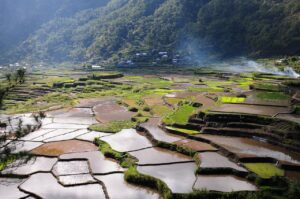
The land, roughly 60,000 acres carved out of Anderson and Roane counties, became Oak Ridge, Tennessee, one of the most classified addresses in American history and the production hub for the enriched uranium used in the atomic bomb dropped on Hiroshima in August 1945. The families who had lived there for generations weren’t told any of that. Most of the workers who flooded in to build the facility weren’t told either. They built it anyway.
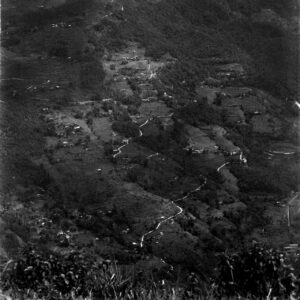
And here’s the strange part: for a time, Oak Ridge didn’t officially exist. The town was real, at its wartime peak it housed around 75,000 people, making it one of the largest cities in Tennessee, but it appeared on no public map. Mail arrived addressed to a post office box number. The roads in weren’t marked. Guards checked your papers at the gates. You could live there for months and still not know precisely what you were helping to build.
The Communities That Disappeared First
Before Oak Ridge, there were several small communities on that land. Wheat. Elza. Robertsville. Scarboro. These were not ghost towns or marginal settlements. Robertsville had a school. Scarboro was home to a Black community with its own church and social fabric that had survived the decades following the Civil War. Wheat had families who had farmed the same ridgelines for multiple generations.
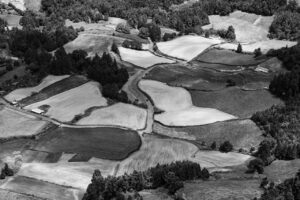
The Army’s acquisition moved fast. Condemnation proceedings began in late 1942, and by early 1943, the land was cleared. Families were compensated through a federal process that many described, decades later, in oral histories and interviews, as rushed and unfair. Some left with less than they’d paid for the property years earlier. A few tried to fight the valuations in court. Most simply went.
The emotional cost didn’t register in any official ledger. You can’t put a number on the loss of a cemetery where your grandparents are buried and to which you no longer have access.
What Got Built on the Cleared Ground
The Manhattan Project entailed the construction of three primary production plants. These plants included Los Alamos, New Mexico, for weapon designs, Hanford, Washington, for plutonium production, and Oak Ridge for uranium enrichment, an arduous technical procedure of enriching the fissionable isotopes.
The plants constructed at Oak Ridge were gigantic in scale. The K-25 gaseous diffusion plant was the largest building when constructed in the world by floor space. The Y-12 plant utilized electromagnetic separation. The X-10 reactor, which today is a National Historic Landmark, was the world’s first operational nuclear reactor. The plants were run on a round-the-clock basis by tens of thousands of workers who did not know about the end product.
Source pexelsThe secrecy wasn’t theatrical. It was engineered. Workers were compartmentalized so that no single person understood the full production chain. Supervisors answered questions with silence or deflection. The local newspaper, which did exist within the fenced city, printed nothing about the work. When the bomb was dropped on Hiroshima and the project was finally announced, many Oak Ridge workers described hearing the news and experiencing the strange, delayed recognition that this was what they had been doing.
The Town That Couldn’t Be Found
Tennessee maps did not include Oak Ridge during the period of the war. It was excluded from road maps. One could not just travel there as there were no signs on the roads that led to the city, and the gates were guarded by military policemen who would check identity with a list of people allowed entry. It was a town with its buses, its schools, its bowling alley, and its movie theaters; a town within the fence.
The gates of Oak Ridge were only opened to the public in 1949. Tennessee made the decision to incorporate Oak Ridge into a city only in 1959. The history of what was built there and the history of what was sacrificed to construct those buildings slowly began to unravel.
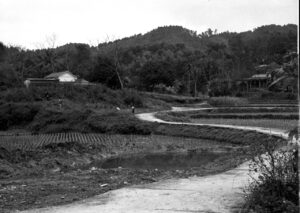
The displaced families never came back. The towns of Wheat, Elza, Robertsville, and Scarboro ceased to exist because of the presence of industries and buildings in the age of nuclear science. People who lost their property and their relatives got access to the cemetery that still exists in the reserve, but the land is no longer theirs, and it never will be again.
Oak Ridge today is a bustling city with a population of around 30,000 people. At the same time, it became the site of one of the most prominent research centers in the country, Oak Ridge National Laboratory. The building of K-25 factory, being too large and polluted for dismantling, stood until the end of the decade. Y-12 National Security Complex still operates.

What’s harder to account for, and what most histories of the Manhattan Project skip past, is what was erased to make room for all of it. The bomb is the story everyone tells. The Tennessee communities that had to disappear first are the story most people have never heard.
If the greatest scientific project in American history required secretly displacing thousands of citizens who were never fully compensated and never allowed to return, what does that say about the price we’ve decided is acceptable to pay for national security?
This article was created with AI assistance and reviewed by Charlotte Dayes, author at NewsDailys. The review included fact-checking, clarity edits, and sourcing of images.