



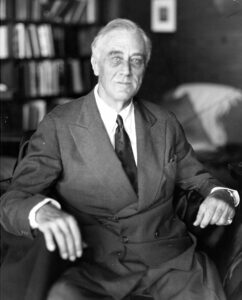
Franklin Roosevelt issued an executive order on a Wednesday morning in April 1933, which established a new federal crime that prohibited American citizens from possessing gold during peacetime. Banks. Coins. Bars. The existence of gold certificates, which served as paper proof of gold stored in vaults, faced legal restrictions that banned possession beyond designated limits.
The written punishment created extremely harsh consequences. The maximum punishment included ten years of imprisonment plus a monetary penalty that, when converted to 1933 value, would have financially ruined most households.
Americans continued to possess their gold through various hidden locations across the United States. The complete confiscation of all gold possessions, which the authorities planned,d never reached its intended outcome.
The Roosevelt administration seemed to possess knowledge about the ongoing events. I was seriously shocked that these developments held no significant value.
The Depression Logic Behind the Order

To understand why the order existed at all, you have to understand what 1933 actually felt like. The banking system had effectively collapsed. The banking industry had experienced widespread failure when thousands of banks closed their doors.
Unemployment had reached levels that are almost impossible to imagine today, with somewhere near a quarter of the working population without jobs. The entire system operated under a fundamental problem, which existed as an ongoing structural issue because of the gold standard system.
The dollar’s value used to operate under a system that established direct links between its worth and gold. The government could only issue currency if it held a corresponding amount of gold in reserve. The system appears to maintain stability according to its theoretical design.
The system led to a situation where people started hoarding gold because they became afraid, which reduced the government’s capacity to create new money needed to combat the Depression. The gold standard system prevented any possibility of an economic recovery,y which was about to begin.
Roosevelt’s executive order was, at its core, an attempt to break that stranglehold. By forcing gold back into the Federal Reserve, the government could reflate the currency, expand credit, and try to restart an economy that had seized up almost completely. The economics of it were contested even then. But the urgency was real.
What “Surrender Your Gold” Actually Looked Like

Americans who complied brought their gold to Federal Reserve banks or licensed dealers and received paper dollars in exchange at the official rate of about $20.67 per troy ounce. Then, within months, Roosevelt raised the official price of gold to $35 per ounce. The people who had surrendered their gold received payment at the rate of $20.67 per troy ounce. The government immediately profited from the price increase because it now possessed the gold that had been surrendered.
The public display of this particular detail leads to greater public outrage than any other aspect of this historical event. The public display of this particular detail leads to greater public outrage than any other aspect of this historical event. The order enforcement reached its most effective point through its order because the order required all law enforcement officers to fulfill their duties. The law protected all numismatic coins, which included gold coins that collectors recognized as valuable.
The law established an exemption that allowed entities to operate their businesses without restrictions. The exemptions created multiple gaps, which allowed people to pass through the openings,s which were as wide as truck driving space. Almost any coin dealer could declare any coin to possess numismatic worth. A family could divide their assets among family members to remain beneath the asset limit. The IRS and Treasury lacked the necessary investigation resources to conduct audits of all safe deposit boxes throughout the United States, even if they had the desire to do so.
The Hiding Strategies That Actually Worked

Americans followed their established procedure. People covered gold coins with cloth before they placed the coins inside coffee tins, which they then buried in their gardens and root cellars, because this method had protected their family wealth from banks that were about to collapse one year earlier. People changed their asset classification to jewelry because this category also provided exemption benefits. The physical form of a gold coin changed into a bracelet or belt buckle,e which created a legal distinction between the two items. Major city jewelers conduct high-volume sales of this type of jewelry transformation during the period after the order was issued.
The wealthy had more options. People could establish foreign accounts. People could create trusts. Security holdings, which included gold that remained stored overseas, existed as assets that the order could not access. The executive order applied to persons “within the continental United States”, a phrase that left room for interpretation and exploitation by anyone with the means to use it.
The current situation shows only a few cases that reached prosecution when I examine past events. The government pursued some cases, most visibly against businesses and large holders who couldn’t credibly claim ignorance. The authorities focused on people who secretly stored small amounts of gold coins at home. The order intended to eliminate both the psychological and economic power that gold hoarding produced when it occurred at massive levels. The system achieved its goal without needing to apprehend every grandmother who possessed a coin collection.
**The Forty-Year Ban and What Ended It**

Most people in America today do not understand how long the prohibition extended. Roosevelt’s executive order became a law through congressional approval. The ban on private gold ownership continued in different forms until December 31 1974. American citizens were prohibited from owning gold bullion for a period of four decades.
Gerald Ford signed the legislation that ended the ban, and within days, Americans could legally purchase gold again for the first time since the Depression. The price had increased from $35 to a higher value at that point. The people who had quietly held their coins through four decades of federal prohibition had, in many cases, held something that was now worth multiples of what the government had offered them to surrender it.
The mathematical calculations for non-compliance showed successful results according to the findings. Which sounds cynical, until you remember that the government changed the price of gold the same year it demanded everyone hand theirs over. Some lessons about trust and monetary policy are easier to learn the hard way.
Most Americans today have no memory of a time when their government could tell them what they were and weren’t allowed to own as a store of value. This fundamental truth requires examination because ongoing discussions about digital currency, central bank control, and financial privacy rights are becoming more practical every year.
This article was created with AI assistance and reviewed by the author. The review included fact-checking, clarity edits, references, and sourcing of images