



This story will teach you the following information.
- The era before electronic amplification established new sound patterns to which people heard through their church bells and city streets, but audio recordings from that time could only show a small part of actual sound.
- The research on auditory memory by neuroscientists demonstrates that people develop their auditory ability to perceive sound patterns as “normal” through a process that takes about one hundred years, which means that all current people cannot create correct mental images of sounds that existed before the advent of electric power.
- The “ring” of a telephone and the “tick” of a clock which people today consider ancient and natural sounds, actually exist as artificial sound reproductions of original sounds which no longer exist.
Your pocket phone creates a phone sound, but it does not actually ring. The device has no ringing function. You hear a synthesized tone which engineers created during the 20th century to imitate the sound of an electromechanical bell, which itself replaced earlier acoustic signals that most people today would not recognize. The strange story begins here about how World War II changed the complete sound environment of contemporary existence.
The acoustic world before roughly 1950 was not a quieter version of today. It was a different world.
The World That Stopped Sounding Like Itself

Start with something simple: a crowd. Before electronic public address systems became widespread in the 1930s and 1940s, large gatherings, political rallies, sporting events, religious ceremonies, produced a different kind of collective sound. Voices couldn’t be amplified and thrown across a space. The crowd noise you hear in early 20th-century newsreel footage is already a degraded artifact, filtered through recording technology that couldn’t capture low frequencies or the ambient wash of a large space. The actual sound of 50,000 people in an open stadium before microphones existed? Gone. No living person remembers it, and no recording accurately preserved it.
Now consider the clock. The ticking sound most people associate with clocks, that crisp, mechanical click, is largely a product of precision manufacturing techniques that were standardized and mass-produced after the 1920s. Earlier mechanical clocks, particularly the large domestic and public ones common before the 20th century, produced sounds that varied enormously by maker, material, and age. Some were heavier. Some were irregular. The uniform “tick-tock” we recognize as timeless is, in fact, quite recent.
And here’s the strange part: we don’t just passively accept these replacement sounds. Research in auditory perception suggests that humans actively update their internal model of “normal” based on what they repeatedly hear, a process that happens below conscious awareness. Within a generation or two, a timeframe researchers in auditory perception have explored, a newly introduced sound can become the baseline against which all other sounds are judged., a newly introduced sound can become the baseline against which all other versions sound wrong or artificial. The replacement becomes the original.
Twelve Sounds That Were Rebuilt

The telephone ring is the most famous example, but it’s far from alone.
The doorbell. Before electric chimes became standard in American homes during the postwar housing boom, most homes used mechanical pull-bells or knock plate systems. The sound was physical, metal on metal, or a spring-wound clapper, and it varied by door. The two-tone electronic chime that most people picture as “classic” didn’t exist in that form until the mid-20th century.
The car horn. Early automobile horns were hand-squeezed rubber bulbs producing a nasal, reedy sound, nothing like the electromagnetic honk standardized across American vehicles by the 1940s. The bulb horn was still common on city streets into the 1920s. No one honks like that now. Most people under 60 have never heard it outside a cartoon.
The train. Steam locomotive acoustics were not simply “louder old trains.” The whistle frequencies, the rhythmic exhaust beat, the particular hiss of brake lines and steam release, these were a complete sonic signature that disappeared from most American rail lines as diesel replaced steam through the 1950s. Recordings exist, but recordings flatten the experience. The felt vibration, the harmonic complexity at close range, that’s gone.
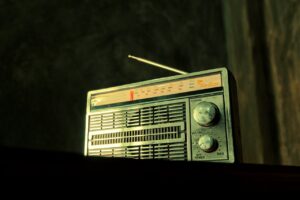
The radio. Not the content, the medium itself. Before FM became the dominant broadcast format and before audio engineering matured, AM radio in the 1930s and 1940s carried a warm, slightly compressed, bandwidth-limited sound that entire generations used as their primary musical reference. When those listeners heard live music, they filtered it through that sonic expectation. The “warmth” of old recordings isn’t nostalgia, it’s the literal frequency response of the transmission technology. We hear those recordings now as retro texture. They heard it as the sound of music.
The cash register. The mechanical “ka-ching“, that percussive, satisfying clatter of a sale being recorded, was produced by actual physical mechanisms: keys, levers, a bell, a drawer spring. It was a sound that varied by manufacturer and wear. Electronic point-of-sale systems began replacing mechanical registers from the 1970s onward, and the “cha-ching” sound now exists almost exclusively as a digital sample used to evoke money. The real version is nearly extinct.
The typewriter. Film and television have kept this one alive as a sound effect, but the specific acoustic signature of a manual typewriter, the resistance of the keys, the carriage return’s physical clunk, the bell at the end of a line, varied dramatically by model and manufacturer. What people recognize as “the typewriter sound” is a composite, an average of a dozen different machines collapsed into one recognizable cliché.
Why Your Brain Can’t Go Back
Auditory neuroscience has a concept sometimes called perceptual normalization, the process by which repeated exposure to a sound recalibrates what the brain registers as natural or neutral. It’s the same mechanism that makes you stop noticing the hum of a refrigerator within minutes of being in a room. Applied across a lifetime of exposure to post-1950 acoustics, the effect is profound. Most people alive today have never heard a city street, a workplace, or a home that sounded the way it did in 1930. And because our brains continuously update their baseline, we don’t experience this as a loss. We experience it as normal.
Sound historians and acoustic ecologists have spent decades trying to reconstruct pre-electrification sonic environments, using early recordings, building records, and material analysis to estimate what a 19th-century city actually sounded like. The results are consistently surprising to modern ears, not because the old world was quieter (it often wasn’t), but because the frequencies, the textures, and the rhythms were built from entirely different materials and mechanisms.
The world didn’t just look different before 1950. It sounded completely different. And because we update our sonic expectations automatically, without awareness or consent, most of us will never know exactly what we stopped hearing.
If you could walk down a city street in 1925 with your current ears, you might not recognize a single ambient sound as familiar. That’s worth sitting with for a moment.
This article was created with AI assistance and reviewed by author. The review included fact-checking, clarity edits, references and sourcing of images