


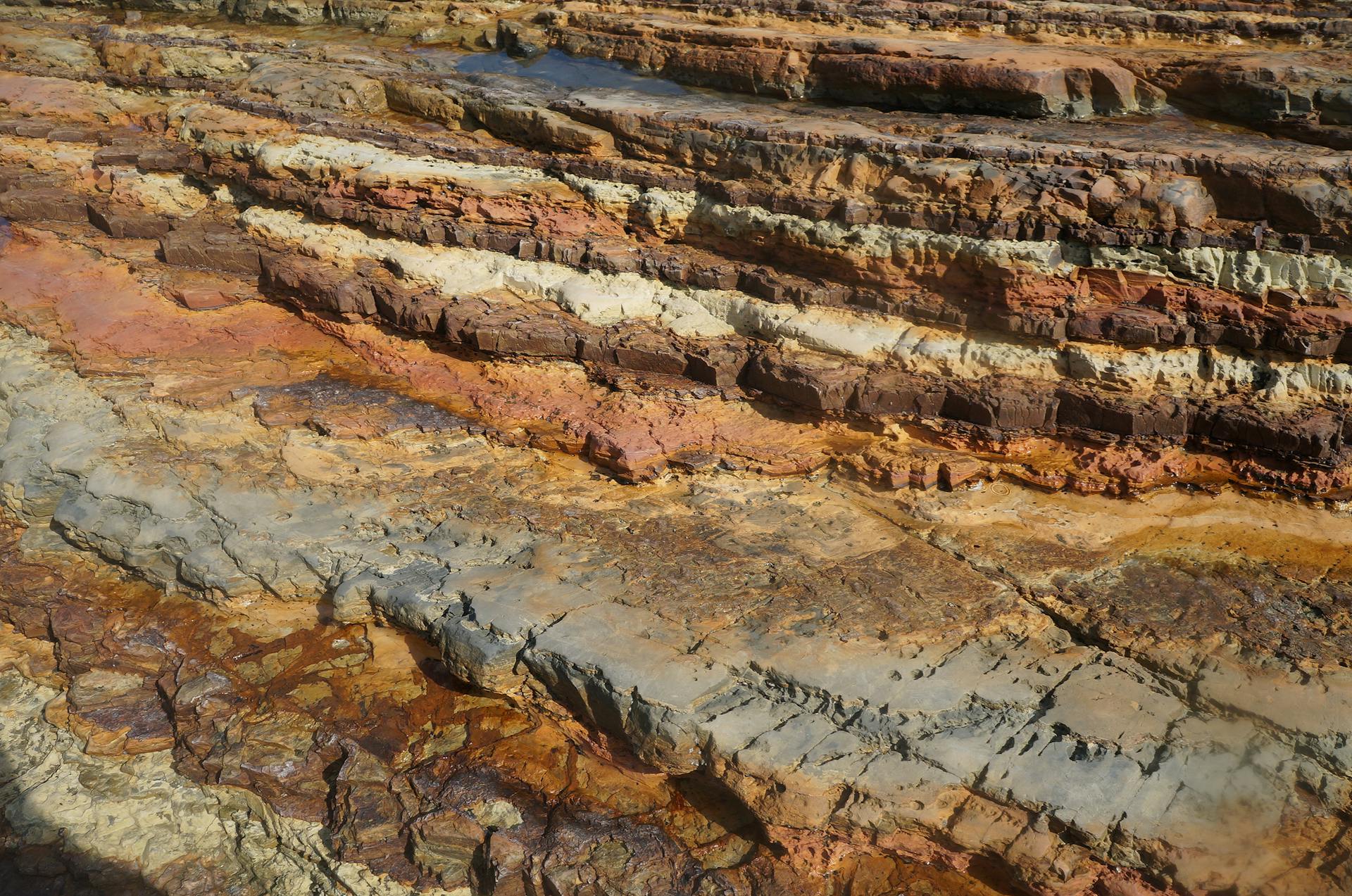
The earth beneath your feet reaches depths which most people will never contemplate. The depth starts at one mile and then extends two hundred miles, and finally reaches three thousand miles,s where rock layers and metal layers compress between each other under conditions that cause regular physical laws to lose their normal behavior. The scientists spent the majority of one hundred years creating a map of the underground layer,s which by 1970 established two basic core Earth structures: a solid inner core, a liquid outer core, a mantle, and a crust.
The project reached its final stage.
Seismologists study the way earthquake waves move through the planet, and they have gathered evidence for more than ten years, which shows something exists inside the inner core that contradicts standard scientific understanding. The boundaries do not show any evidence. The mantle does not show any evidence. The Earth’s core contains a unique center layer that earth scientists will never be able to access physically because it lies beyond their measurement instruments. Some researchers now refer to it informally as the “inner inner core.” Others prefer more careful language. Both ways of expressing the concept show that the textbook diagram contains incorrect information.
Scientists overlooked something that should have been obvious to them. The detection equipment required to identify this layer has newly achieved the necessary detection capacity.
The Only Way to See the Center of the Earth

Nobody has ever drilled close to the Earth’s core. The deepest borehole ever drilled, the Kola Superdeep Borehole in Russia, reached roughly 7.6 miles (about 12.2 kilometers) before the project was abandoned, a remarkable engineering achievement that still barely scratched the crust. The core sits nearly 4,000 miles below the surface. For all practical purposes, it is unreachable.
So geologists do something elegant instead. They listen.
When an earthquake strikes, it sends seismic waves radiating outward in every direction, including straight down through the planet. These waves behave differently depending on what material they pass through. They speed up in some materials, slow down in others, bounce or refract at boundaries between layers.
By recording how waves from earthquakes around the world arrive at seismograph stations, scientists can essentially perform a CT scan of the planet’s interior. It takes a global network of sensors, decades of accumulated earthquake data, and increasingly sophisticated computational modeling. But it works.
What researchers have found using this method is that waves traveling through the very center of the Earth, the innermost region of the inner core, behave differently than waves traveling through the surrounding inner core material. The difference is subtle. But it’s consistent. And consistency, in science, is the thing that makes a pattern real.
What the New Layer Might Mean

The leading interpretation is that the innermost zone has a different crystal structure from the rest of the inner core. Earth’s inner core is made primarily of iron, and at the pressures found there, pressures that dwarf anything achievable in a laboratory, iron atoms arrange themselves into geometric lattice patterns. The direction of those lattice alignments affects how seismic waves move through the material. If the innermost region has a different alignment, it means the iron there crystallized under different conditions, possibly at a different point in Earth’s history.
That’s where the implications get genuinely large.
The inner core isn’t static. It’s been growing, slowly, over billions of years, as the planet cools and liquid iron in the outer core gradually solidifies. If the innermost layer has a distinct crystal structure, it could be a record of an earlier phase of that cooling process. A kind of geological fossil, preserved at the center of the planet, from a time when Earth’s thermal history was different. Which sounds almost too tidy until you realize that reading planetary history from seismic wave behavior is exactly the kind of indirect evidence that geology runs on. The whole of science is inference.
Researchers are also interested in what this might mean for Earth’s magnetic field. The geodynamo, the process by which the liquid outer core generates the magnetic field that protects life on Earth from solar radiation, is driven by heat and compositional differences in that outer core. How the inner core grew, and when, affects the conditions that power the geodynamo. If the inner inner core represents a distinct phase of inner core formation, it could change models of how Earth’s magnetic field evolved over time. And those models matter, because the magnetic field has reversed before, and the question of when and why it might reverse again is not purely academic.
Why This Took So Long to Find

The evidence for an innermost layer isn’t new as an idea; researchers have proposed the possibility for decades. What’s changed is the quality of the data. Global seismograph networks have expanded significantly. Computational power has grown to the point where researchers can model the behavior of seismic waves through complex interior structures with far greater precision than was possible even twenty years ago. And new analytical approaches, including the use of waves that have bounced back and forth through the core multiple times, have made it possible to isolate signals from the very deepest part of the planet that were previously buried in noise.
Science rarely works through single dramatic revelations. It works through accumulation. Data sets get larger. Models get more sophisticated. A signal that looked ambiguous in one study gets confirmed by an independent team using a different dataset. The inner core followed that pattern, a gradual convergence of evidence from multiple research groups, working independently, arriving at the same conclusion through different methods. That convergence is what moves a hypothesis from interesting to credible.
The Earth has existed for 4.5 billion years. Scientists have systematically studied earthquakes through seismology for approximately 130 years. The planet continues to create structural surprises, which either humbles you or reassures you according to your personality. The world still contains fundamental secrets that human beings have not managed to completely understand. Scientists might discover a permanent record of the planet’s initial thermal development through its deepest core. The record might become accessible through advanced detection of seismic waves, which travel through that particular layer instead of through direct drilling.
The Earth’s center has existed since the beginning of time, before any living organisms appeared on Earth. This location might become the final sitethath humans will ever comprehend completely. Seismologists who maintain their listening practice will uncover information that we have not yet considered to inquire about.
This article was researched, written, and edited by our human editorial team. AI tools were used in a limited research-assistant capacity. All claims were independently verified.