

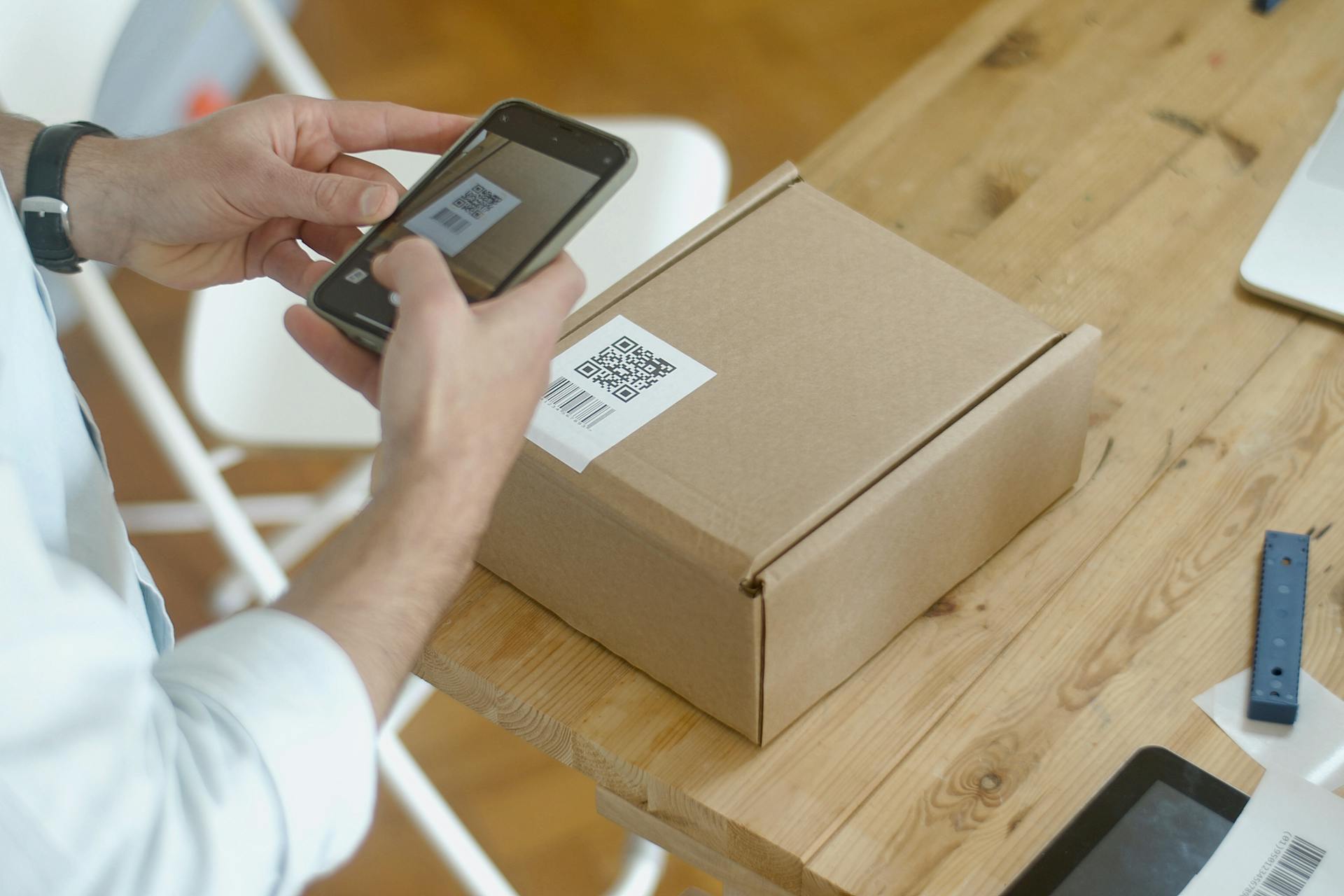
The first product ever scanned by a barcode at a checkout counter was a pack of Wrigley’s Juicy Fruit gum. That detail, small and almost absurd, is the hinge point of one of the longest gaps between invention and adoption in modern commercial history. The barcode had already been sitting in a patent filing for more than two decades by the time that gum slid across a scanner in an Ohio supermarket. Nobody bought it. Nobody wanted it. And then, suddenly, everybody needed it.
That gap is the story. Not the invention. The invention is almost beside the point.
The Idea That Arrived Before Its Time
Two graduate students at the Drexel Institute of Technology (now Drexel University) came up with the core concept in 1948, reportedly inspired by Morse code, the idea that varying widths of lines could encode information the same way dots and dashes encoded sound. Their patent, awarded in 1952, described a system of concentric circles rather than the vertical stripes most people picture today. It looked more like a bullseye than anything you’d recognize on a cereal box.
And here’s the strange part: the technology was genuinely clever. Even by early standards, the underlying logic was sound. But sound logic doesn’t move industries. Economics does. And in the early 1950s, the economics weren’t there yet. Laser scanning didn’t exist in a usable commercial form. Computers were the size of rooms and cost what small countries spent on infrastructure. The barcode was a solution looking for hardware that hadn’t been built yet.
So it waited.
The Crisis That Made Retailers Desperate

By the late 1960s, American grocery chains were in genuine trouble. Labor costs were climbing. The checkout lines were slow. Pricing errors were eating into margins that were already razor-thin. The industry didn’t need a cooler checkout process; it needed a rescue. A joint industry committee convened by the Grocery Manufacturers of America and the Food Marketing Institute (then operating as the Super Market Institute and National Association of Food Chains) convened to solve the problem, and the question they kept circling back to was: what if the product could identify itself?
That question had already been answered. In a patent office. In 1952.
Here’s the thing: you can have the right answer sitting in a filing cabinet for twenty years, and it still means nothing if the industry can’t agree on how to use it. Before a barcode could work at scale, every manufacturer and every retailer had to commit to the exact same format, one universal code that a cereal manufacturer in the Midwest and a regional grocery chain in the South would both honor without question.
Without that agreement, the whole system collapsed into chaos. The negotiation to establish what became the Universal Product Code took years. Committees, competing proposals, industry politics. The boring machinery of standardization that makes everything else possible.
The UPC was formally adopted in 1973. The first commercial scanner was installed the following year.
One Pack of Gum. One Scanner. One Tuesday Morning.

The scan happened on June 26, 1974, at a Marsh supermarket in Troy, Ohio. A cashier ran the pack of gum across a newly installed laser scanner, a register printed an itemized receipt, and the transaction was recorded automatically. No price lookup. No manual entry. The machine read the stripes, matched them to a database, and returned a price in under a second.
Nobody in the store that morning knew they were watching the start of something that would eventually appear on billions of products every day worldwide. The cashier was doing her job. The gum was gum.
But the moment mattered, because it proved the system worked under real-world conditions. Retailers who’d been skeptical, and there were many, now had a demonstration they could visit, replicate, and pitch to their boards. Adoption was still slow for several years. The scanners were expensive. Retailers had to retrofit checkout lanes. Suppliers had to redesign packaging.
Then Walmart got involved. And after that, the holdouts didn’t hold out much longer.
What the Barcode Actually Changed
Speed is the obvious answer. Checkouts got faster, errors dropped, and lines moved. Fine. But the change that actually mattered was informational; for the first time, a retailer could know, in real time, automatically, exactly what was selling, in which quantities, at which location. Not a weekly inventory count done by a stockroom clerk with a clipboard. Right now. Continuously. Supply chains tightened around that signal like a fist. The relationship between a shelf and a warehouse became, for the first time in retail history, genuinely responsive rather than perpetually behind.
Some economists argue that the barcode did more for retail productivity in the late 1970s and 1980s than any single piece of technology until the internet. That’s a big claim. But walk through any modern distribution center and watch the scan-and-sort system running at full speed, and the claim starts to feel conservative rather than bold.
The barcode also quietly became the template for every identification system that followed, QR codes, RFID chips, the digital product identifiers embedded in apps and supply chains today. All of them trace a conceptual lineage back to those two graduate students and their bullseye drawing.
Which sounds like a tidy ending. Except the barcode is still there, still on almost everything, still doing its job, decades after most people assumed something sleeker would replace it. There’s something almost stubborn about it. A technology so useful that even the future didn’t bother to retire it.
If the biggest ideas are the ones that outlast the era they were invented for, the barcode might be the most underrated invention of the 20th century. Most people have never once thought about it. Which is probably the point.
This article was created with AI assistance and reviewed by the author. The review included fact-checking, clarity edits, references, and sourcing of images