

The most accurate clock ever built would not lose a single second if it had started ticking at the moment of the Big Bang and was still running today. That’s not a metaphor. It’s the actual engineering benchmark physicists use to describe the performance of optical atomic clocks, the most precise instruments humanity has ever constructed.
Which makes the obvious question almost too strange to say out loud: why does anyone need a clock that accurate?
The answer turns out to be one of the more quietly mind-bending stories in modern science. Precision timekeeping isn’t just about knowing what time it is. At the frontier, it becomes a tool for detecting gravity, mapping the interior of the Earth, testing whether the laws of physics are actually constant, and, here’s the part that tends to stop people, rewriting the definition of what a second even means.
When “Good Enough” Stopped Being Good Enough
For most of human history, timekeeping tracked the Sun. A day was a day. The n mechanical clocks divided it further. The came quartz oscillators, then the first generation of atomic clocks in the mid-20th century, which worked by counting the vibrations of cesium atoms as they cycled between energy states. These became the backbone of GPS, telecommunications, and the internet. They’re accurate to about one second over hundreds of millions of years some modern cesium fountain clocks perform even better. That sounds absurd. And for most purposes, it is more than enough.
But “most purposes” has a ceiling.
Optical atomic clocks, the current generation, don’t use microwaves to interrogate atoms the way cesium clocks do. They use laser light, which oscillates at frequencies roughly 100,000 times higher. More oscillations per second means more ticks per unit of time, which means vastly finer resolution. The result is a clock that can detect differences so small they have no analogue in ordinary experience. We’re talking about timekeeping sensitive enough that raising the clock by a few centimeters, literally lifting it off the table, produces a measurable shift in its rate due to the weakening of Earth’s gravitational field with altitude.
Einstein predicted this. General relativity says that time passes slightly faster farther from a gravitational mass. For most of the 20th century, confirming this effect required sending clocks into orbit. Now you can do it on a lab bench.
What Physicists Are Actually Using These For
Here’s where it gets genuinely strange. The precision of optical atomic clocks has crossed a threshold where they’re no longer just measuring time; they’re becoming scientific instruments in their own right. A network of these clocks, spread across different elevations, can effectively scan the gravitational landscape beneath them. Denser rock, underground cavities, shifting magma: all of it produces tiny but detectable variations in local gravity, which the clocks register as differences in their tick rates. This technique, called chronometric geodesy, is being developed as a way to map Earth’s interior with a precision that traditional seismic methods can’t match.
The applications extend further. Clocks this accurate can test whether the fundamental constants of physics, the speed of light, the strength of electromagnetism, and the mass of the electron, are actually constant, or whether they drift imperceptibly over time. Some theories of dark matter predict that they should drift. So far, measurements suggest they don’t. But the only reason we can say that with any confidence is because we now have clocks sensitive enough to notice if they did.
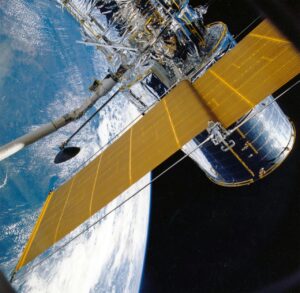
Then there’s navigation. GPS works because satellites carry atomic clocks, and the system triangulates your position from the timing of signals. The accuracy of your position fix is directly limited by the accuracy of those clocks. Optical atomic clocks are not yet in orbit, they’re fragile, large, and require laser cooling systems that don’t travel well, but miniaturization is underway. When they do reach orbit, the improvement in GPS precision could be dramatic enough to enable navigation systems with centimeter-level accuracy rather than the meter-scale accuracy typical of consumer GPS today, though exact improvement projections vary by engineering estimate.
The Second Is About to Be Redefined. Again.
There’s one more wrinkle worth sitting with. The international definition of a second, the unit that underpins every clock, every data network, every financial transaction with a timestamp, is currently based on cesium. Specifically, one second is defined as 9,192,631,770 cycles of radiation corresponding to the transition between two hyperfine levels of the cesium-133 atom.
That definition has held since 1967. But the international bodies responsible for timekeeping standards have been working toward redefining the second in terms of optical transitions, which would effectively upgrade the global foundation of time to match the new generation of clocks. The math worked out decades ago. The practical challenge has been building enough optical clocks, in enough countries, to agree on a new standard.
The math worked. Which was almost the problem, because it revealed that the definition of a second that the entire world had been using was slightly less precise than what physics could now deliver. Upgrading the standard means every system that depends on it needs to accommodate the change. That’s not a small thing. Time, it turns out, has infrastructure.
What makes optical atomic clocks so conceptually vertiginous is that they’ve taken precision past the point where the improvement is about convenience. Nobody needed a clock that outrun the age of the universe. But in building one, physicists created a tool that can hear the Earth breathe, test whether the universe has stayed the same since it began, and eventually navigate a ship to within a footstep of its destination from orbit. Sometimes the most useful thing you can build is the most extreme version of something that already works.
If the definition of a second changes in the next decade, almost no one will notice, and almost everything will be slightly more real.
This article was created with AI assistance and reviewed by the author. The review included fact-checking, clarity edits, references, and sourcing of images