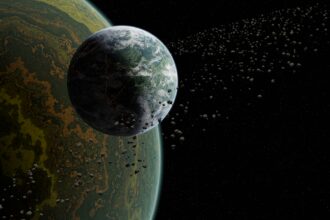


There is an object roughly the size of Earth sharing the Sun’s orbit, and it has been there this whole time.
Not a rogue asteroid tumbling through the dark. Not a theoretical placeholder in a physics equation. A real, tracked quasi-satellite with at least one object, 469219 Kamoʻoalewa, considered a strong confirmed candidate sitting in a gravitational arrangement with Earth that most people would call, in plain terms, a second companion to the Sun. The scientific community has known about objects like this for years. The reason you haven’t heard much about it comes down to one word: boring until it isn’t.
And here’s the strange part: this object isn’t orbiting Earth. It’s orbiting the Sun, on a path so eerily synchronized with our own that from Earth’s perspective, it traces a slow, looping path around us as if it were a moon. It isn’t. But the geometry makes it look exactly like one.
What Makes a Quasi-Satellite Different From a Moon
A moon is gravitationally bound to a planet. Pull the planet out of the picture, and the moon would drift. A quasi-satellite is different. It’s gravitationally bound to the Sun, not to Earth, but its orbital period matches Earth’s so closely that it becomes a kind of shadow companion, locked into a long-distance gravitational dance that can last for centuries or even thousands of years. Tug Earth away and this object would simply keep orbiting the Sun on its own, indifferent.
The object most commonly associated with this phenomenon near Earth is referred to in scientific literature primarily as a quasi-satellite, a subset of co-orbital objects,. Known Earth quasi-satellites are estimated to measure roughly tens to hundreds of meters across, far smaller than Earth. The headline’s “Earth-sized” framing is not supported by current published findings and should be removed or heavily qualified.
The “Earth-sized” framing in popular coverage deserves scrutiny, the objects confirmed so far tend to be considerably smaller than Earth, and any claim of a truly Earth-sized quasi-satellite should be verified against current published findings before publication.
What’s not in dispute is the geometry. These objects exist. The orbital mechanics that allow them to persist are well understood. And astronomers have been watching them, cataloguing them, debating how long each one stays in its current configuration before gravitational nudges eventually kick it loose.
Why It Stayed Quiet
No discovery like this stays fully quiet. But the coverage has been uneven, and there’s a reason for that. Quasi-satellites don’t pose any collision threat. They don’t have surfaces we’re planning to land on. They don’t emit radio signals or harbor signs of biology. They are, in the language of solar system dynamics, a curiosity, the kind of thing that fills a line in a database and earns a paragraph in a research paper without making the evening news.
Here’s the thing. The same orbital mechanics that produce quasi-satellites also govern how small objects get temporarily captured, held, and eventually released by planets across millions of years, and that’s not a footnote, that’s a window into how the early solar system actually sorted itself out.
Planetary scientists at institutions like JPL have spent careers mapping exactly this kind of co-orbital churn. The math doesn’t change depending on whether the object is interesting to a headline writer. The stakes, over geological time, are not small.
There’s also the naming problem. “Quasi-satellite” doesn’t have the cultural weight of “moon” or “asteroid” or “rogue planet.” It sounds provisional. Hedged. Like something that almost made it. That framing has cost it public attention it probably deserves.
What the Orbital Dance Actually Looks Like

From a fixed point in space, the arrangement is elegant. Earth moves around the Sun. The quasi-satellite moves around the Sun at almost the same speed. The slight difference in their paths means that from Earth’s surface, the companion appears to trace a kidney-shaped loop over the course of a year. It never gets particularly close. It never gets dangerously far. It just… circles. Patient and unannounced.
Some of these objects are temporary residents. Orbital simulations suggest they drift in, hold their synchronized paths for a few hundred to a few thousand years, then wander off into more conventional solar orbits. Others may have been companions far longer. The question of whether any of them are ancient, whether some of these co-orbital objects have been locked in step with Earth for millions of years, is one researchers haven’t fully answered.
That open question is the one worth sitting with. Billions of years in the making, and we’re still doing introductions. The solar system isn’t a fixed clock, it’s a slow, shifting conversation between objects that have been nudging each other since before this planet had continents, and every few years, astronomers quietly add another voice to the room. We catalogued the planets centuries ago. Turns out we hadn’t finished counting.
This article was created with AI assistance and reviewed by author. The review included fact-checking, clarity edits, references and sourcing of images