


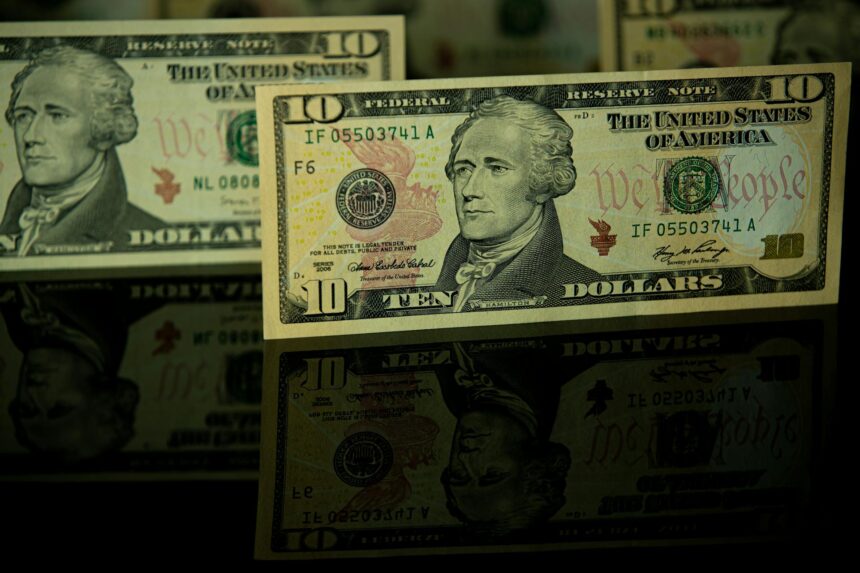
In 1947, more than nine of every ten dollars held in official government reserves around the world weren’t a dollar at all. It was a pound. Sterling sat at the center of global finance,e the way the sun sits at the center of the solar system, not because anyone chose it that morning, but because everything had been arranged around it for a very long time. Twenty-six years later, that share had fallen to roughly 10—15% by the early 1970s. Britain hadn’t been conquered. It hadn’t gone bankrupt. It had simply been slowly, then suddenly, left behind.
A recent working paper from the Hoover Institution, written by economists from Stanford and NYU, did something no one had quite done before. It measured how much the dollar’s “convenience yield” has eroded since 2023. That’s the premium global investors pay just to hold dollar-denominated assets, the quiet surcharge that reflects trust. The number has been shrinking. And that, the paper argues, is how these things begin.
The dollar’s current share of identified global foreign-exchange reserves stands at approximately 57%. That sounds like a lot until you remember where it started: around 85% in the mid-to-late 1970s, and still around 70- 71% as recently as 1999. In roughly a generation, the dollar has surrendered about 14 percentage points of that lead. Quietly. Without a single dramatic announcement.
The Moment Britain Learned It Was Finished

Here’s the part that should make any dollar-watcher uncomfortable. Britain’s decline didn’t happen in a straight line. For years, the pound held on. Analysts wrote reassuring papers. Then a crisis arrived that the numbers couldn’t absorb.
In the autumn of 1956, Britain and France moved militarily against Egypt to retake the Suez Canal. The United States, under Eisenhower, refused to back them. Within weeks, sterling came under speculative attack. British reserves fell sharply, by some accounts hundreds of millions of dollars, as capital fled, forcing an emergency call to the IMF that London had hoped it would never have to make. It wasn’t just a military humiliation. It was the moment the world saw that Britain could no longer defend its own currency in a crisis without American help. After Suez, the slide accelerated. The pound never fully recovered its standing.
That pattern, gradual erosion, then a shock that crystallizes doubt, is what economists call a “tipping point dynamic.” Confidence in a reserve currency doesn’t erode proportionally. It holds, and holds, and then something happens,s and it doesn’t.
What the Dollar Is Facing Now
According to Brookings, the U.S. dollar has fallen roughly 10% on a broad trade-weighted basis since the start of Trump’s second term, coming in two sharp bursts rather than a smooth decline. That two-burst pattern matters. It suggests the market isn’t simply repricing the dollar gradually. It’s reacting to specific events, recalibrating trust in specific moments.
That’s how it went foSterlingng, too.
The Hoover paper doesn’t predict that the dollar will collapse, or that the euro or the yuan will replace it in the next decade. Economists are careful about that kind of claim, and rightly so. Reserve currencies don’t fall apart the way companies do; there’s no bankruptcy filing, no closing date. What the paper does argue is that the erosion of the convenience yield is a real and measurable signal, not a talking point. The premium the world pays to hold American assets is shrinking. When that premium disappears entirely, the dollar becomes just another currency in the mix.
That may take ten years. It may take thirty. Britain’s slide from 90% to 11% took twenty years.
What history actually tells us isn’t that the dollar is doomed. It’s that these transitions are almost always invisible until they aren’t, that the world keeps using a currency long after it has stopped fully trusting the country behind it, right up until a crisis makes the gap impossible to ignore. Britain had an empire, a navy, and a century of goodwill behind its currency. It still lost the reserve throne, and it lost it faster than almost anyone in 1947 would have believed possible.
The 56.92% figure sitting in the IMF’s data right now is still a position of enormous strength. The question worth sitting with is whether it looks more like 1947 or more like 1955, the quiet year before Suez, when the pound was still the pound, and nobody in London thought the telegram was about to arrive.
This article was researched, written, and edited by our human editorial team. AI tools were used in a limited research-assistant capacity. All claims were independently verified.