


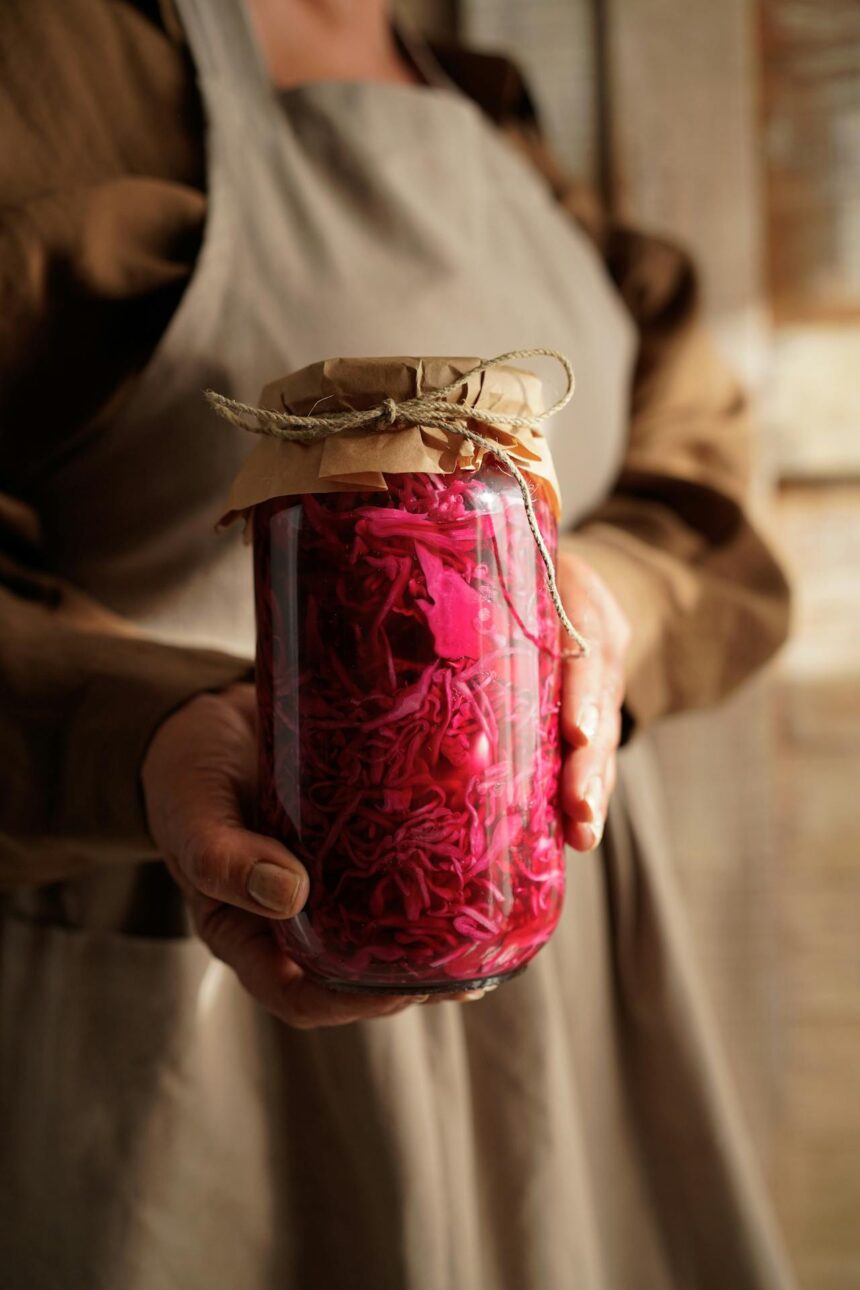
There are jars of kimchi sitting in Korean American households that have been fermenting on the same refrigerator shelf for decades. Grandmothers made it the same way their grandmothers did salted cabbage, chili flakes, garlic, a little fish sauce packed into crocks, and left to do their slow, bacterial work. Nobody called it a health intervention. Nobody needed to.
But in early 2026, researchers at South Korea’s World Institute of Kimchi published findings in the journal Bioresource Technology that reframe that humble jar in a way its makers never anticipated. A lactic acid bacterium living inside fermented kimchi, a strain called Leuconostoc mesenteroides isolated from kimchi, can bind to nanoplastics inside the gut and help carry them out of the body. Not metaphorically. Literally grab them and escort them to the exit.
And here’s the part that makes this more than a feel-good food story: the researchers didn’t just observe the bacteria doing this in a petri dish. They tested it under conditions designed to mimic the actual human intestinal environment, which is acidic, enzymatically active, and nothing like a clean laboratory flask. Under those conditions, the kimchi-derived strain maintained a high nanoplastic adsorption rate under simulated intestinal conditions. A comparison strain, tested the same way, dropped to a markedly lower rate. The difference isn’t subtle. It’s the difference between a sponge and a dry cloth.
What Nanoplastics Are Actually Doing Inside You
To understand why this matters, you have to understand what nanoplastics are and where they end up. These are particles smaller than one micrometer, which means they are invisible to the naked eye and small enough to pass straight through the intestinal wall. Once they do, they don’t just sit harmlessly in the bloodstream. Research has detected nanoplastics accumulating in the kidneys, liver, and brain. The science on long-term human health effects is still developing, but the particles are getting into places that, not long ago, we assumed were protected.
Americans encounter microplastics and nanoplastics through food packaging, drinking water, and even the air. The scale of the problem is one reason the topic has spread so rapidly online, and also one reason a food-based solution feels almost too good to be true. Which is exactly why the mouse data matters.
In germ-free mouse experiments, animals given the kimchi-derived strain excreted significantly more nanoplastics in feces compared to the control group. Twice. That’s not a marginal improvement in a lab setting. That’s a meaningful signal that the mechanism is real and worth pursuing in human trials.
The research was funded by South Korea’s Ministry of Science and ICT, a government agency, not a supplement company. That matters too.
The Long History Behind a Very New Discovery

Kimchi has been fermented in Korea for at least fifteen hundred years. The bacterium Leuconostoc mesenteroides is one of the organisms responsible for that fermentation, converting sugars into lactic acid and giving kimchi its characteristic tang. It’s also found in other fermented vegetables, such as sauerkraut, and certain pickles, though the specific strain used in this research was isolated from kimchi.
Fermented foods have had a complicated relationship with Western medicine. For most of the twentieth century, the health claims around them were treated as folk wisdom at best, grandmother’s remedy, not clinical evidence. The gut microbiome revolution of the past two decades changed that. We now understand that the community of microorganisms living in the intestine is not incidental to health. It’s central to it. Probiotics went from the dusty corner of the health food store to a $60 billion global industry.
What the World Institute of Kimchi found in 2026 fits inside that larger story. But it adds a genuinely new chapter. This isn’t a bacterium promoting gut health in the general sense. This is a bacterium doing something specific, mechanical, and measurable: attaching to a class of pollutants that the human body has no evolved mechanism to handle, and walking them toward the door.
How strange it is to think about that, a microorganism that has lived in fermented cabbage for centuries, quietly adapted to the acid and salt and cold of the crock, and it turns out to have a skill set precisely suited to a problem that didn’t exist until the 1950s.
What This Doesn’t Mean (Yet)
It would be easy to read this study and immediately start eating kimchi by the quart. A note of proportion is warranted. These findings are from mouse models, not human clinical trials. The jump from germ-free mouse gut to the enormously complex, bacteria-dense environment of the human intestine is not a small one. Researchers will need to confirm that strain CBA3656 performs similarly in humans, that the quantities involved are practical, and that there are no unintended effects.
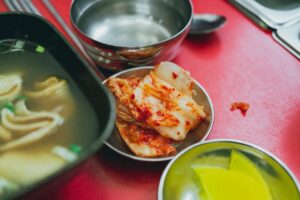
The study also doesn’t tell us whether eating commercially available kimchi, which varies widely in bacterial content depending on fermentation time, temperature, and processing, delivers meaningful amounts of this specific strain. That question hasn’t been answered yet.
What the study does confirm is that the mechanism is real, the strain is identifiable, and the effect is reproducible in controlled conditions. That’s how useful science starts. Not with a cure, but with a result worth following.
<h3>Sources</h3>
<ul class=”article-sources”>
<li><a href=”https://phys.org/news/2026-03-kimchi-derived-probiotic-excretion-intestinal.html” rel=”noopener noreferrer”>Phys.org. Kimchi-derived probiotic excretion study</a>, Primary news report on the World Institute of Kimchi study published in Bioresource Technology, March 2026</li>
</ul>
This article was researched, written, and edited by our human editorial team. AI tools were used in a limited research-assistant capacity. All claims were independently verified.