


In the winter of 1973, American families sat in lines that stretched around the block just to buy gasoline. Stations ran dry. Thermostats got turned down. The price of a gallon more than quadrupled in a matter of months because a group of Arab oil-producing nations had decided to stop selling to the United States. The embargo lasted only five months. The damage lasted years.
Congress remembered. In 1975, lawmakers passed the Energy Policy and Conservation Act and authorized the creation of the Strategic Petroleum Reserve, a system of underground salt caverns along the Gulf Coast designed to hold enough crude oil to cushion the country through exactly that kind of crisis. The idea was simple: when the world cut off our supply, we would open our own. It was the closest thing the United States had ever built to a financial shock absorber for energy.
For a long time, it worked as designed. The reserve grew steadily through the 1980s and 1990s, reaching its all-time peak of approximately 727 million barrels in late 2009. That was enough to replace roughly two months of U.S. net petroleum imports at the time, not a permanent solution, but enough breathing room to let diplomats talk and markets stabilize. The salt caverns in Louisiana and Texas sat quietly underground, doing their job, which was mostly to exist.
And here’s the strange part: the thing that has drained the reserve most isn’t a crisis. It’s a spreadsheet.
The Budget Trick Nobody Talked About
Over the past two decades, Congress discovered that the SPR could serve a purpose its architects never intended. When legislators needed to make a spending bill look cheaper on paper, they could mandate a future sale of oil from the reserve and count that projected revenue as an offset against new spending. The oil wouldn’t move for years. The money wouldn’t arrive for years. But on a Congressional Budget Office score sheet, it looked like savings, right now, today, making the bill appear more deficit-neutral than it actually was.
The National Taxpayers Union Foundation has documented how this practice, used repeatedly across multiple spending packages, contributed to the drawdown of reserves that had nothing to do with supply emergencies. The oil wasn’t released because there was a crisis. It was released because it made the math look better. Which sounds like a minor accounting quirk until you realize that the reserve now sits at roughly 400 million barrels, 44 percent below that 2009 peak, and the country is currently facing the kind of supply disruption the whole system was designed to handle.
As of a recent U.S. Energy Information Administration report in April 2026, the U.S. Energy Information Administration confirmed those holdings in its weekly petroleum status report. The current administration had already announced a substantial release of oil from the reserve in response to a major supply disruption, the narrow waterway through which roughly a fifth of the world’s oil supply moves on any given day. That release was part of a large coordinated international drawdown by a coalition of nations, making it the largest coordinated emergency reserve action in the history of the International Energy Agency’s system.
A 172-million-barrel release. From a reserve that already sat at 409 million barrels. The math is uncomfortable.
What the Salt Caverns Were Actually Built For
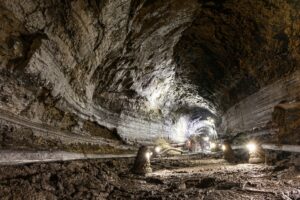
It helps to understand what the reserve physically is. The SPR isn’t a warehouse or a tank farm in the conventional sense. It is a series of solution-mined caverns dissolved out of natural salt domes deep underground, some of them more than 2,000 feet below the surface.
The geology of the Gulf Coast salt domes made them ideal: stable, naturally pressurized, impermeable to leaks. The government began filling them in 1977 after the legislation passed, and they have held up through hurricanes, power outages, and decades of changing administrations without a significant structural failure.
The engineering was solid. The politics, less so.
We tend to think of the SPR the way we think of a fire extinguisher, something that sits in the corner, never quite thought about, ready for the moment it’s needed. The reality is that over the past twenty years, Congress has been quietly pulling the pin every few sessions and using the extinguisher to water the office plants. Each individual drawdown was defensible. The cumulative effect is what nobody wanted to say out loud.
What Half a Tank Actually Means
The reserve at 409.2 million barrels is not empty. That point is worth making clearly. There is still a substantial cushion, more oil than most countries hold in any strategic reserve at all. But the context matters. The United States consumes roughly 20 million barrels of petroleum per day. At that rate, the current reserve represents about 20 days of total consumption, not the same as import replacement, but a rough sense of scale. The 2009 peak would have represented closer to 36 days. That gap is real.
What the 1975 architects feared most was not a permanent cutoff but a short, sharp disruption, the kind where a few weeks of price panic causes economic damage that takes years to unwind. The Arab embargo lasted five months. The Iranian Revolution of 1979 lasted longer but was most damaging in its early weeks, before markets adjusted. The SPR was sized for that window: not to solve the problem, but to buy time.
A reserve that has been drawn down 44 percent buys less time. And the release already announced in March 2026 draws it down further still.
There is something almost melancholy about the way the reserve has been used. The people who stood in those 1973 gas lines knew exactly why a strategic reserve mattered; they had felt the absence of one in their own daily lives. The lawmakers who voted to create it in 1975 understood the stakes clearly.
And then, over fifty years of relative energy abundance, the memory of those lines faded, the reserve turned into a convenient line item, and here we are: facing the largest coordinated release of strategic reserves in history from a tank that was already less than 60 percent full.
Whether the reserve gets rebuilt before the next disruption arrives is a question that will not be answered by this article. But it is a question worth holding.
Sources
Lambda Finance. U.S. Strategic Petroleum Reserve Level History
This article was researched, written, and edited by our human editorial team. AI tools were used in a limited research-assistant capacity. All claims were independently verified.