

Sometime around AD 330, a ship went down off the coast of what is now Arzachena, in northern Sardinia. Whatever sank it, storm, piracy, or a navigational error in unfamiliar water, it took a significant portion of the Roman Empire’s working currency straight to the bottom. The coins sat there for roughly 1,700 years, locked inside a meadow of Posidonia oceanica seagrass that slowly drew the oxygen out of the surrounding sediment and kept the bronze from corroding. Then, in late 2024, an amateur diver looked down through the water and saw something glinting.
In early 2026, Italy’s Ministry of Culture confirmed the recovery of tens of thousands of bronze coins from the seabed, the largest late-Roman maritime coin hoard ever pulled from the Mediterranean. The previous record belonged to the Seaton Down Hoard in Devon, UK, which yielded 22,888 coins. The Sardinia hoard doesn’t just beat that number. It nearly doubles it.
The coins are bronze nummi, and they date to the early-to-mid fourth century AD. That window matters more than it might seem. Those are precisely the years when the Roman government was supposed to have its monetary house in order.
The Reform That Was Meant to Fix Everything
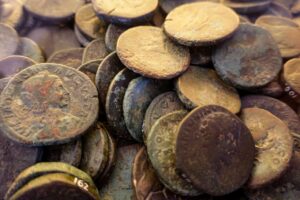
Here’s the part that makes this discovery genuinely strange. The nummus itself was created specifically to solve a crisis. In AD 294, Emperor Diocletian introduced the denomination because Roman silver coinage had been debased so badly, the silver content shaved down so many times to stretch the treasury further, that markets across the empire had effectively stopped accepting it. Merchants knew the coins were nearly worthless. Trade seized up. The government’s answer was a new bronze coin, standardized, theoretically trustworthy.
By the time the coins at the bottom of the Sardinian sea were minted, Constantine I and his sons were in charge, and the official narrative was one of stability. The mint marks on the recovered coins come from workshops spread across the empire: workshops spread across the empire. That’s not a local cache. That’s money moving through a genuinely imperial system.
And yet. Someone was transporting a substantial weight of bronze currency, likely well over a hundred kilograms of bronze currency,y across the open Mediterranean, not storing it, not hoarding it in a villa, but shipping it. The scale suggests a state transaction, or something close to one. And it ended at the bottom of the sea.
What a Shipwreck Actually Tells You
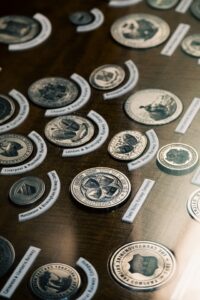
Coin hoards found buried on land usually mean one thing: someone hid their savings during a bad time and never came back for them. A maritime hoard is different. Ships don’t carry currency for safekeeping. They carry it because it’s going somewhere, changing hands, funding something. The Arzachena hoard is, at its core, evidence of commerce, or of the infrastructure that was supposed to support it.
This makes the story a bit uncomfortable for the official version of fourth-century Rome. The nummus was a reform coin, introduced because the previous monetary system had broken down. The coins in this shipwreck span the exact years when that reform was meant to be working. And here is a fortune’s worth of them, lost, never recovered, with no record of what happened to whoever sent them or wherever they were going.
That isn’t proof of collapse. But it is a data point. Governments that successfully stabilize their currencies don’t usually leave the historical record full of losses. The fact that this hoard sat unclaimed for seventeen centuries means no one ever came looking, or anyone who might have been in no position to.
The Ministry of Culture has not yet announced where the coins will be permanently housed, or when detailed analysis of the full collection will be published. The mint marks will take time to catalog. So will the wear patterns, which can tell researchers how long each coin was in circulation before it went under. In archaeology, the real story usually comes after the headline.
What we know now is this: somewhere off the northern coast of Sardinia, the Roman empire lost a shipment of its own currency, and the sea kept it better than Rome ever could.
This article was researched, written, and edited by our human editorial team. AI tools were used in a limited research-assistant capacity. All claims were independently verified.