



The last public payphone in New York City was removed in 2022. Someone took a photo. Someone took a photo. It made the rounds. People felt nostalgic for about 48 hours, and then forgot.
What nobody mentioned: the copper wire that fed that payphone is almost certainly still in the ground.
That’s not a metaphor. The United States built one of the largest physical communication networks in human history across the 20th century, hundreds of thousands of miles of copper wire, underground conduits, relay stations, switching hubs, and junction boxes stretching from Manhattan to rural Montana. The payphone was just the visible tip of it.
And when the payphone died, the infrastructure underneath it didn’t go with it. Most of it is still there. Some of it is still active. A surprising amount of it is doing work you depend on right now, today, whether you know it or not.
Here’s the strange part: nobody planned for this. Nobody sat in a boardroom in the 1990s and decided to preserve the old copper network as a kind of technological safety net. It just… stayed. Because pulling it out costs more than leaving it in.
The Network That Predates the Internet by a Century

The foundation of the American telephone network was laid starting in the late 1800s, and it kept expanding for nearly a hundred years after that. By the middle of the 20th century, the Bell System had constructed what engineers at the time called the largest machine ever built by human hands. That’s not promotional copy. That was a genuine engineering claim, and by most measures it held up.
The network ran on copper wire because copper conducts electricity well, bends without breaking, and lasts underground for decades without degrading. Installers buried it in conduits beneath city streets, strung it on poles across farmland, and threaded it through buildings. The physical plant, the industry term for all that hardware, represented an investment that, in today’s dollars, would represent an enormous sum by some estimates reaching into the hundreds of billions or more.
When AT&T was broken up in 1984, the copper didn’t vanish with the company. It got carved up among the regional Bell companies, the so-called Baby Bells, and then spent the next four decades passing through mergers and rebranding until a handful of large carriers held the deed. The wire itself never moved. Just the letterhead changed.
What’s Still Running on the Old Lines
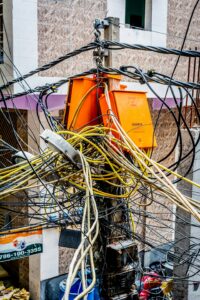
DSL internet service, the kind that runs over a phone line, still uses copper wire in a significant portion of American homes, particularly in rural and suburban areas where fiber hasn’t arrived yet. So does a lot of alarm system infrastructure. Business landlines. Hospital communication backup systems. Emergency services in areas where cellular coverage is thin.
The copper network also underpins something most people don’t think about: the PSTN, or Public Switched Telephone Network. The FCC has been managing a decades-long transition away from it, but the transition has moved slowly. Parts of the old network are still legally required to remain operational in certain contexts, because they serve populations, elderly residents, rural communities, people without smartphones, for whom the landline isn’t nostalgia. It’s infrastructure.
There’s also the matter of physical conduit. In dense urban areas, the underground tunnels and ducts that originally carried telephone cable have become valuable real estate for fiber optic installation. Telecom companies and municipalities have been pulling fiber through the same conduit paths that Bell engineers designed in the 1930s and 1940s. The old network didn’t just survive, in some cases it provided the literal pathway for its own replacement.
The Payphone’s Surprising Second Life

The payphone itself had a longer run than most people remember. At the industry’s peak in the early 1990s, there were somewhere around two million payphones operating across the United States. That number collapsed over the following decades as mobile phones spread. By the late 2010s, the count had fallen dramatically, to a small fraction of the peak figure.
But the booths and kiosks that replaced them in many cities didn’t sever the underground connection. New York’s LinkNYC program, which converted payphone locations into Wi-Fi kiosks, still relies in part on the same street-level infrastructure points that payphones used. The above-ground hardware changed. What’s below the sidewalk largely didn’t.
This is, when you think about it, a pattern that repeats throughout the history of communications technology. Telegraph lines became telephone lines. Telephone conduits became fiber conduits. The surface technology changes. The buried infrastructure accumulates.
Why Nobody’s Pulling It Out
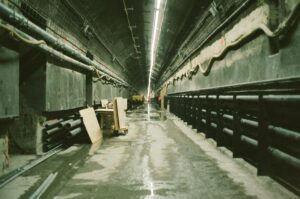
Blunt math. Digging up a city block in Chicago or Philadelphia to pull out copper wire costs far more than the scrap copper is worth at current commodity prices. So carriers leave it. Regulators haven’t required removal. And out in rural areas, where the wire runs for miles between a few dozen farmhouses, the numbers are even worse.
What this creates is a kind of layered archaeological record beneath American cities and towns. Dig up a street in an older American city and you’ll find infrastructure from multiple eras stacked or running alongside each other: century-old brick-lined conduits, mid-century copper bundles, newer coaxial cable, and the latest generation of fiber, all in the same trench, all installed by different companies, some of them no longer in existence.
The regulatory picture adds another layer of complexity. The FCC’s IP transition has given carriers permission, in many markets, to retire copper-based services. But retirement doesn’t mean removal. It means the carrier stops maintaining the line and stops offering service over it. The copper stays. It just goes dark.
Some of it will stay dark for a very long time. The wire that ran to that New York payphone will probably outlast the smartphone in your pocket by several decades. Which sounds like a strange kind of victory for a technology that everyone agreed was dead.
Whether the copper grid eventually gets repurposed, scrapped, or simply forgotten under successive layers of asphalt is a question the industry hasn’t fully answered. The infrastructure is there. The plan for it, largely, is not.
This article was researched, written, and edited by our human editorial team. AI tools were used in a limited research-assistant capacity. All claims were independently verified.