

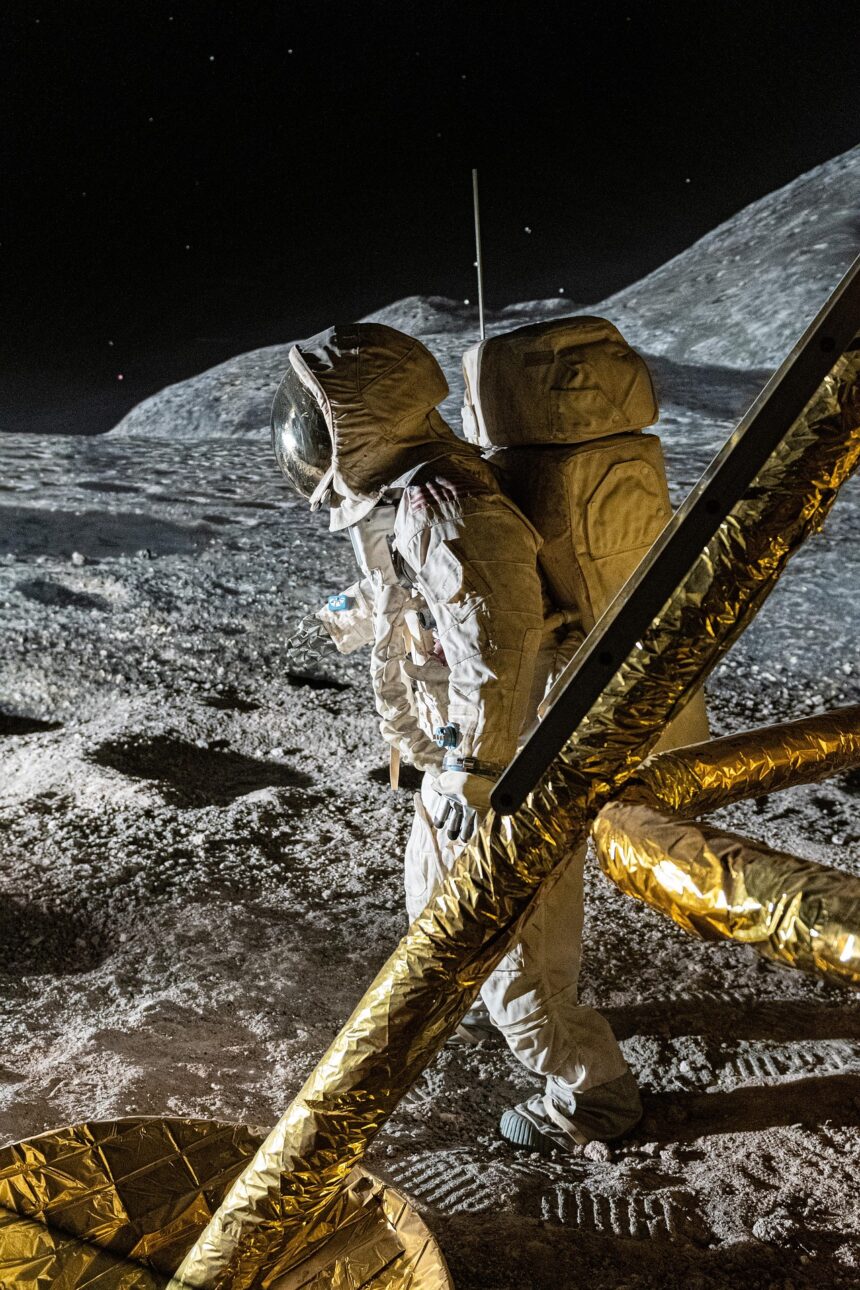
There was a moment in the summer of 1969 when two men were descending toward the surface of the Moon in a vehicle the size of a garden shed, guided by a computer roughly as powerful as a modern musical greeting card. Not almost as powerful. Not in the same ballpark. We’re talking about a machine with memory measured in kilobytes less storage than a single low-resolution photograph on your phone takes up today.
That comparison sounds absurd. It is absurd. And it tells us something that gets lost in the retelling of the Apollo story.
The Apollo Guidance Computer the AGC, as engineers called it, was built in the mid-1960s at the MIT Instrumentation Laboratory (now the Charles Stark Draper Laboratory). At the time, it was a genuine marvel. It was one of the first computers to use integrated circuits, which was cutting-edge enough that NASA’s adoption of the technology actually helped push the early semiconductor industry forward. Chip manufacturers needed a large, reliable customer. NASA needed something small enough to fit inside a spacecraft. The arrangement worked for everyone.
The machine itself weighed around 70 pounds and occupied roughly the volume of a small suitcase. It ran at about 2 megahertz (more precisely, approximately 2.048 MHz), had approximately 4 kilobytes of erasable memory (RAM), and stored its core programs in roughly 72 kilobytes of what engineers called core rope memory, a fixed storage medium where programs were literally woven into wire loops by hand. By teams of women, mostly, in a facility in Massachusetts, threading copper wire through and around magnetic cores one instruction at a time. The software existed as physical fabric before it existed as code.
And here’s the thing that most retellings miss entirely: the computer wasn’t even the point.
The AGC’s job wasn’t to think. It was to navigate, monitor, and, when something went wrong, hand control back to the astronauts faster than a human could do it alone. The astronauts weren’t passengers.
Neil Armstrong flew the final approach to the lunar surface largely by hand after the guidance computer flagged a series of overload alarms during the descent. The computer’s response to those alarms was itself a feat of software design: rather than crashing, it rebooted, shed lower-priority tasks, and kept the critical navigation running. It triaged itself. In 1969.
The Numbers That Make Modern Engineers Go Quiet
Your smartphone, sitting in your pocket right now, runs on a processor billions of times more powerful than the AGC. It has more storage than all the computers involved in the Apollo program combined likely possessed.. Even the cheap chip embedded in a musical greeting card, the one that plays eight bars of “Happy Birthday” when you open the flap, outperforms the machine that calculated a trajectory to the Moon and back.
We say these things at dinner parties and people laugh. Then the room gets a little quiet. Because the implication sits there.
Those engineers had less to work with than a child’s birthday present, and they landed humans on the Moon, brought them home six more times, and didn’t lose a crew on the lunar surface. What they had instead of processing power was constraint. And constraint, it turns out, is a remarkable teacher.
Every byte of memory in the AGC was rationed. Margaret Hamilton ran the software team at MIT and coined the term “software engineering” partly because no existing word covered what they were actually doing. There were no manuals for writing navigation software for a lunar lander. So they wrote the manuals. Every failure mode they anticipated was one nobody had ever seen before, which meant every solution they found was one nobody had ever tried.
What Happens When You Can’t Afford to Waste Anything
Here’s what modern software development almost never requires: the assumption that you cannot add more memory, cannot add more processing power, cannot patch it later. Every line of code in the AGC had to work the first time, in conditions that couldn’t be fully simulated on Earth, with astronauts’ lives depending on it.
That’s not nostalgia talking. It’s a genuine engineering philosophy that has largely been abandoned, for understandable reasons. When storage is cheap and processors are fast, you optimize later. When a lunar module has 4 kilobytes of RAM and a 238,000-mile communications delay, you optimize now or you don’t come home.
Programmers who found the AGC source code online described something close to quiet shock. The code was elegant in the way that scarce things get elegant. Not because the engineers were geniuses with unlimited time, but because they had no room for sloppiness. Constraint did that. And pieces of the AGC’s real-time computing architecture still show up in how engineers think about critical systems today.
The Birthday Card That Keeps Humbling Us
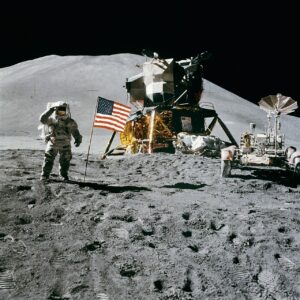
We tend to tell the Apollo story as a story about ambition. About what humans can do when they decide to do something impossible. That’s all true. But there’s a smaller, stranger truth nested inside it.
The birthday card comparison doesn’t make the Moon landing seem less impressive. It makes it more so. Because the card doesn’t navigate. It doesn’t triage. It doesn’t hand control to a human pilot at exactly the right moment with exactly the right data. It plays eight notes and waits to be thrown away.
The AGC had 4 kilobytes and a job that mattered. It did the job.
How strange it is to remember, sitting here with a phone in our hand that contains more computing power than we will ever use, that the most consequential navigation task in human history was handled by something smaller than the device you use to set a kitchen timer.
The engineers who built the AGC are mostly gone now. But the code is still there, online, available to anyone who wants to look. Some of the wire-woven rope memory cores survive in museums. And the questions they answered, about what software owes its users, about what a machine must never fail to do, haven’t been answered better since.
This article was researched, written, and edited by our human editorial team. AI tools were used in a limited research-assistant capacity. All claims were independently verified.