

On the Ides of March, in 44 BC, a group of Roman senators surrounded Julius Caesar in what they believed was a moment of political salvation. Within minutes, he had been stabbed twenty-three times. History recorded the deed. What it failed to preserve with any precision was exactly where it happened, and for roughly 150 years of modern excavation, the answer sat beneath a structure that Romans used as a public latrine.
That is not a metaphor. It is, depending on your appreciation for irony, either the most undignified footnote in the history of Western civilization or a reminder that ancient cities were not built as museums.
Researchers working in the area of the Largo di Torre Argentina, a sunken archaeological complex in central Rome, announced findings that they believe pinpoint the precise spot of the assassination. The site itself had been known for decades. What changed was the interpretation of a specific architectural feature:
a concrete structure that earlier excavators had catalogued and more or less moved past. It turned out to be, according to the team’s analysis, the base of the very monument erected by Caesar’s successor to mark and seal the spot where he fell.
Here’s the strange part. The structure was not hidden underground in the way most buried history is hidden. It was visible. Catalogued. Photographed. It had simply been identified as something else, a latrine, built during a later period of Roman construction, and filed away under that label for generations of subsequent archaeologists to accept without much challenge. The actual assassination spot, the sealed platform, sat directly beneath it, misidentified and mostly ignored.
What the Largo di Torre Argentina Actually Is
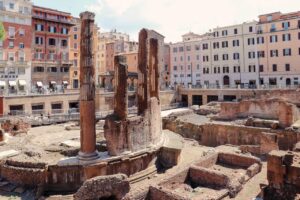
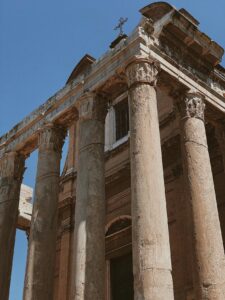
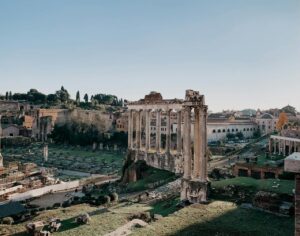
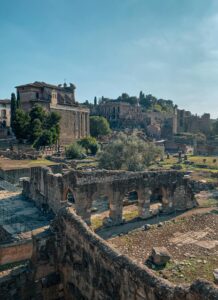
The Largo di Torre Argentina complex is one of Rome’s more unusual open-air sites. It sits several meters below the current street level, which gives it the feeling of a wound in the city rather than a monument to it. The ruins visible from the surrounding streets include the remains of four Republican-era temples and the portico of a structure associated with Pompey, the general whose rivalry with Caesar reshaped the late Republic.
The Curia of Pompey, a meeting hall within the portico complex adjacent to the Theater of Pompey, was where Caesar met with the Senate on that March morning. He was attending, or had been lured to, a session in the portico adjacent to the theater, a meeting that his assassins had arranged with the location in mind. The portico gave them privacy from the main city crowd. It was, in other words, not a chaotic street murder. It was organized, and the location was chosen.
After the assassination, the historical record indicates that the spot was deliberately sealed, closed off, marked, and treated as a kind of grim memorial. The structure that sealed it would eventually be built over as Rome changed around it, and as the association between the physical location and the event faded from daily memory into historical abstraction.
Why It Took This Long
Two thousand years is a long time. But the more interesting question is why the last 150 years of modern archaeology, a period during which the site was actively excavated and studied, didn’t catch this earlier.
Part of the answer is that archaeology is slower than people imagine. A site as complex as the Largo di Torre Argentina has dozens of overlapping periods of construction. Roman builders built on top of earlier Roman builders, who built on top of Republican-era foundations, which themselves sometimes incorporated even older material. Reading that stratigraphy correctly takes time, careful documentation, and occasionally, a willingness to revisit conclusions that seemed settled.
So here’s what actually happened. When the site opened to formal study in the early 1900s, the temples got all the attention. They were dramatic. They were legible. The concrete lump that would eventually be identified as the assassination monument got logged, labeled “latrine,” and forgotten. Not buried. Not suppressed. Just filed wrong, the way a misfiled folder sits in a cabinet for decades, because nobody has a reason to pull it back out.
That is how wrong conclusions survive in academic literature. Not through dramatic cover-ups or deliberate suppression. Through the ordinary human tendency to trust the last person who looked carefully.
What the New Analysis Found
The research team’s argument rests on the concrete structure’s dimensions, its construction technique, and its precise spatial relationship to the surrounding architecture. A structure built to seal and memorialize a specific spot would be expected to have certain characteristics: deliberate placement, careful construction, and a size proportional to the significance of what it marked. The team argues that this structure meets those criteria in ways that a utility latrine, built for practical use during a later period, would not.
They also draw on written sources. Ancient texts describe the sealed area and its general location within the portico complex with enough specificity that cross-referencing the physical remains against those descriptions became possible. The two, they argue, align, a conclusion drawn from ancient written accounts of the assassination and the physical evidence at the site.
None of this is proven beyond dispute. Archaeology almost never delivers that. What the researchers are offering is a well-supported identification, one that the physical evidence and the ancient texts back more strongly than any competing theory currently on the table.
What Gets Sealed, and Why
There is something worth pausing on here. The Romans who came after Caesar, and specifically those who consolidated power in his name, made a deliberate choice to seal the spot rather than leave it open. That decision was not purely sentimental. A sealed spot could not become a rallying point. It could not be used by Caesar’s political enemies to stage public grief or public anger. By closing it off, the new regime controlled what the location meant.
And then time did the rest. The sealing structure lost its label. The label it acquired, latrine, was about as far from political memory as you could get. For a century and a half of modern study, Rome’s most consequential political murder had its precise address listed, essentially, as a bathroom.
The excavations continue. The site at Largo di Torre Argentina is still being studied, and researchers say there is more work to do before the identification can be considered definitive. But for anyone who has ever stood at the edge of that sunken complex and looked down at the temples and wondered exactly where it happened, the answer, it seems, may have been visible the whole time.
History has a habit of doing that.