



Nobody designed it to save lives. That wasn’t the point.
The original idea was simpler and, depending on how you feel about surveillance, considerably more unsettling: use radio waves to see through walls. Military researchers wanted to know if someone was hiding on the other side of a door before soldiers entered a building. The question wasn’t “is this person healthy?” It was “Is this person there?”
What they discovered, almost by accident, was that the human body doesn’t just reflect radio waves. It modulates them. Your chest rising and falling, your heart squeezing and releasing, your diaphragm pushing air, all of it creates tiny, measurable disturbances in a radio signal passing through or bouncing off a wall.
The signal comes back slightly different from how it left. And if you know what you’re looking for, that difference tells you something remarkable: it tells you whether someone is alive, how fast their heart is beating, and whether their breathing pattern looks normal.
That’s the seed of what researchers now call contactless vital sign monitoring, and it has traveled a long, strange road from military corridors to hospital waiting rooms.
How Your Body Interrupts a Radio Signal

To understand why this works, it helps to know one thing about radio waves: they don’t stop at walls. Drywall, wood, and even some concrete slow them down or partially absorb them, but they pass through. That’s why your Wi-Fi router in the living room can reach your bedroom. The signal bleeds through everything.
Now consider what happens when that signal hits a human body. Flesh and water absorb and scatter radio waves differently than air does. Your lungs expand roughly twelve to eighteen times per minute under normal conditions, and each expansion shifts your chest wall outward by a centimeter or two. Your heart beats somewhere between sixty and one hundred times per minute at rest, and each beat creates a mechanical pulse that ripples through your chest wall in a fraction of a second.
These movements are small. But radio waves are sensitive to very small changes, that’s the entire principle behind radar detecting aircraft miles away. Scale that sensitivity down and point it at a human chest from across a room, and you can pick up the chest-wall displacement caused by a single heartbeat.
The underlying principle is Doppler radar, the same physics used in weather radar and speed guns, applied to detect tiny movements of the chest wall. The same Doppler principle that lets a weather radar track a storm’s movement, or lets a speed gun clock a fastball, applies here.
The radar transmits a signal, the signal bounces back, and any movement in the target shifts the frequency of the return signal slightly. Measure that shift carefully enough,h and you can reconstruct a waveform that looks remarkably like an electrocardiogram, a heartbeat trace, without ever touching the person.
Here’s the strange part: the hardware to do this isn’t exotic. Researchers have demonstrated working versions using modified Wi-Fi routers, software-defined radios that cost less than a new phone, and off-the-shelf components from electronics suppliers.
The breakthrough wasn’t inventing new hardware. It was figuring out the signal processing, the math that separates the heartbeat signal from background noise, wall reflections, a person shifting their weight, and a ceiling fan running in the next room.
The Part the Military Wasn’t Expecting

By the time civilian researchers got their hands on this concept, the possibilities branched in ways nobody had fully mapped.
Sleep labs noticed first. If you can detect breathing and heart rate through a wall without waking someone up, you’ve just invented a monitoring system that doesn’t require strapping sensors to a sleeping person’s chest, finger, or face. Anyone who has tried to sleep in a medical facility with clip sensors on every limb understands why that matters. The monitoring itself disrupts the sleep you’re trying to study.
Researchers began testing whether the technology could detect sleep apnea, the condition where breathing stops repeatedly during sleep, sometimes dozens of times a night, often without the person knowing. Early results suggested it could. Not perfectly, not yet with the diagnostic precision of a full sleep study, but accurately enough to flag people who might need further testing.
Then, elder care researchers picked it up.
One of the persistent problems in caring for older adults living alone is the gap between when something goes wrong and when someone finds out. A fall at midnight. A cardiac event at 3 a.m. A sudden change in breathing pattern that signals the early stages of pneumonia.
Family members and care providers can’t watch continuously, and most people resist wearing monitoring devices full-time; they’re uncomfortable, the batteries die, and they feel, fairly or not, like a surrender.
A system that monitors vital signs passively, through the wall, without requiring the person to do anything at all, no wrist band, no chest patch, no clip on the finger, is a different proposition entirely. You live in the house. The system watches. If something changes, it sends an alert.
What Wi-Fi Already Knows About You
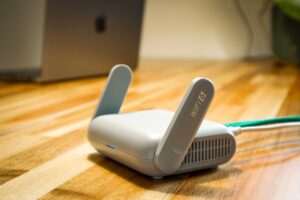
The research took another turn when engineers realized they didn’t necessarily need dedicated radar hardware. They had Wi-Fi.
Modern Wi-Fi routers already emit radio signals continuously. Those signals bounce around your home, off walls, furniture, and bodies, and return to the router carrying information about everything they touched. Normally, that reflected information is treated as noise, interference that makes the data signal harder to read.
But a group of researchers figured out that the noise contains something useful. The signal disturbances caused by a person breathing in a room show up in standard Wi-Fi channel data.
With the right software analyzing the signal in real time, your existing home router couldtheoretically. Inn laboratory demonstrations, researchers have shown it may be possible to monitor breathing patterns for multiple people in a room using existing Wi-Fi infrastructure, though this capability remains at the research stage and is not yet commercially available. No additional hardware was required in those experiments.
Which is either fascinating or deeply uncomfortable, depending on where you sit on the question of privacy.
Here’s the thing. The router you bought at Costco to stream movies could, in a future software update, become a passive health monitor. Or a presence detector. Or something nobody has named yet, some application that sounds reasonable to its designers and alarming to everyone else. The technology doesn’t care about intent. It reads the signal. That’s all it does, and that’s enough.
Where This Is Actually Headed

Clinical researchers are cautious, as they should be. Detecting that a heartbeat is present and counting its rate is not the same as diagnosing a cardiac arrhythmia. The gap between “your heart is beating irregularly” and “here is what is wrong with your heart” requires interpretation that consumer-grade sensing cannot currently provide. Medical devices face regulatory review for good reason, and a Wi-Fi router is not a medical device.
Hospitals are running trials. Elder care facilities are piloting passive monitoring systems. There is growing interest from insurers and health technology investors in passive monitoring systems, though the extent of active industry engagement varies and is difficult to verify independently.
The FDA started examining how to classify devices that monitor health without touching the body, a category that barely existed as a commercial product before the mid-2010s.
The question that’s harder to answer isn’t whether the technology works. At this point, in controlled settings, it does. The harder question is what we want to do with it. A system that monitors your breathing while you sleep sounds like a medical tool. The same system monitoring whether you’re home, when you moved, and when you stopped moving, sounds like something else.
The radar was never designed to be a doctor. But it has a very good memory.
This article was researched, written, and edited by our human editorial team. AI tools were used in a limited research-assistant capacity. All claims were independently verified.