


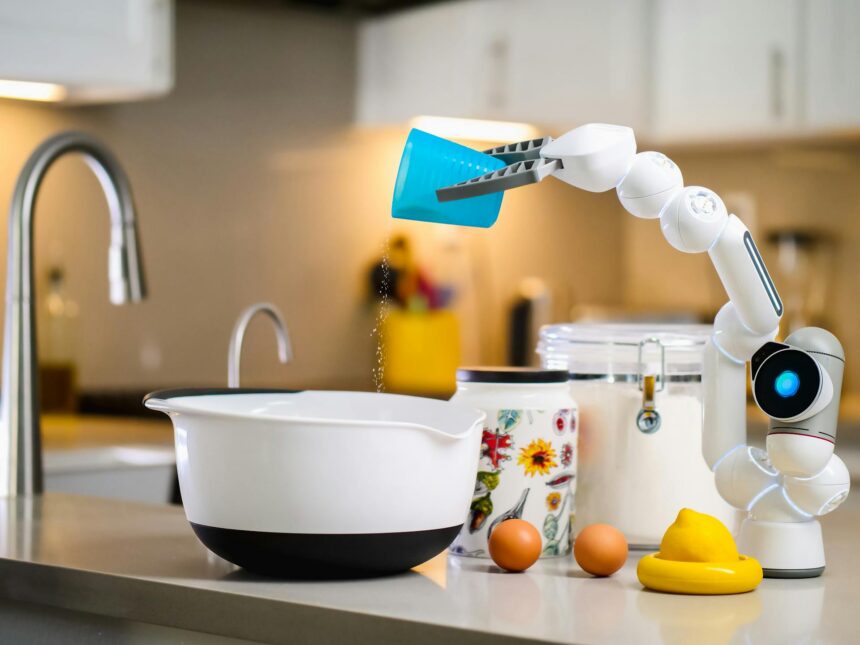
In April 2026, a San Francisco startup posted a video that, on the surface, looked almost boring. A robotic arm hovered over an air fryer. It opened the basket, placed food inside, closed it, and pressed the button. Routine stuff unless you knew that the robot had encountered that specific appliance only a handful of times in its entire training history. Not twice that week. Twice, total.
The company is Physical Intelligence, and the model they released is called π0.7 (per Physical Intelligence). What it demonstrated that day has a technical name, compositional generalization, but the plain-English version is more interesting: this robot figured something out. It improvised. It looked at an object it barely knew and worked through the problem the way a reasonably capable person would. That had never been credibly demonstrated before at this level.
That gap, between a robot that can do what ithas practiced and a robot that can figure out what it hasn’t, is the gap between a factory machine and something you’d actually want in your kitchen.
The Problem Every Home Robot Has Hit
Factory robots have been extraordinary for decades. They weld, they paint, they assemble with precision that no human hand could match at scale. But they are, at their core, specialists. Program one to install a left door panel on a 2024 Civic, and it will install that door panel ten thousand times without complaint. Show it a slightly different fixture, and it stops.
That brittleness has haunted every attempt to build a robot for the home. A home is the opposite of a factory floor. Appliances differ by brand, model, and decade. Counters are cluttered. Jeans fold differently depending on how they came out of the dryer. The environment doesn’t cooperate, and no training dataset can anticipate every variation of every object in every kitchen in America.
So researchers have spent years asking a version of the same question: Can a robot learn to generalize? Can it transfer knowledge from one task to a related-but-different one, the way a person who can make scrambled eggs can probably figure out a frittata?
What π0.7 Actually Did
Physical Intelligence’s answer, for now, is: yes, with help.
π0.7 is a large Vision-Language-Action model (Physical Intelligence has cited a parameter count in the billions), meaning it processes what it sees, understands plain-language instructions, and translates both into physical movement. The architecture runs on a large language model backbone (Physical Intelligence has indicated it builds on Google’s Gemma family). The “action” part is what separates it from a chatbot; it doesn’t just answer questions, it moves.
The air fryer demonstration was the clearest proof of the concept. At the start, the model’s initial success rate on that task was very low, in the single digits, according to Physical Intelligence. With roughly thirty minutes of plain-language coaching, operators describing what they wanted in ordinary English, not by rewriting code, that number climbed dramatically, to well above 90%, according to Physical Intelligence. Same model. Same hardware. No retraining. Just better instructions.
And here’s the thing that makes that number strange: it happened in half an hour. Traditional robot reprogramming for a new task can take days of engineering work, calibration runs, and physical adjustments. What Physical Intelligence showed is that if the underlying model is capable enough, the gap between “never seen it” and “nearly perfect” can be crossed by talking to it.
The demos extended beyond the air fryer. The same model folded jeans, loaded dishes, and cleaned glass surfaces, tasks that involve different grip pressures, different object shapes, and different definitions of “done.” The model threaded between them. Not flawlessly, but well enough to matter.
Why the Scaling Data Changes Everything
The deeper reason to pay attention to π0.7 isn’t the air fryer. It’s a research paper published in early 2026 on scaling robotics generalization (verify paper title and date before publishing). That paper offered the first solid evidence that robotics foundation models follow the same data-scaling laws as large language models, the same mathematical relationship between training data, model size, and capability that explains why GPT-4 is so much more capable than GPT-2.
This sounds abstract. It isn’t. It means robot AI may improve as predictably as language AI did, and language AI improved fast enough to surprise almost everyone watching it. If EgoScale’s findings hold, the trajectory for physical robot capability isn’t a slow plateau. It’s a curve.
Physical Intelligence has raised substantial funding at a multi-billion-dollar valuation (verify current figures before publishing), with reports suggesting a new round could push that figure significantly higher (verify current reporting before publishing). That kind of capital follows conviction. The people writing those checks are betting that the scaling laws hold, and that whoever has the most real-world robot training data when capability inflects will own a very large market.
The Distance Still to Cover
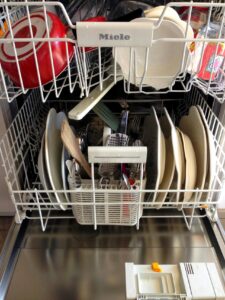
None of this means the dishwasher-loading robot is arriving next Tuesday. The demos were controlled. The tasks, while relatable, were chosen because they were achievable. Real kitchens have wet counters, unpredictable children, and air fryers that are shoved behind the bread box. The gap between a clean lab demonstration and a product that works reliably in the average American home is still substantial.
But the argument being made by Physical Intelligence, and, implicitly, by the capital behind them, is that the nature of the gap has changed. It used to be structural. Robots couldn’t generalize; the ceiling was architectural. What π0.7 suggests is that the ceiling is now a matter of scale, data, and iteration. Those are things the industry knows how to work on.
The factory robot took decades to go from concept to workhorse. The home robot has been promised so often that skepticism is reasonable. But the specific claim being made in April 2026 is narrower and more verifiable than the ones before it: that a robot can look at something it barely knows and figure out what to do.
It loaded the air fryer. That’s a small thing. It may also be the first sentence of a much longer story.
<h3>Sources</h3>
<ul class=”article-sources”>
<li><a href=”https://techcrunch.com/2026/04/16/physical-intelligence-a-hot-robotics-startup-says-its-new-robot-brain-can-figure-out-tasks-it-was-never-taught/” rel=”noopener noreferrer”>TechCrunch. Physical Intelligence π0.7 announcement</a>, Primary reporting on the model release, demo results, and funding figures</li>
</ul>
This article was researched, written, and edited by our human editorial team. AI tools were used in a limited research-assistant capacity. All claims were independently verified.