

The Hittite Empire once controlled most of Anatolia, matched empires with Egypt, and sent armies that rattled the ancient world. Then it collapsed, around 1200 BCE, and took its secrets with it. One of the biggest: a sacred city called Zippalanda, mentioned repeatedly in Hittite religious texts as a major cult center, a place of pilgrimage, a city that mattered. For more than a hundred years, archaeologists couldn’t find it. Not because they weren’t looking. Because it was sitting under wheat fields in central Turkey the whole time.
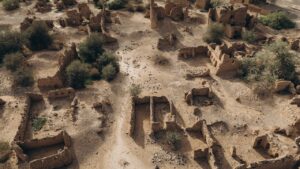
Researchers announced the identification of Zippalanda at the site known as Uşaklı Höyük, a mound rising out of the Yozgat province in north-central Turkey. The site had been excavated on and off for years, but the confirmation that this was, specifically, Zippalanda came from a convergence of evidence that’s hard to argue with: monumental architecture, large-scale storage facilities, evidence of religious ritual, and a geographic location that matches the ancient texts almost exactly.
And here’s the thing that makes this strange: Uşaklı Höyük wasn’t exactly hidden. Locals knew about the mound. Travelers had passed it. The problem wasn’t invisibility. It was that nobody had dug deep enough or connected enough dots, until now.
The City the Hittites Never Stopped Mentioning
Zippalanda appears in Hittite cuneiform tablets with unusual frequency. The Storm God of Zippalanda was one of the empire’s major deities, invoked in prayers, treaties, and royal rituals. That level of religious attention suggests this wasn’t a minor outpost. It was a city with theological weight, the kind of place a Hittite king would visit to legitimize his rule or seek divine favor before a military campaign.
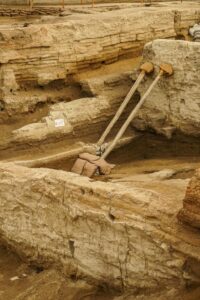
What excavators found at Uşaklı Höyük fits that profile. The site contains remains of large mudbrick buildings consistent with temple or administrative use, along with evidence of organized food storage at a scale that implies feeding crowds, not just a local population. Pilgrimage sites across the ancient world share that signature: infrastructure for visitors, surplus supply, ceremonial space. Zippalanda checks those boxes.
The geographic match is equally compelling. Hittite texts describe Zippalanda’s location in relation to other known sites — Hattusa, the imperial capital, and several secondary cities whose positions have already been confirmed. Uşaklı Höyük falls within the corridor that those texts describe. Not approximately. Precisely.
What Three Thousand Years of Farmland Can Hide
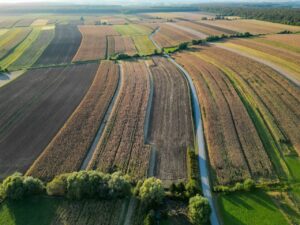
The site’s obscurity isn’t really a mystery once you see the place. Höyük is the Turkish word for a tell, a mound formed by centuries of accumulated settlement, each layer of civilization built on the rubble of the last. Uşaklı Höyük is one of thousands of such mounds across Anatolia. Most of them have never been fully excavated. Most of them never will be.
What made this one different was the patience of the excavation team, which has been working the site systematically since 2008 under the direction of researchers affiliated with Italian and Turkish institutions. Slow work. Careful work. The kind that doesn’t make headlines until suddenly it does.
Bronze Age levels at the site have yielded pottery consistent with Hittite production, seal impressions, and architectural remains that date to the height of Hittite power, roughly 1400 to 1200 BCE. That’s the window when Zippalanda would have been active. The overlap isn’t coincidental.
Worth noting: archaeological identification is rarely a single eureka moment. It’s a weight-of-evidence argument, built over years and carefully peer-reviewed. The scholars working at Uşaklı Höyük have been cautious about the claim, which is exactly why it’s credible.
Why a Lost City Still Has Something to Teach Us
The Hittites are one of history’s more underappreciated empires. They negotiated what is often called the world’s first recorded peace treaty, with Ramesses II of Egypt, after the Battle of Kadesh around 1274 BCE. They were sophisticated administrators, skilled metalworkers, and serious theologians. Their collapse, part of the broader Late Bronze Age catastrophe that brought down nearly every major civilization in the Eastern Mediterranean, remains one of archaeology’s most debated questions.
Finding Zippalanda doesn’t solve that collapse. But it fills in the map. Every confirmed site adds texture to how the empire was organized, how religion and politics were intertwined, how populations moved and traded and prayed. A cult city of this significance being located tells researchers where to look next, what road networks connected it, and what smaller sites might cluster around it.
The Hittite world is coming back into focus, one buried mound at a time. And the fact that one of its most religiously significant cities was hiding in plain sight, under cultivated farmland, in a country full of unexcavated tells, is a reminder that the ancient world isn’t as well-known as we sometimes assume.
Most of what happened before writing, and much of what happened after it, is still underground. Zippalanda is one answer. The questions it opens may take another century to work through.
This article was researched, written, and edited by our human editorial team. AI tools were used in a limited research-assistant capacity. All claims were independently verified.