

On February 19, 1942, Franklin D. Roosevelt signed Executive Order 9066. It didn’t name a single ethnic group. It didn’t use the word “Japanese.” It simply authorized the Secretary of War to designate military zones and remove “any or all persons” from them. Seventy-seven days after Pearl Harbor, that careful legal language became the machinery for imprisoning 120,000 people, roughly two-thirds of whom were American citizens by birth.
Most of them had done nothing. Not one was ever convicted of espionage.
The order moved fast. Within weeks, families along the West Coast received notices giving them days, sometimes 48 hours, to report to assembly points. They could bring only what they could carry. Homes, farms, fishing boats, businesses: left behind or sold for whatever a desperate seller could get in two days. A strawberry farm in Watsonville. A grocery store in Sacramento. A flower nursery in Gardena that had taken a family twenty years to build. Gone, at a fraction of the value, before the buses arrived.
The Camps Nobody Called Prisons
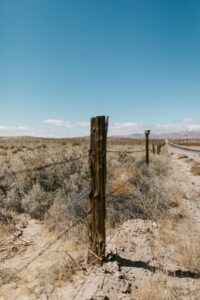
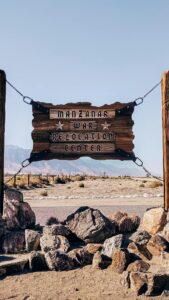
The War Relocation Authority eventually operated ten facilities spread across some of the most inhospitable land the federal government could find. Manzanar, in California’s Owens Valley, sat at an elevation of 3,700 feet where summer temperatures hit 110 degrees, and winter winds drove dust through the tarpaper barrack walls. Minidoka, in Idaho. Topaz, in the Utah desert. Heart Mountain, in Wyoming. Each one was ringed with barbed wire and guard towers. The government called them “relocation centers.” The people inside called them what they were.
And here’s the part that gets buried: the constitutional challenge came almost immediately. Fred Korematsu, a 23-year-old welder from Oakland, refused to report. He was arrested, convicted, and appealed all the way to the Supreme Court. In December 1944, nearly three years into the incarceration, the Court ruled 6-3 against him in *Korematsu v. United States*, finding the exclusion order constitutional on grounds of military necessity.
Justice Robert Jackson, in dissent, called it “a loaded weapon ready for the hand of any authority that can bring forward a plausible claim of an urgent need.” He was right. The majority opinion was never formally overruled for forty more years.
The Evidence That Changed Everything
In 1981, a legal historian named Peter Irons was researching a book on the wartime cases when he found something extraordinary buried in the National Archives. Government attorneys had suppressed evidence during the original Supreme Court proceedings.
A report from the Office of Naval Intelligence, the government’s own intelligence agency, had found no evidence of Japanese American disloyalty or espionage along the West Coast. The Justice Department had that report. They had kept it from the Court.
That discovery cracked the case open. In 1983, a federal district court vacated Korematsu’s conviction using a legal procedure called a *writ of coram nobis*, reserved for cases involving fundamental error. The judge found the government had committed prosecutorial misconduct. Korematsu was 64 years old when his conviction was erased.
The Apology That Came 46 Years Late
Congress commissioned a formal investigation in 1980. The Commission on Wartime Relocation and Internment of Civilians spent three years reviewing the record and taking testimony from survivors. Its 1983 report concluded that Executive Order 9066 was not justified by military necessity. The causes, it found, were “race prejudice, war hysteria, and a failure of political leadership.” Plain language. No hedging.
Five years after that report, the Civil Liberties Act of 1988 was passed under President Ronald Reagan, authorizing a formal apology and $20,000 in reparations to each surviving internee. By the time payments began in 1990, roughly a third of the original detainees had already died. They never received a dollar or an apology. The math on that, if you sit with it, is uncomfortable.
What “Military Necessity” Actually Covered
The military necessity argument deserves one more look because it was always thin, and the government knew it. German and Italian Americans, whose countries of origin were also at war with the United States, faced no mass removal. Individual arrests, yes. Targeted investigations, yes. But not 120,000 people swept up by geography and ancestry. The racial logic was visible in real time to anyone who cared to look.
California’s attorney general at the time, Earl Warren, later Chief Justice of the Supreme Court and author of *Brown v. Board of Education*, supported the removal enthusiastically and later called it the greatest regret of his public life.
The Supreme Court’s *Korematsu* precedent technically remained on the books for 74 years. The Court finally and explicitly repudiated it in 2018, in *Trump v. Hawaii*, though critics noted the timing: the Court was simultaneously upholding a different executive order restricting travel from several majority-Muslim countries. Justice Sonia Sotomayor made the parallel explicit in dissent. The “loaded weapon” Justice Jackson warned about in 1944 had never really been unloaded.
What the incarceration of 120,000 people actually demonstrated was not a wartime security measure that worked. It demonstrated how quickly a constitutional government can shed constitutional protections when fear and racism point in the same direction, and how long it can take to admit that afterward.
This article was researched, written, and edited by our human editorial team. AI tools were used in a limited research-assistant capacity. All claims were independently verified.