

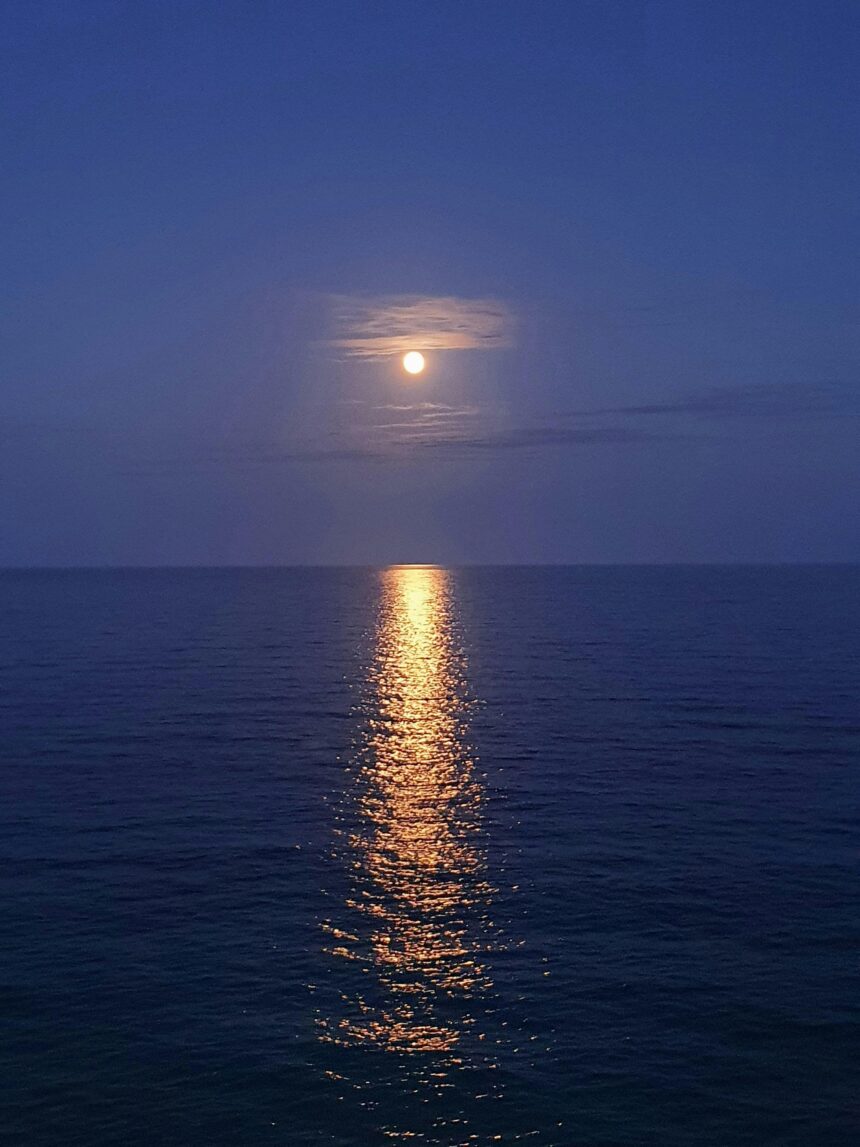
Every year, without ceremony or announcement, the Moon moves 3.8 centimeters farther from Earth. That’s roughly the rate your fingernails grow. Over a human lifetime, the Moon will drift about three meters away. Not perceptible. Not dramatic. But over geological time, the math becomes staggering, and scientists have spent decades trying to understand why the current retreat rate appears faster than what the ancient record suggests it should be.
They may finally have a working answer. And it involves the shape of Earth’s oceans.
The Moon doesn’t drift because of some cosmic repulsion or fading gravitational grip. It retreats because of tidal friction, a process so fundamental it’s been operating since the Moon formed roughly 4.5 billion years ago. As Earth rotates beneath the Moon’s gravitational pull, ocean water bulges slightly toward the Moon. Earth’s rotation carries that bulge ahead of the Moon’s position. The Moon tugs on the bulge; the bulge tugs back on the Moon.
That exchange transfers rotational energy from Earth to the Moon, nudging it into a slightly higher, wider orbit with every passing year. It also slows Earth’s rotation, which is why days were shorter hundreds of millions of years ago, roughly 22 hours instead of 24.
The physics has been understood in broad outline since the 1960s. What remained puzzling was the rate discrepancy.
The Geological Record’s Quiet Contradiction
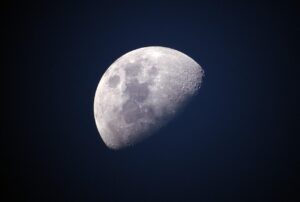
When geologists study ancient tidal rhythms, preserved in layered rocks called tidal rhythmites, they can reconstruct how fast the Moon was retreating at various points in Earth’s history. The record suggests that, averaged across billions of years, the Moon moved away more slowly than it appears to be moving now.
If you run the current 3.8-centimeter rate backward in time, the Moon would have been inside Earth’s Roche limit, the distance at which tidal forces would tear it apart, far more recently than is geologically plausible. Something about the current rate is anomalous.
This is where ocean basin geometry enters the story.
Tidal friction isn’t constant. It depends on how water sloshes around in ocean basins and how well those basins resonate with the tidal rhythm. Think of it like a bathtub: slosh water at just the right frequency and it amplifies. Do it off-beat and the energy dies out. When a basin’s natural sloshing period lines up with tidal forcing, energy transfer between Earth and Moon gets amplified.
More energy transfer, faster recession. Researchers studying ancient ocean layouts have proposed that we’re living through one of those high-resonance windows right now, a period when the Atlantic’s current shape drives unusually efficient tidal energy transfer. Here’s the thing. That’s not a permanent condition. It’s a pulse.
And it wouldn’t be the first time. The geological record shows other high-recession periods separated by long stretches of slower drift. As continental drift continues and ocean shapes slowly change, the resonance will shift and the recession rate will change with it.
What Laser Reflectors on the Moon Confirmed
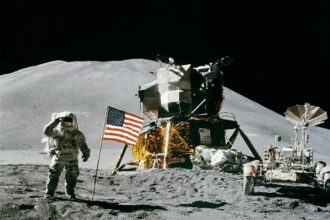
The 3.8-centimeter annual figure isn’t an estimate. It comes from one of the most precise ongoing measurements in science. During the Apollo missions, astronauts left retroreflectors on the lunar surface, arrays of corner-cube prisms designed to bounce laser pulses back to Earth with extraordinary precision. Observatories around the world have been firing lasers at those reflectors since the early 1970s and timing the return pulses to millimeter accuracy.
The result is one of the longest-running precision measurements in the history of science, and it confirms the recession rate with certainty. What it can’t tell us, on its own, is whether that rate is typical or anomalous relative to deep geological time. That question requires the rock record, and the rock record is what drove researchers to look harder at ocean resonance as the explanation.
Why This Matters Beyond the Number
The practical consequences of the Moon’s recession are not urgent on any human timescale. Three meters per lifetime is nothing. But the implications for Earth’s deep past and deep future are real.
The Moon stabilizes Earth’s axial tilt. Without it, or with a significantly more distant Moon, Earth’s obliquity could vary more dramatically over time, with consequences for long-term climate stability. A Moon that was once much closer, as it was early in Earth’s history, produced tides so powerful they may have played a role in shaping early ocean chemistry and, some researchers have proposed, early conditions for life.
Going the other direction: in roughly 600 million years, the Moon will be far enough away that total solar eclipses will no longer be possible. You probably know the Moon looks almost exactly the same size as the Sun from Earth. That’s not physics. That’s luck. A cosmic coincidence that only works right now, in this sliver of Earth’s 4.5-billion-year run. Our great-great-grandchildren’s grandchildren will never see a total eclipse. The geometry simply won’t allow it anymore.
The Moon is also, very slowly, taking Earth’s rotational energy with it. Days will continue to lengthen. In hundreds of millions of years, a day will be significantly longer than 24 hours. Eventually, on timescales that dwarf the current age of animal life on Earth, Earth and Moon could reach a state where the same face of Earth always points toward the Moon, just as the Moon already keeps one face toward Earth. Whether the Sun expands into a red giant before that point is reached is a separate, and more pressing, cosmic question.
The Answer and the Longer Question
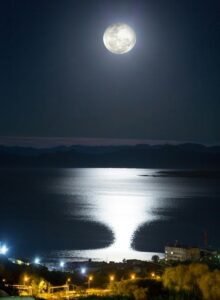
What scientists appear to have confirmed, or at least solidly proposed, is that the current recession rate reflects where we sit in a cycle of variable tidal efficiency, not a permanent change in the Earth-Moon relationship. The Atlantic’s current shape is, in a geological sense, a temporary amplifier.
The Moon’s gradual departure has been happening for 4.5 billion years. It will continue for billions more. The rate will fluctuate as continents drift and ocean basins reshape. The 3.8-centimeter figure is, in the long view, a snapshot, one frame from a film that started before complex life existed and will continue long after it’s gone.
That’s either a humbling thought or a reassuring one, depending on your disposition toward large numbers and deep time. The Moon isn’t going anywhere fast. It just happens to be going slightly faster right now than it has, on average, across geological history, because of the way water sloshes around in a particular ocean basin on a particular rocky planet in an otherwise unremarkable arm of the Milky Way.
The math has always worked out. It’s the timing that keeps surprising us.
This article was researched, written, and edited by our human editorial team. AI tools were used in a limited research-assistant capacity. All claims were independently verified.