


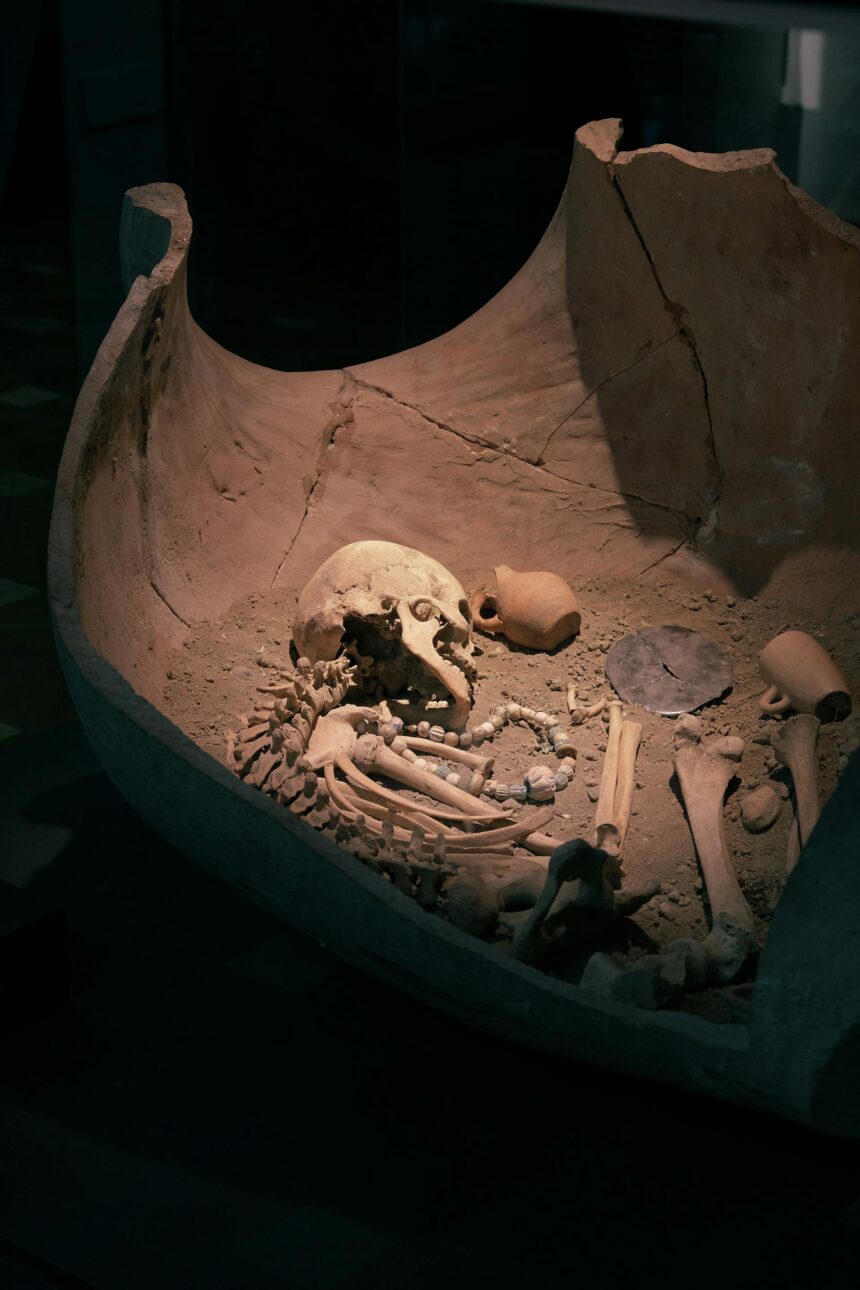
The bones had been in the ground for roughly 5,000 years before anyone thought to ask what killed the person they belonged to. When researchers finally extracted DNA from the t teeth, being among the best preservers of ancient genetic material, what came back wasn’t ambiguous. It was a plague.
Not a distant ancestor of plague. The actual bacterium, Yersinia pestis, identifiable by its genetic signature, is sitting in the root canals of someone who died millennia before the Black Death swept through Europe.
That finding, and others like it from ancient burial sites across Eurasia, didn’t just extend the known timeline of the plague. It raised a harder question. If Yersinia pestis was circulating in human populations thousands of years before 1347, why didn’t it kill at medieval scale back then? And what changed?
The answer, it turns out, is written in the bacterium’s own genome. And it changes the standard story of the Black Death in ways that most history books haven’t caught up with yet.
What Ancient DNA Actually Reveals
The traditional account went roughly like this: plague originated somewhere in Central Asia, traveled west along trade routes, arrived in Crimea around 1346, hitched a ride on Genoese merchant ships, and devastated Europe within a few years. Rats carried fleas. Fleas bit people. People died in enormous numbers, somewhere between a third and half of Europe’s population.
That account isn’t wrong, exactly. But ancient DNA studies have complicated every stage of it.
The oldest confirmed samples of Yersinia pestis found in human remains predate the medieval outbreak by thousands of years. Researchers working with Bronze Age skeletal material from burial sites across what is now Russia, Kazakhstan, and parts of northern Europe have recovered plague DNA that is genetically distinct from the medieval strain, but recognizably related to it.
These ancient variants appear to lack a key genetic feature that makes modern plague so efficient at spreading between people: the ability to survive and replicate inside the flea’s gut.
Here’s the strange part. The bacterium that killed Bronze Age people was already dangerous. It could infect humans and it could kill them. But it was almost certainly spreading differently, probably through direct contact with infected animals, not through the flea-borne route that made the medieval plague so catastrophically fast. Somewhere in the intervening millennia, Yersinia pestis acquired a specific genetic mutation that made fleas into amplifiers. That single evolutionary step is the difference between a localized outbreak and a pandemic.
The Mutation That Made It Medieval
The gene is called ymt, and getting it was the turning point. Before ymt, the bacterium survived poorly in a flea’s gut. After ymt, it could colonize that gut, form a blockage, and when the flea bit a new host, regurgitate a concentrated dose of bacteria directly into the wound. Efficient. Relentless. Almost perfectly adapted to tear through dense, rat-adjacent, medieval cities.
What the ancient DNA record shows is that this mutation appears to have emerged sometime during the late Bronze Age or early Iron Age. The precise dating is still debated. But the implication is significant: by the time the Silk Road trade networks were at their peak, the fully weaponized version of Yersinia pestis was already circulating in rodent populations across Central Asia. The medieval outbreak wasn’t the birth of plague. It was plague’s first encounter with the specific conditions, population density, long-distance trade, urban rat populations, that let it operate at full capacity.
Which sounds almost logical until you sit with it. A bacterium spent thousands of years quietly evolving in rodent reservoirs, acquired one key capability, and then waited for human civilization to build the infrastructure that would let it spread globally. The math worked. Which was the problem?
Why the Origin Story Still Matters

Yersinia pestis still exists. It still infects people. A few hundred to around a thousand cases are reported each year globally, mostly in parts of Africa, Asia, and the American Southwest. It remains treatable with antibiotics, but the reservoir animals, ground squirrels, prairie dogs, and marmots, aren’t going anywhere.
The ancient DNA research is helping scientists understand which genetic features of the bacterium are stable and which are capable of changing. That matters for surveillance. If you know the evolutionary path of a pathogen, you have a better shot at spotting early warning signs if it starts moving in a dangerous direction again.
There’s also a deeper methodological shift happening here. For most of recorded history, we understood ancient diseases entirely through written accounts: monastic chronicles, court records, letters describing symptoms.
Those sources are valuable. They’re also incomplete, geographically biased, and filtered through the understanding, and the terror, of people who had no idea what was actually killing them. Ancient DNA bypasses all of that. It goes straight to the bacterium itself, preserved in tooth enamel and bone for millennia, and asks it directly what it was.
The Burial Sites Nobody Expected to Find
Some of the most significant findings have come from burial sites that weren’t originally excavated with plague research in mind. Archaeologists working on Bronze Age cemeteries in the Eurasian steppe found plague DNA almost incidentally, as part of broader ancient genomics projects looking at population movement and diet. The plague results stopped those projects cold.
What the burial patterns suggest, and this part is still being interpreted, is that some of the large-scale population disruptions visible in the ancient European archaeological record may have had a microbial component. Cultures that appear to decline or contract during the Bronze Age have been examined as potential plague casualties. Not all of them show it. Some do. The question of whether early Yersinia pestis contributed to Bronze Age societal collapses is genuinely open, and it’s one of the more unsettling things the field is now actively debating.
For a long time, the Black Death felt like a singular catastrophe, a before-and-after line in European history. The ancient DNA record suggests it was more like the most visible peak in a much longer, mostly invisible story. A bacterium that had been reshaping human populations, in quieter ways, for thousands of years before anyone had the language to name it.
The bones in those Eurasian graves knew something historians didn’t. It just took 5,000 years and a sequencing machine to ask the right question.
This article was researched, written, and edited by our human editorial team. AI tools were used in a limited research-assistant capacity. All claims were independently verified.