

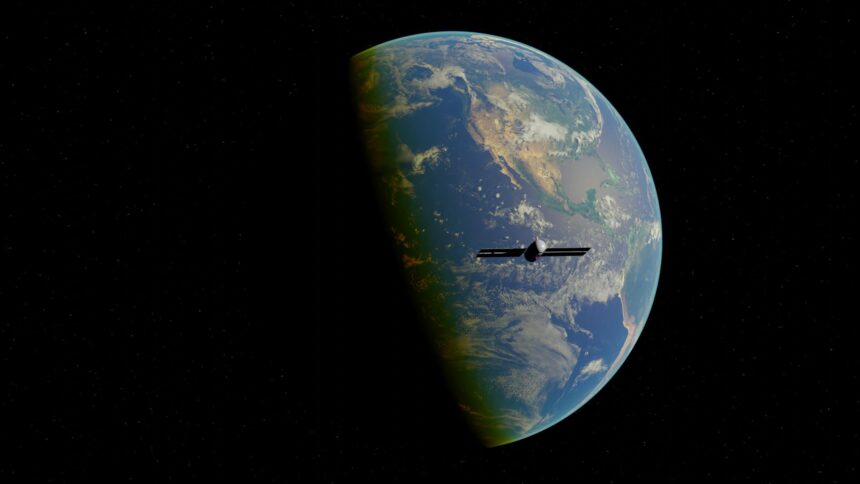
Something is orbiting Earth right now that isn’t the Moon.
It doesn’t glow the way the Moon does. You can’t see it without a telescope. Most people alive today had no idea it existed until astronomers confirmed it, and even then, the news barely registered outside of scientific circles. But up there, a small rocky object caught in Earth’s gravitational grip, circling our planet in a slow, looping path that takes it years to complete. Astronomers call objects like this “mini-moons,” and for a long time, the conventional thinking was that Earth probably didn’t have one, or that any captured object would stay only briefly before the Sun’s gravity tugged it away.
That thinking turned out to be wrong. Not a little wrong. Significantly wrong.
Astronomers using high-powered sky surveys have confirmed that Earth has a natural quasi-satellite a space rock that has been gravitationally tethered to our planet for longer than earlier models suggested. The object follows what scientists describe as a “horseshoe orbit,” a kind of gravitational dance where the rock traces a wide, looping path relative to Earth without ever cleanly circling it the way the Moon does. It’s not a perfect orbit. It’s messier than that. But it’s real, and it’s been going on for a very long time.
Here’s the strange part: this isn’t necessarily unusual in our solar system. Other planets have held onto temporary companions before. What surprised researchers is how long this particular object appears to have been with us, and what that suggests about the way Earth interacts with the space around it.
The Difference Between a Moon and a Mini-Moon
When most of us picture a moon, we picture the thing that rises at night and controls the tides. That’s a gravitationally bound satellite, locked into a clean, stable orbit by Earth’s mass. What astronomers have confirmed here is something different, technically called a quasi-satellite or co-orbital object.
The distinction matters. A quasi-satellite doesn’t orbit Earth the way the Moon does. Instead, it orbits the Sun on a path so similar to Earth’s that from our perspective, it appears to loop around us. Think of two cars on a circular track, one slightly faster than the other. From inside the slower car, the faster one seems to spiral back and forth around you, even though both are technically just driving around the same track. That’s roughly the geometry here.
What makes this object remarkable is its stability. Most quasi-satellites that Earth picks up are transient. The Sun’s gravity eventually wins, and the rock moves on. But this one has been hanging around in a configuration that, by astronomical measures, qualifies as long-term. That longevity is what pushed it from curiosity to genuine scientific interest.
And it raises an obvious question: if this one has been here so long, how many others have come and gone without us noticing?
What the Sky Surveys Are Actually Finding
Detecting an object like this requires patience and the right tools. The sky surveys that caught it, wide-field telescope systems designed to sweep large portions of the sky repeatedly, weren’t built specifically to find quasi-satellites. They were designed primarily to track near-Earth asteroids, the kind that could theoretically cross our path. Mini-moons turned out to be a byproduct of that search.
The object itself is small. We’re not talking about anything remotely comparable to the Moon, which is large enough to be seen clearly from Earth with the naked eye and has enough mass to drive our tides. This quasi-satellite is estimated to be in the range of tens of meters across, the size of a house, roughly, or a small building. It reflects very little light, which is part of why it took so long to confirm.
Once found, the math is what convinced astronomers it wasn’t just passing through. Orbital calculations traced its path backward through time and forward into the future. The object appears to have been in a stable co-orbital relationship with Earth for an extended period, and the projections suggest researchers project it will remain in a similar configuration for the foreseeable future, though exact timescales depend on ongoing modeling.
That kind of stability is rare. And rare, in planetary science, tends to mean interesting.
Why This Changes the Picture of Earth’s Neighborhood
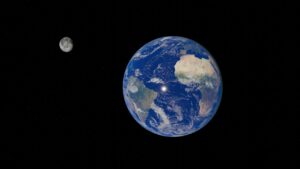
For most of human history, the assumption was simple: Earth has one moon. The Moon. Full stop. That framing shaped everything from mythology to tidal science to the way we talk about space. “Earthrise”, the famous photograph taken by Apollo 8 astronauts in 1968 showing our planet hanging over the lunar surface, became one of the defining images of the 20th century precisely because it captured something that felt singular and complete. Earth and its moon. Two objects in a clean relationship.
What planetary science has slowly revealed over the past few decades is that “Earth’s neighborhood” is considerably more crowded and dynamic than that image suggests. There are thousands of near-Earth objects. There are Trojan asteroids sharing our orbital path around the Sun. There are objects that swing close enough to be temporarily captured before escaping again. And now, confirmed, there is at least one object that has been quietly co-orbiting with us long enough to qualify as a genuine companion.
None of this makes the Moon any less remarkable. But it does complicate the simple story.
It also raises a question that researchers are beginning to take seriously: could Earth have captured and lost other quasi-satellites throughout its history without anyone ever knowing? The answer, almost certainly, is yes. Before modern sky surveys, we simply didn’t have the tools to catch them. Objects this small, this dark, and this far away were invisible to us.
What We Still Don’t Know

The origin of this particular object is still an open question. It could be a fragment from the asteroid belt that drifted into a resonant orbit with Earth over millions of years. It could be something that was knocked loose from elsewhere in the inner solar system and gradually settled into a path near ours, though researchers caution this remains one hypothesis among several. There’s no way to know for certain without a close-up look, and no mission is currently planned to visit it.
That’s the thing about astronomy at this scale. You can calculate an object’s orbit to extraordinary precision. You can determine its approximate size from how much light it reflects. You can even make reasonable guesses about its composition based on how it moves. But you can’t hold it in your hands. You can’t chip off a piece and run it through a mass spectrometer. The object stays where it is, looping slowly through space, and we watch from a distance and do the math.
What astronomers are fairly confident about is this: as sky survey technology improves, we will find more of these. The next generation of wide-field observatories, some already under construction, will be capable of detecting objects significantly smaller and dimmer than anything current systems can reliably catch. The mini-moon catalog is almost certainly going to grow.
Which means the question isn’t really whether Earth has a second moon. We’ve settled that. The question is how many companions our planet has collected and released over its 4.5-billion-year history, and whether any of those lost visitors left any trace we might still find.
The Moon, you know, is still there, pulling the tides, lighting the night, doing what it has always done. But up above it, in a slower and stranger orbit, something else is circling. It has probably been there longer than our species has existed. We just finally learned to look for it.
This article was researched, written, and edited by our human editorial team. AI tools were used in a limited research-assistant capacity. All claims were independently verified.