

In the winter of 1938, a Viennese architect named Victor Gruen boarded a ship for New York with two hundred dollars in his pocket and a portfolio of unbuilt ideas. He spoke almost no English. He had left behind his architecture practice, most of his possessions, and a city that was, by then, no longer safe for Jewish professionals. What he did not leave behind was an idea about what a city should feel like and that idea, transplanted into the American landscape, would eventually produce something he never intended and came to despise.
The American shopping mall, as a building type, did not grow organically from the soil of consumer capitalism. It was designed. By one person. Working from a specific theory about human behavior in urban space. By the late 1940s, American cities were emptying. The postwar suburban expansion, accelerated by the GI Bill and, later, the Federal-Aid Highway Act of 1956, had pulled millions of families away from downtown commercial districts. Strip malls rows of stores fronting a parking lot, had followed them outward. But strip malls were not Gruen’s idea of a city. They were, in his view, the opposite of one. Gruen had grown up in Vienna, a city built around the Ringstrasse, where commercial, civic, and cultural life happened together in enclosed arcades and pedestrian streets.
You walked. You stopped. You ran into neighbors. Commerce was embedded in community, not isolated from it. American suburbs, to his eye, had stripped all of that out and left only the transaction. His response was the enclosed shopping center. Not a strip mall. A fully enclosed, climate-controlled, pedestrian environment that would replicate the social density of a European city center in the middle of a parking lot. The project that changed everything opened in Edina, Minnesota, in 1956.
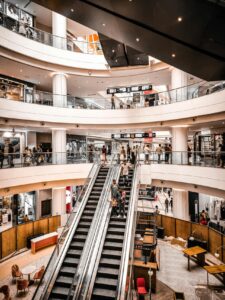
Southdale Center was the first fully enclosed, two-level shopping mall in the United States. It had department stores at both ends, anchor tenants, in the language that would become standard, and a climate-controlled interior court between them. Gruen described the climate-controlled interior court in terms evoking perpetual spring, a phrase that has been widely associated with his vision for the space. And here is the strange part: what Gruen actually submitted in his original plans was far more ambitious than what got built.
His vision for the Southdale district included apartments, offices, schools, a medical center, and parks, a genuine mixed-use neighborhood that happened to contain a shopping center. The developers built only the mall. The surrounding land became parking. He knew immediately that something had gone wrong. Southdale worked commercially. That was the problem, from Gruen’s perspective. The retail math was undeniable: anchor tenants at opposite ends of a climate-controlled corridor guaranteed foot traffic past every store in between. Customers who came for the anchor department stores walked past dozens of smaller retailers to get there. Dwell time increased. Sales per square foot increased.
The formula was replicable anywhere with a large enough parking field and two department stores willing to sign leases. Developers did not need Gruen’s full vision. They needed the corridor, the anchors, and the climate control. Within a decade, the enclosed mall had spread to virtually every major suburb in America. The model also had a more subtle effect. Mall developers, following the Southdale template, deliberately eliminated any navigational clarity that might let shoppers exit quickly. No windows. No clocks. Identical flooring and lighting throughout. These features were not accidental, they echoed principles later associated with casino design, disorienting layouts intended to maximize dwell time. The goal was disorientation in service of dwell time.
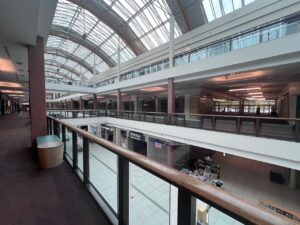
Gruen had wanted to create a public square. What emerged was a controlled commercial environment engineered to separate people from money. By the 1970s, Victor Gruen had returned to Vienna and was publicly disowning what American developers had done with his concept. He reportedly referred to the proliferation of enclosed malls as “those bastard developments”. His objection was not sentimental. It was structural. The mall had been extracted from its urban context and replicated as a pure retail instrument, without the housing, the civic infrastructure, or the public ownership that would have made it something other than a machine for extracting consumer spending. He was not wrong about the outcome.
The American mall, as built, became one of the most effective retail environments ever constructed, and one of the most socially sterile. It produced no city life. It produced consumption. The two are not the same thing, and Gruen had always known that. The deeper irony is economic, and it took about sixty years to arrive. The mall model that displaced downtown commercial districts succeeded so completely that it eventually faced the same problem it had originally solved: the next generation of consumers left. Online retail did to the enclosed mall roughly what the enclosed mall had done to Main Street. By the early 2020s, a significant number of American malls had closed or were in the process of closing.
The ones that survived did so, in many cases, by adding the elements Gruen had originally specified: apartments, offices, medical clinics, entertainment venues, civic anchors. The industry called this “mixed-use redevelopment,” as though it were a new idea. It was not a new idea. It was the original drawing, the one the developers had declined to build in 1956. Victor Gruen spent his career trying to bring European urban density to the American suburb. What he actually built was the template for its commercial opposite, a building type so successful it eventually hollowed out the very cities it was meant to replace, and so fragile it is now being retrofitted, sixty years later, with the apartments and civic spaces he drew in the first version. The blueprints were always there. Nobody wanted to pay for them. This article was researched, written, and edited by our human editorial team. AI tools were used in a limited research-assistant capacity. All claims were independently verified.