

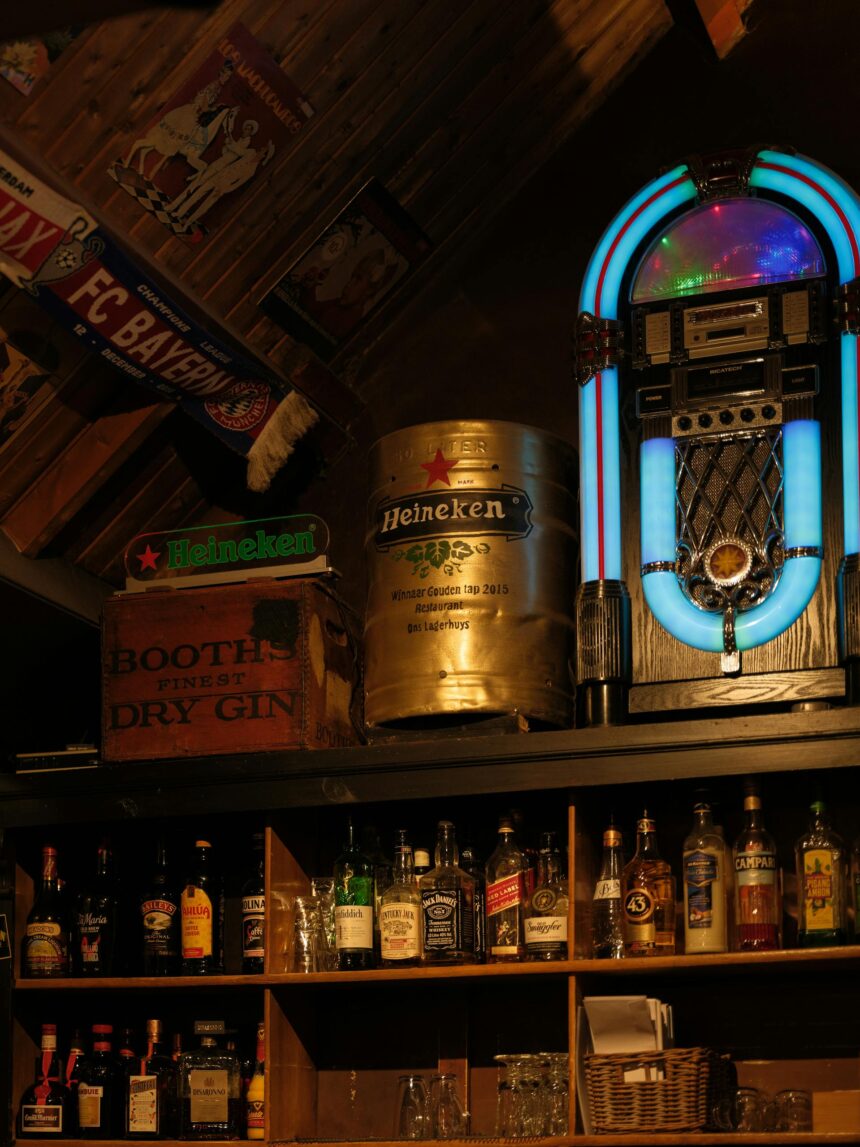
In the early 1950s, there were more jukeboxes operating in American diners, bars, and bowling alleys than most people realize, by some estimates, rivaling or exceeding the number of television sets in American homes at the time. That fact tends to stop people. It shouldn’t. The jukebox wasn’t a curiosity. It was infrastructure.
And embedded in that infrastructure was a solution to a problem that the music industry has spent the last two decades trying to solve with machine learning, behavioral data, and billions of dollars in engineering. The jukebox did it with a coin slot and a room full of strangers.
What the Room Already Knew

Here’s how music discovery actually worked in a 1950s diner. You walked in. Someone had already played something. You heard it. You liked it, or you didn’t. If you liked it, you walked to the machine, found the song, dropped in a coin, and played it again. Or you found something next to it on the menu and tried that.
The selection in any given jukebox wasn’t random. It was curated by the operator, a person who visited weekly or monthly, pulled the play-count data from the machine’s mechanical counters, and swapped out the slow performers for new titles.
That operator was, functionally, a recommendation engine. A human one, with local knowledge. He knew that the diner on Route 9 skewed older and liked country, while the soda fountain three blocks over moved R&B. He didn’t need a neural network. He needed a notebook and a route.
The result was a feedback loop that felt, to the person standing at the machine, as if the jukebox knew them. It didn’t. It knew the room.
The Algorithm’s Blind Spot

Spotify’s recommendation engine. Discover Weekly, Release Radar, and the algorithmic playlists that Spotify has said drive a substantial share of listening on the platform work on individual signals. It watches what you play, how long you play it, when you skip, and what you add to playlists. Then it extrapolates. The logic is reasonable. The problem is that listening is not always a private act.
People don’t just listen for themselves. They listen to the room. A song choice at a party is a social gesture. A song playing in a restaurant shapes the meal. A jukebox in a bar creates a shared experience that no one engineered top-down; it emerged from the collective choices of everyone who dropped in a coin that night. Spotify’s algorithm, however sophisticated, is built around the individual user account. It has almost no model for what you want other people to feel.
And here’s the strange part: the jukebox operators of the 1950s understood this intuitively. They weren’t selling music. They were selling atmosphere. The distinction matters more than it sounds.
Why Physical Presence Changed the Math

There’s a mechanism that behavioral economists call social proof. When you see others doing something, ordering a dish, choosing a path, or playing a song, you update your own preferences toward theirs. The jukebox was a social proof machine. You could see what other people had selected. The song playing when you walked in was evidence of what the room had chosen. You could look at the physical song list and notice which titles had worn labels from repeated handling.
None of that signal is available on Spotify. The platform is, by design, a private experience. Your plays are invisible to the stranger sitting next to you at the coffee shop. You both have earbuds in. The room is gone.
This isn’t a criticism of streaming. It’s an observation about what got traded away. Streaming gave listeners access to virtually everything ever recorded. That’s a genuinely remarkable thing. But access is not discovery. Discovery requires a filter, and the best filters, historically, have been other people in the same room making choices you can observe.
The Attempts to Get It Back

The music industry has been trying to rebuild social discovery for years. Collaborative playlists. Shared listening sessions. “What your friends are playing” features. Last.fm built an entire platform around social listening graphs in the early 2000s. SoundCloud built its reputation partly on the social layer, comments tied to specific timestamps in songs, which is genuinely clever and genuinely underrated as a discovery mechanic.
Spotify has experimented repeatedly with friend-facing features over the years, most of which got quietly shelved. Apple Music has a following/follower model that almost no one uses.
Here’s the thing. Engineers build the social layer. Users ignore it. And the reason, probably, is that digital social listening feels performed in a way that physical listening never did. Nobody chose a song on a jukebox to seem interesting to strangers. They chose it because they wanted to hear it. The social effect was a byproduct. Not the point.
That asymmetry is hard to engineer around.
What the Coin Slot Actually Did
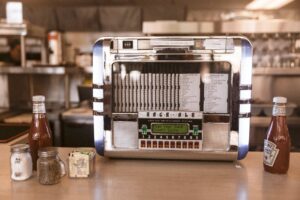
The jukebox had one feature that no streaming platform has yet replicated: friction. A coin costs something. Not much, a nickel or a dime in the 1950s, but enough that every selection was a small, public commitment. You didn’t play a song idly. You played it because you wanted it in the room.
Streaming eliminated friction almost entirely, which is mostly good. But friction had a side effect: it made choices legible. A song on a jukebox was a signal. A play on Spotify, counted invisibly in a data center, is not.
The music industry spent the 20th century building discovery infrastructure that worked because it was local, physical, and slightly communal. Then the 21st century took all three of those things apart in the name of convenience. The algorithms are genuinely impressive. But a diner jukebox in Akron, Ohio, running on mechanical counters and a route driver’s notebook, was doing something the engineers haven’t quite figured out how to replicate.
Whether that’s a solvable engineering problem or a lost property of physical space is the question worth sitting with.
This article was researched, written, and edited by our human editorial team. AI tools were used in a limited research-assistant capacity. All claims were independently verified.