

The workers were supposed to be digging a foundation, not making history. But when their equipment broke through a layer of compacted earth somewhere beneath a major European capital, what came up with the rubble wasn’t soil. It was walls. Cobblestones. The unmistakable geometry of a city that had simply been buried and forgotten or so the official story went.
Here’s the part that didn’t make the initial press release: authorities had reason to suspect something was down there long before the first shovel went in.
The existence of a substantial medieval settlement beneath the modern street grid wasn’t exactly a secret in academic circles. Historical maps, old church records, and centuries-old accounts from local chroniclers had long pointed to a thriving community that once occupied the same ground. But between the political pressures of urban development, the bureaucratic appetite for infrastructure timelines, and a general institutional reluctance to hand a construction site over to archaeologists, the dots were never officially connected. Not publicly, anyway.
What the Ground Was Hiding
Medieval cities didn’t vanish overnight. They were buried incrementally, by fires that left charred debris no one cleared, by floods that deposited silt across entire neighborhoods, by deliberate landfill operations that raised street levels by meters over centuries. In several Italian cities, including Bologna, urban archaeologists have documented medieval streets buried under multiple meters of accumulated fill, with original paving stones and drainage channels sometimes surviving intact. The city above forgot the city below. The city below kept its shape.
What construction crews tend to find in these situations isn’t dramatic rubble. It’s the quiet persistence of domestic life, hearth stones, ceramic fragments, the foundations of market stalls, the outlines of alleyways. In well-preserved cases, timber frames survive. Sometimes the contents of a room survive. The buried city doesn’t announce itself. It just sits there, exactly as it was left, waiting for someone to break through the ceiling.
The Silence That Preceded the Announcement
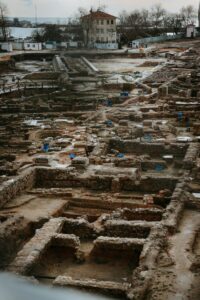
Here’s the thing. The gap between discovery and public announcement is never accidental. In city after city. Cities like Dublin, Thessaloniki, and Warsaw have each seen major archaeological discoveries emerge during construction projects; the same choreography plays out: work halts, archaeologists arrive under non-disclosure, and then, sometimes two or three years later, a press release lands describing the find as wholly unexpected. A surprise. Nobody saw it coming.
Which sounds reasonable until you check the historical record. Which is the part most people miss?
City archives, university dissertations, and even popular histories published decades before the construction work began often contain explicit references to the buried settlement. The knowledge existed. It circulated. It simply wasn’t convenient, because acknowledging a medieval city under a proposed metro line or a government building project means delays, costs, and the kind of public scrutiny that infrastructure ministries prefer to avoid. Archaeology and concrete pours are not natural allies.
Why Burying a City Is Easier Than Explaining It

Straightforward incentive. Once medieval remains are formally disclosed, heritage protection laws across the EU, including directives that flow from the 1992 Valletta Convention on Archaeological Heritage, require construction to stop while excavation proceeds. Work stops. Excavation teams move in. Timelines stretch. Budgets bloat. And the bureaucratic pressure, every single time, runs in exactly one direction: find nothing, or find something small enough to document in a week and pave over by Friday.
What makes this particular case notable, and what tends to make these cases notable in general, is not just the scale of what was found, but the paper trail that existed beforehand. The buried city wasn’t lost. It was inconvenient. And inconvenient things, in the history of urban planning, have a long tradition of becoming temporarily invisible.
The construction project was eventually completed. The medieval remains were partially excavated, partially preserved in situ beneath the new foundations, and partially documented in a report that took years to reach the public. A small interpretive display was installed somewhere in the finished building. Visitors pass it without reading it.
Somewhere below the street you’re imagining right now, there are walls that have been standing longer than the nation above them. The only question worth asking isn’t how they got buried. It’s how many other cities are still down there, waiting for someone to accidentally break through the ceiling, and whether anyone already knows.
This article was created with AI assistance and reviewed by the author. The review included fact-checking, clarity edits, references, and sourcing of images