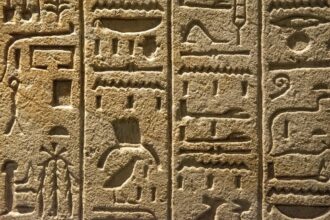



There is a group of people that the ancient Japanese imperial court called the Emishi. For centuries, the Yamato state sent armies to subdue them. Wrote them out of history. Pushed them to the margins of the map and then, largely, off it. The Emishi lived in the northeastern reaches of Honshu, in a region now called Tohoku, and they resisted imperial expansion for so long that historians still argue about exactly when their distinct identity disappeared. What the imperial record never considered was this: their DNA wasn’t going anywhere.
A study published in 2026 in a peer-reviewed journal by researchers at RIKEN has quietly rewritten what we thought we knew about where Japanese people come from. For roughly sixty years, the accepted model described Japan’s population as the product of two ancestral groups: the ancient Jomon hunter-gatherers who arrived tens of thousands of years ago, and the Yayoi farmers who migrated from continental Asia several thousand years ago. Two streams. Two peoples. One nation.
The new research found

The team analyzed whole-genome sequences from thousands of people across seven regions of Japan, stretching from Hokkaido in the north to Okinawa in the south. It was among the largest genomic studies of its kind ever conducted for a non-European population. And buried in that data, concentrated in the Tohoku region of northeastern Honshu, was a genetic signature distinct from both the Jomon and Yayoi profiles. Something else had been there all along.
And here’s the strange part: this wasn’t a minor statistical footnote. The third ancestral component appears to be the genetic echo of the Emishi — the same people that the Yamato imperial state spent generations attempting to conquer, assimilate, and ultimately silence. History recorded their defeat. Genetics recorded their persistence.
The Numbers That Change the Map

The study also revealed something that complicates the tidy image of Japan as a genetically uniform nation. Jomon ancestry made up a substantially higher proportion of the genomes tested in Okinawa than in western Japan. That is not a small difference. It means that two people standing in the same country, separated by a few hundred miles of coastline, carry meaningfully different genetic histories — shaped by migration patterns, geography, and the long reach of imperial expansion that pushed certain populations to the edges of the archipelago rather than absorbing them cleanly.
Western Japan, closer to the Asian continent, absorbed more Yayoi influence. Okinawa, relatively isolated in the south, preserved more Jomon ancestry. And Tohoku, the old Emishi heartland in the northeast, carries this third signal that doesn’t fit either category. Japan, it turns out, is not one genetic story. It is at least three, running in parallel through millions of people who may never have had reason to wonder.
For a country that has long been described by outsiders and in its own national mythology as unusually homogeneous, this is a significant revision. The homogeneity was always, in part, a story told by the winners.
What the Neanderthals Left Behind
The study found something else worth pausing on. Buried in modern Japanese genomes carry a number of functional genetic locations inherited from Neanderthals and Denisovans, ancient human relatives who vanished from the fossil record tens of thousands of years ago. These aren’t inert remnants. Some of them are still active in ways researchers can link to various complex health conditions.
That is a strange thing to sit with. The genetic material of people who ceased to exist as a distinct species before the pyramids were dreamed of is still doing something in the bodies of people alive today. It isn’t unique to Japan; Iliar Neanderthal inheritance has been documented in European and other Asian populations, but the specificity of 44 identifiable, functional locations makes the Japanese genomic dataset an unusually clear window into how deep ancestry actually works. It doesn’t end. It accumulates.
The Longer Story

For Asian American Heritage Month, this research lands with particular resonance. Japan has served as a kind of shorthand for the idea of a bounded, singular national identity, a culture so cohesive it became, for better and worse, a template for how outsiders imagine Asian nationhood. The genetics say otherwise.
The Emishi are not a romantic footnote. They were real people who resisted real conquest, and the imperial records that survive describe them largely through the eyes of the state that defeated them. Their own voice, their own account of who they were, is mostly gone. But the RIKEN study suggests that some of them endured in the only archive that doesn’t burn: the genome.
What makes this finding genuinely unsettling, in the best possible way, is the timeline. Sixty years of scientific consensus, built on a model that seemed complete, turned out to have a missing chapter. The people who were erased from the historical record weren’t erased from the biological one. And it took analyzing 3,256 genomes across the length of a country to find them.
How many other national origin stories are waiting for the same revision is a question that genomic science is only beginning to ask.
Sources
This article was researched, written, and edited by our human editorial team. AI tools were used in a limited research-assistant capacity. All claims were independently verified.