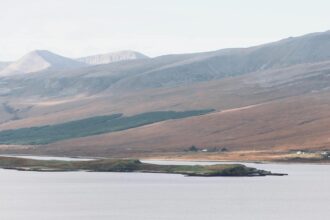


The channel at Grindasundet is narrow and cold and looks, from the surface, like a thousand other passages threading through the Øygarden archipelago outside Bergen. Fishing boats have worked these waters for generations. Recreational divers have passed through. But lying on the seabed the whole time, invisible beneath the surface, was a line of stones arranged by human hands more than a thousand years age a structure so deliberate, so large, and so precisely placed that marine archaeologists from the Norwegian Maritime Museum knew immediately what they were looking at.
A whale trap. The first physical one ever found.
In early 2026, researchers announced the discovery of a massive man-made stone belt stretching across the floor of Grindasundet across the floor of Grindasundet, a narrow channel in the Øygarden archipelago in the Øygarden archipelago. The Norwegian Maritime Museum attributed the find to its underwater mapping project. And here’s the part that makes this discovery genuinely strange: the structure they found matches, almost exactly, descriptions written down in Norwegian legal texts over a thousand years ago.
Those texts are called the Gulating Law one of the oldest surviving records of Norwegian legal traditions. The law didn’t just mention whale drives in passing. It spelled out who owned the whales, how the catch was divided, what happened when disputes arose. Whole sections governed the rights to coastal waters used for exactly this kind of organized hunt. The law existed. The descriptions existed. But the physical evidence, the actual stones, the actual structure, had never been found. Until now.
The Trap Itself
The mechanics of what happened here are worth understanding, because they show something about Viking-era coastal communities that gets lost when we focus only on longships and raids.
Small whales, likely minke whales according to researchers, were the likely target in Grindasundet. Researchers believe the operation worked like this: wooden barriers and ropes weighted with stones were used to herd the whales into the channel. Once the animals were confined in the narrowing water, they were killed with purpose-built weapons, according to researchers. The stone belt on the seabed, those 25-plus meters of carefully placed rock, was the anchor point for the whole system. It wasn’t decoration. It was engineering.
What strikes you, thinking about it, is the organizational complexity. This wasn’t one man with a harpoon. It required boats, coordinated movement, weighted ropes, purpose-built weapons, and enough shared legal understanding that communities had written laws governing the proceeds. Someone had to own these waters. Someone did.
The Monastery That Owned the Bay

During the Middle Ages, a medieval monastery in Bergen held the rights to the bay at Grindasundet. The implications of that are worth sitting with for a moment. A religious community, monks and nuns dependent on the sea, controlled one of the most productive whale-hunting sites on the Norwegian coast. The whaling operation wasn’t incidental to monastery life. According to researchers, it appears to have been a significant source of income.
Whale meat fed people through long winters. Whale oil lit lamps. Blubber had uses we’ve largely forgotten. For a coastal community in medieval Norway, a successful whale drive wasn’t just a good day on the water. It was the difference between a monastery that thrived and one that struggled. The Nonneseter community understood this. The Gulating Law, one of Norway’s oldest legal codes, understood this. And now, for the first time, we can see the physical apparatus that made it all work.
That’s what tends to get lost in popular accounts of the Vikings, the sheer organizational sophistication of everyday economic life. The raids were real. So was the infrastructure.
What 1,100 Years of Silence Looks Like

The Gulating Law has been studied by scholars for a very long time. Legal historians, archaeologists, and Scandinavian scholars knew the whale-drive passages were there. They just had no physical corroboration, no artifact, no structure, no proof that the written rules governed a real operation rather than a theoretical one. That gap, between the text and the ground, is a familiar frustration in medieval archaeology.
The discovery at Grindasundet closes it, at least here, at least for this one bay. The stones on the seabed are not ambiguous. They are arranged. They are deliberate. They match the descriptions in the law with a precision that, according to the Norwegian Maritime Museum, left researchers little doubt about what they had found.
It is strange to think about, honestly. For over a thousand years, boats passed above those stones. Fishermen anchored in that channel. The water kept its secret without any particular effort. The stones didn’t hide. They just waited.
What the Find Changes

Medieval whale hunting in Norway has always been understood as historically significant. The Gulating Law made that clear. But significance written in legal texts is a different thing from significance you can measure, photograph, and map on a seabed chart.
The museum’s underwater mapping project at the Norwegian Maritime Museum has been working to document submerged cultural heritage along the Norwegian coast, and the Grindasundet find represents the kind of confirmation that changes how researchers interpret everything else in the historical record. If the whale trap described in an 1,100-year-old legal code is physically verifiable, right there, 25 meters of stone, exactly where the law says it should be, then other descriptions in the same documents deserve a second, harder look.
There is almost certainly more down there. More channels. More stone structures. More evidence of an industry that sustained communities for centuries before anyone thought to write it down, and then sustained them for centuries more after they did.
The monks of Nonneseter knew which bay was worth owning. They were right about that for a very long time. It took divers in 2026 to prove it.
This article was researched, written, and edited by our human editorial team. AI tools were used in a limited research-assistant capacity. All claims were independently verified.