


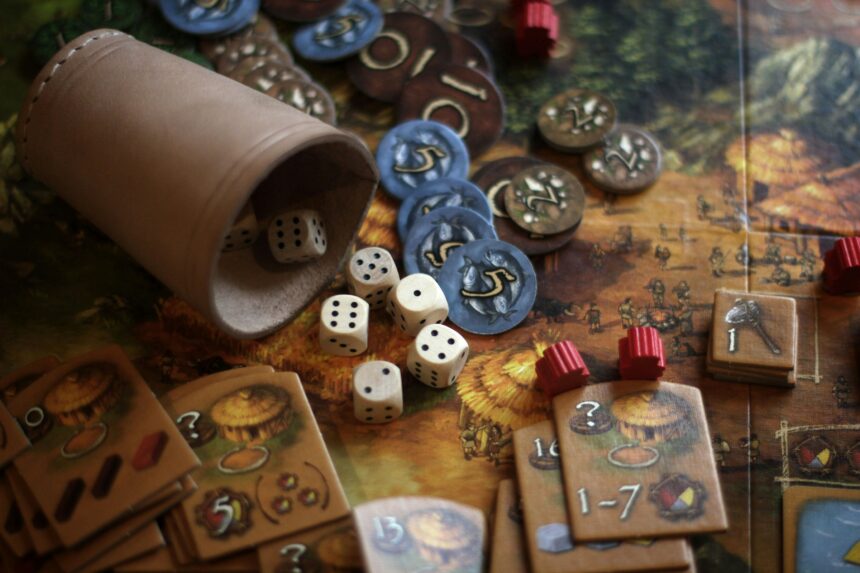
There is a flat, oval sliver of bone, no bigger than a thumbnail, sitting in an archaeological collection from a site in Wyoming. It is roughly 12,000 years old. According to research published in 2026 in the journal American Antiquity, it is the oldest known gambling tool in human history.
That detail alone is worth sitting with for a moment.
The study, conducted by a researcher who identified bone dice used by Ice Age hunter-gatherers, identified bone dice used by Ice Age hunter-gatherers on the western Great Plains, across the western Great Plains, dating to roughly 12,800 to 12,200 years ago. These were the people of the Folsom Period, living at the very end of the last Ice Age, hunting megafauna across a landscape we would barely recognize today. And they were gambling.
The finding doesn’t just add a footnote to history. It demolishes a quiet assumption that most of us absorbed without ever questioning it, that dice, probability, and organized games of chance were gifts from the ancient Old World. From Egypt, Greece, and Mesopotamia. From somewhere over there. Turns out the oldest gambling tools on Earth were here all along, on soil that would one day be called America.
The Bone That Changed Everything
The dice Madden studied weren’t carved cubes with pips. They were two-sided gaming pieces, flat, oval pieces of bone, tossed in groups to generate random outcomes much like flipping a handful of coins at once. Simple in form. Sophisticated in function. The randomness was the point.
And here’s the part that stays with you: Madden didn’t find a handful of these objects. He identified hundreds of dice sets from sites across North America, documenting continuous use from 12,000 years ago all the way through the period of European contact. This wasn’t an isolated invention that flickered out. It was a tradition that lasted longer than the entire span of recorded Western civilization.
For context, the earliest Old World dice, typically cited as coming from ancient Mesopotamia or Egypt, date to roughly 6,000 years ago. That means Indigenous North Americans were rolling dice before the Egyptians built the first pyramid. Before anyone wrote the first cuneiform tablet. Before the concept of a city had taken root, it had almost everywhere on earth.
Games as Diplomacy, Not Just Pastime

What makes this research genuinely striking isn’t just the age of the discovery. It’s what the evidence suggests these games were for.
The dice weren’t merely entertainment. According to the findings, evidence hints that the games were played mostly by women and functioned as neutral, rule-governed spaces for inter-group exchange, of goods, of information, of alliances. Think of them less as a casino and more as a conference table. A shared set of rules that let two groups, perhaps speaking different languages, sit across from each other and transact in something fair.
That reframes the entire picture. We tend to imagine gambling as a vice, something that crept into human culture once civilization got comfortable enough to afford it. But these bones suggest something older and more practical. A game of chance, governed by agreed-upon rules, may have been one of the earliest technologies for building trust between strangers.
Which sounds almost modern until you realize we are still essentially doing the same thing, just with poker chips and conference rooms.
What the Eurocentric Narrative Got Wrong

There is a longer story underneath this discovery, and it has less to do with dice than with whose history gets counted.
For generations, the standard account of human intellectual progress ran roughly west to east, then east to west. Civilization bloomed in Mesopotamia and Egypt, spread through Greece and Rome, and eventually arrived in the Americas with European explorers. The Americas, in this telling, were populated by peoples who were outside the main current of human development until contact.
The bone lots from Wyoming and Colorado don’t fit that story. They fit a different one, of a continent populated by peoples who had been innovating, trading, governing social interaction, and developing sophisticated cultural technologies for thousands of years before anyone arrived to tell them otherwise.
Madden’s count of hundreds of dice sets across the continent isn’t the picture of a scattered people with no cultural continuity. It’s the picture of a tradition, maintained across generations and across vast distances, for a span of time that dwarfs most of what we call “recorded history.”
What 12,000 Years Looks Like

It is genuinely hard to feel the weight of 12,000 years. Easier, maybe, to hold the small detail: a flat piece of bone, shaped and smoothed by someone’s hands at the end of the Ice Age, tossed on the ground in a game that mattered enough to play.
The Folsom Period sites where these objects were found are the same sites where researchers have long recovered the distinctive fluted stone points that tell us these hunters were pursuing mammoths and giant bison across the Great Plains. We knew they were skilled. We knew they were organized. We are only now learning that they were also, in the most serious sense of the word, playful.
The games continued. New groups, new sites, new regions, but the same flat oval bones, the same casting of lots, the same moment of waiting to see how chance would fall. From the end of the Ice Age to the arrival of European ships: a continuous thread of human culture that no one in a standard history classroom was ever taught to look for.
The oldest dice in the world were not found in a Mesopotamian palace or an Egyptian tomb. They were sitting in the soil of Wyoming, waiting to be recognized.
This article was researched, written, and edited by our human editorial team. AI tools were used in a limited research-assistant capacity. All claims were independently verified.