



In the spring of 1878, a converted building in New Haven, Connecticut, began routing telephone calls between subscribers. There were around two dozen customers. The operator sat at a board roughly the size of a wardrobe door and plugged copper-tipped cords into lettered jacks by hand.
The whole system fits in one room. Within forty years, variations of that same robot, om scaled up, staffed by thousands, replicated in every city in the industrialized world, would handle more simultaneous human conversations than any communication system in history. The switchboard wasn’t a stepping stone. For a long time, it was the destination.
And here’s the strange part: it worked so well that the people running it couldn’t imagine anything better. Not because they lacked imagination, but because the engineering problem the switchboard solved was genuinely hard, and the solution was genuinely elegant. Understanding why it died requires understanding, first, exactly what it was.
What the Board Actually Did
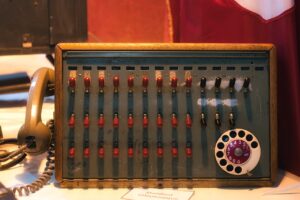
A telephone switchboard was a real-time routing machine. Every subscriber in a city had a line terminating at a central office. When you picked up your handset, a small lamp or flag at the exchange lit up to signal an operator. She, and for most of the switchboard’s history, the operators were women, would plug one end of a patch cord into your jack, ask for your party, then patch the other end into the destination jack. Two subscribers were now connected through the board. When the call ended, she pulled the cord.
That’s the simplified version. In practice, a large urban exchange in the early twentieth century had boards stretching the length of a gymnasium wall, with hundreds of operators working in shifts around the clock. Calls routed between cities required handoffs between exchanges, each one a human judgment call made in seconds.
The operators weren’t just plugging cords; they were managing traffic, resolving busy signals, holding connections, and running a live network with no margin for error. The system’s throughput depended entirely on their speed and accuracy. Most trained operators could complete a connection in a matter of seconds. The best were faster than that.
This is where the trap was set.
The Efficiency That Became the Ceiling
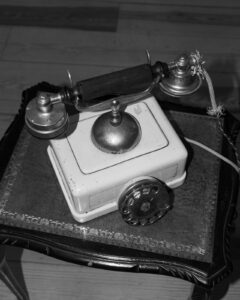
Every technology has a scaling problem, and the switchboard’s was arithmetic. More subscribers meant more jacks, more cords, more operators. The number of possible connections between subscribers grows much faster than the number of subscribers themselves, a mathematical reality known to network engineers as combinatorial explosion.
Double the subscribers, and you more than double the routing complexity. By the early decades of the twentieth century, telephone companies in major American cities were running exchanges that required thousands of operators per building just to keep pace with demand.
The economics were brutal. Labor was the cost. Operators had to be trained, scheduled, and replaced when they left. And they left constantly, turnover in exchange work was high, partly because the conditions were demanding, partly because the pay reflected the era’s assumptions about women’s work. The telephone companies weren’t blind to this. They were looking, from very early on, for a way to route calls without human hands at the board.
The answer was already being invented before most people knew they needed it.
The Undertaker Who Invented Direct Dial

The automatic telephone exchange has an origin story that reads like a legend, because it almost is one. The conventional account credits Almon Strowger, an undertaker in La Porte, Indiana (though he had connections to Kansas City), who became convinced, who became convinced, rightly or wrongly, that a telephone operator was routing calls intended for his funeral business to a competitor.
His solution was to design a switching mechanism that didn’t require a human intermediary at all. The Strowger switch, patented in 1891, used electromechanical stepping relays to route calls based on a sequence of electrical pulses. You dialed a number, literally rotated a dial, and the machine made the connection.
Whether Strowger’s competitor story is entirely true is a matter of some historical debate. What isn’t debated is that his switch worked, and that the telephone industry spent the next several decades figuring out how to deploy it at scale. The transition from manual to automatic switching took longer than you might expect. The switchboard wasn’t simply replaced overnight. It was displaced gradually, exchange by exchange, city by city, as automatic equipment proved it could handle the volume.
That process stretched from the 1890s well into the mid-twentieth century. Some rural exchanges ran with human operators into the 1970s. The last major urban exchanges had largely converted by mid-century, well before rural systems completed the transition.
Why the Machine Won, and What It Cost

The automatic exchange beat the switchboard on exactly the terms the switchboard had always competed: speed, reliability, and scale. A bank of Strowger relays, and later, crossbar switches, and later still, electronic switching systems, could handle more simultaneous calls than any team of operators, at any hour, without breaks, without errors, without turnover. The economics weren’t close.
But the machine won something else, too, that nobody fully accounted for at the time. It won privacy. When a human operator completed your call, she could hear your conversation, at least until she pulled the cord. Most didn’t listen. Some did. The automatic exchange removed the question entirely. Your call went through a relay, not a person. This wasn’t advertised as a feature. It was a side effect. But it quietly changed what telephone communication meant, and what people were willing to say on one.
The operators who lost their jobs to the relays didn’t disappear from the workforce overnight. Many were absorbed into other telephone company roles. Others moved on. The industry managed the transition carefully, at least by the standards of the era, partly because replacing a skilled operator corps all at once would have broken the network. You can’t fire the machine you’re running on.
What the Switchboard Actually Tells Us
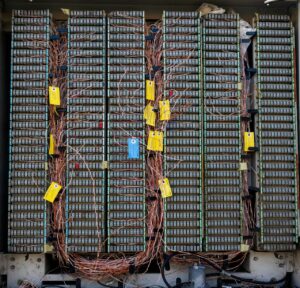
The telephone switchboard’s story gets told, when it gets told at all, as a simple narrative of progress. Old technology has been replaced by better technology. Operators replaced by automation. History moving forward. That framing isn’t wrong. It’s just incomplete.
What the switchboard really shows is how a technology can be optimized past the point of its own survival. The operators got faster and more precise. The exchanges got larger and more efficient. The whole system was refined, decade by decade, into something genuinely extraordinary, a human-powered routing network of staggering complexity, running in real time, with a reliability record that engineers still study. And then a machine did it cheaper.
This is the pattern that repeats. Not the sudden arrival of a better idea, but the slow grinding of a well-built system against the ceiling of its own nature. The switchboard was limited not by its design but by its physics: it required human hands, and human hands can only move so fast. Once the electromechanical switch crossed the threshold of reliability, the outcome was settled. The operators were already building the most efficient version of something the world was about to stop needing.
The Strowger switch, for its part, eventually ran into its own ceiling. Electromechanical relays gave way to crossbar systems, which gave way to electronic switching, which gave way to the packet-switched networks that carry your voice calls today, where there is no dedicated circuit at all, just data broken into fragments and reassembled at the other end. The switchboard’s direct descendant is a server farm somewhere, routing packets between IP addresses at speeds no human operator and no relay could approach.
The woman in New Haven who plugged the first cord into the first jack in 1878 was the beginning of a chain that runs, unbroken, to every phone call made right now. She just couldn’t see where it ended.
This article was researched, written, and edited by our human editorial team. AI tools were used in a limited research-assistant capacity. All claims were independently verified.