


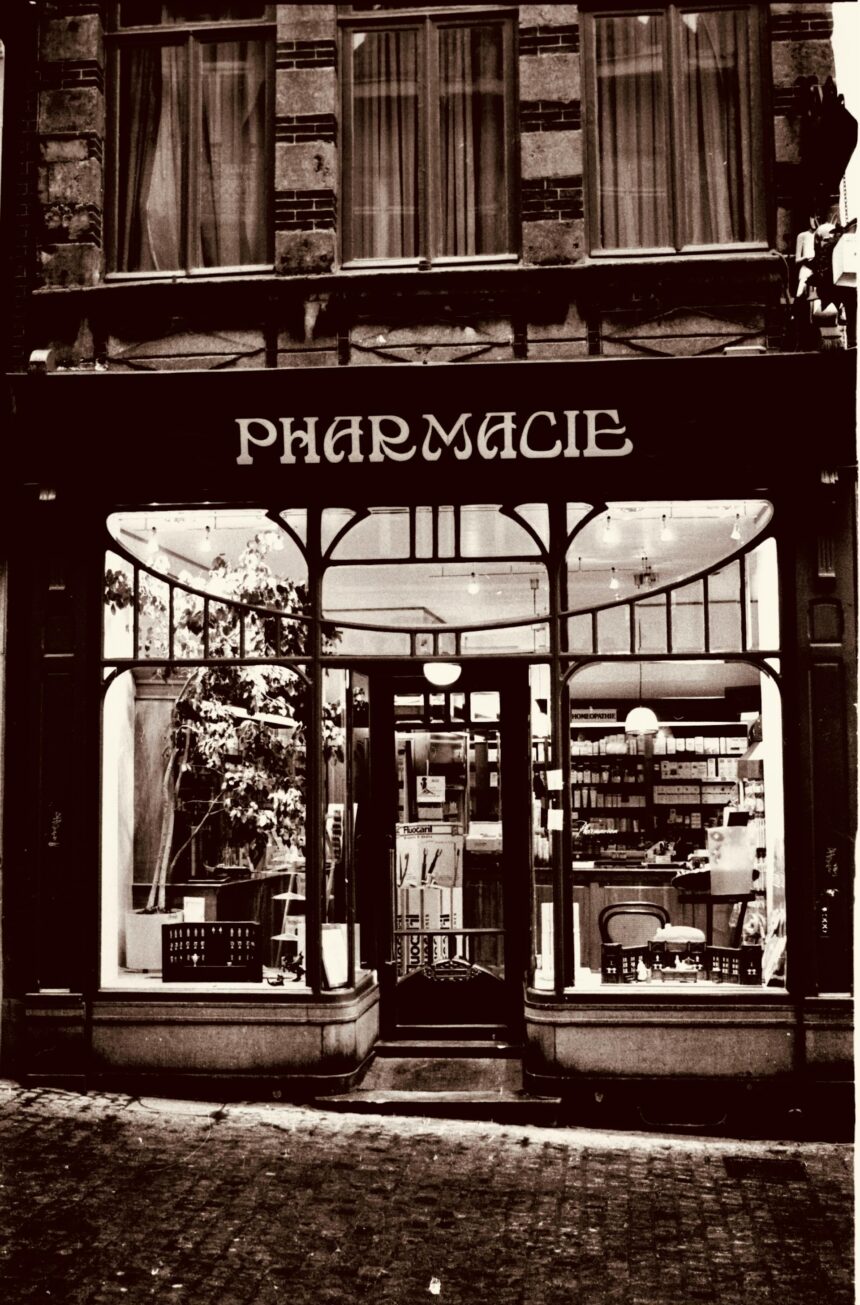
In the spring of 1984, a bill moved through Congress so quietly that most of the pharmacists it would eventually destroy had no idea it existed. The Drug Price Competition and Patent Term Restoration Act changed the rules for how generic drugs entered the American market
. It was sold as a consumer win. Prices would fall. Access would improve. And all of that was true, as far as it went. What the bill’s supporters didn’t advertise and what took another decade to become obvious was that the new economics of generic drugs would concentrate pharmaceutical supply chains in ways that made the independent corner pharmacy structurally obsolete.
That’s the part most histories of American retail leave out.
The World the Corner Pharmacy Was Built For

To understand what disappeared, you have to understand what it was. The independent pharmacy of the mid-twentieth century was not simply a place that dispensed pills. It was a credit institution. It was a neighborhood health advisor.
In small towns across the rural Midwest and the South, the pharmacist often knew more about a family’s medical history than the county doctor, because the pharmacist was the one who actually saw them every week. The soda fountain in the back was not a quirk of design. It was a reason to stop in, to talk, to be seen.
The economics that supported all of this were straightforward. Brand-name drugs carried fat margins. An independent operator could stock a manageable formulary, build relationships with a handful of pharmaceutical distributors, and price competitively enough to keep a loyal neighborhood base. The system was not efficient by modern standards. But it was stable.
What the 1984 legislation did, over time, was compress those margins to near zero on the most commonly prescribed drugs. Generics flooded the market. That was genuinely good for patients. But the pricing power that followed didn’t distribute evenly.
Large chain operators. Large chain operators. Walgreens, Eckerd, Revco, and CVS, could absorb wafer-thin generic margins because they made it up on volume., could absorb wafer-thin generic margins because they made it up on volume. An independent running a single store on a county road in Iowa could not.
The Middleman Problem Nobody Talked About

Here’s the strange part. The margin compression alone might not have been fatal. What accelerated the collapse was a second structural shift that arrived in the late 1980s and early 1990s: the rise of the pharmacy benefit manager, or PBM.
PBMs were intermediaries, companies that sat between drug manufacturers and insurance plans and negotiated reimbursement rates. On paper, they were supposed to lower costs for everyone. In practice, they became the gatekeepers of which pharmacies got included in insurance networks, and on what terms.
A PBM negotiating on behalf of a large employer health plan had every incentive to funnel prescriptions toward chain pharmacies, which could offer steeper discounts in exchange for preferred network status. The independent on Main Street, with no leverage and no lobbyist, often found itself either excluded from preferred networks entirely or reimbursed at rates that didn’t cover the cost of dispensing.
This is the mechanism that rarely makes it into the popular account of what happened to small-town America. The story people tell is about Walmart and big-box retail killing local commerce. That story is true, but it’s incomplete. The pharmacy collapse had its own specific architecture, its own legislation, its own set of industry actors who shaped the rules. It didn’t just happen. It was built.
What the Numbers Eventually Showed

By the early 2000s, independent pharmacies were closing at a rate that alarmed state pharmacy boards but attracted almost no national press coverage. The closures tracked a predictable geography: rural counties, low-income urban neighborhoods, anywhere that a chain operator had done the math and decided the foot traffic wasn’t worth the real estate. Those were, not coincidentally, the same communities that had relied most heavily on the independent model.
The practical consequences were concrete. In counties that lost their only pharmacy, patients with chronic conditions, diabetes, hypertension, heart disease, faced new travel distances to fill prescriptions that had previously been a short walk away. Research on what happens to medication adherence when that distance increases is not encouraging. People skip doses. They stretch supplies. They stop refilling.
The pharmacist-as-advisor relationship disappeared along with the building. A chain pharmacist working a twelve-hour shift across three locations has limited time for the kind of conversation that once caught a dangerous drug interaction before it became a hospitalization.
The Consolidation Nobody Stopped
The chain pharmacy industry consolidated aggressively through the 1990s and 2000s. Revco was absorbed. Eckerd was absorbed. By the time the dust settled, By the time the dust settled, a handful of large chains, led by Walgreens, CVS, and Rite Aid, had come to dominate retail pharmacy locations across the country. United States. The independent sector shrank to a fraction of what it had been at mid-century.
None of this was secret. State pharmacy associations tracked it. Trade publications covered it. The Federal Trade Commission reviewed several of the major mergers. What didn’t happen was any serious federal intervention to preserve the independent sector as a public health infrastructure. That conversation was never really had.
Partly this was ideology, the prevailing assumption in American economic policy since the 1980s has been that consolidation equals efficiency, and efficiency is good. Partly it was the lobbying math. The chain pharmacy industry had Washington representation that independent operators, by definition, could not match.
What Was Actually Lost

The soda fountain was the first thing to go, even before the pharmacies themselves. Then the full-service photo counter. Then the greeting card aisle, then the magazine rack. These were not merely nostalgic losses. They were the reasons people came in, and without them, the pharmacy became purely transactional, a place you visited only when you were already sick.
The independent pharmacy had been, in many communities, the last commercial anchor left after the hardware store and the five-and-dime closed. When it went, the building often sat empty for years. There was nothing behind it in the succession plan because the economics that had made the original possible no longer existed.
Some independents survived. A handful adapted to compounding pharmacy, to specialty medications, to the concierge model where a pharmacist operates almost like a personal health consultant. These are real businesses. But they serve a different market, mostly urban, mostly insured, mostly already-resourced. The rural county that lost its only pharmacy in 1997 did not get a compounding pharmacy to replace it.
What the 1984 legislation set in motion was not inevitable. Plenty of countries with generics markets managed to preserve a more distributed pharmacy infrastructure through a combination of reimbursement policy and network access rules. The United States made different choices, mostly in the 1980s and 1990s, mostly without anyone framing them as choices about rural public health. They were framed as choices about market efficiency.
The distinction matters more now than it did then. The pharmacy deserts that opened up over the following three decades are now documented, mapped, and studied. The policy window that might have prevented them closed a long time ago.
This article was researched, written, and edited by our human editorial team. AI tools were used in a limited research-assistant capacity. All claims were independently verified.