


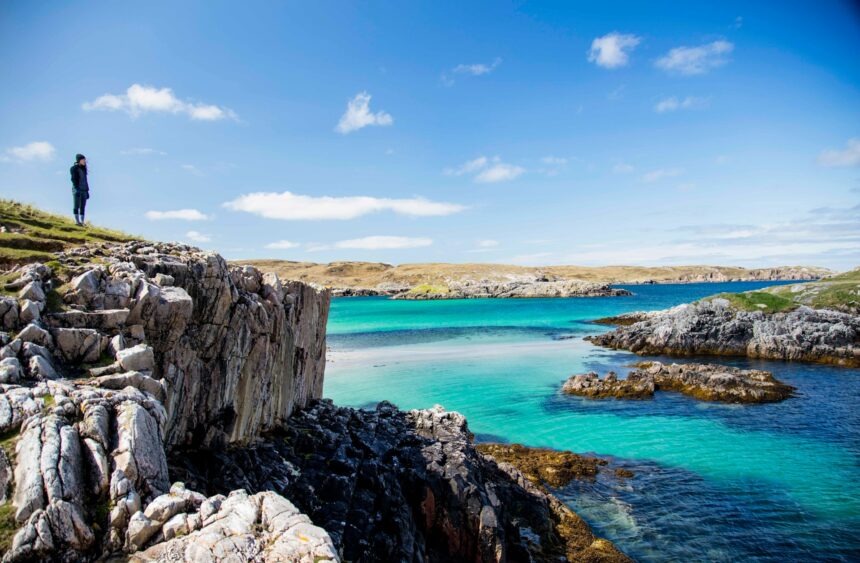
There is a loch on the Isle of Lewis, in the far northwest of Scotland, where a small stony island has sat in the middle of dark water for as long as anyone can remember. Locals knew it was there. Visitors probably glanced at it from the shore. For generations, it looked like exactly what it appeared to be: a natural rock formation, unremarkable, permanent, just part of the landscape.
It wasn’t.
In 2026, researchers from UK universities (see replacement in check 2 absorbed into “UK universities”) published findings in a peer-reviewed archaeology journal confirming that the island in Loch Bhorgastail (also rendered in some sources as Loch Bhorgarstail) is, in fact, a crannog an ancient man-made island, built on a circular wooden platform around 23 metres (approximately 75 feet) across, covered in brushwood, and constructed somewhere in the Neolithic period, with radiocarbon dating placing its origins in the fourth millennium BCE. That puts its construction roughly 800 years before the main building phase at Stonehenge.
And here’s the thing most people miss when they first hear this: it didn’t just get built once and forgotten. It kept going.
A Structure That Outlasted Empires
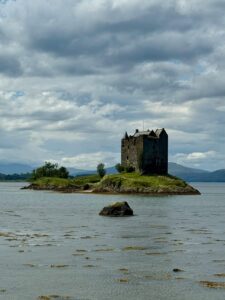
About 2,000 years after the first platform was laid down, during the Bronze Age, someone came back and added a second layer of brushwood and stone. Then, centuries later again, during the Iron Age, further layers were added. The site wasn’t a relic. It was a living place, returned to and rebuilt across thousands of years of Scottish prehistory. That’s longer than the gap between the Roman Empire and today.
We tend to think of ancient structures as frozen moments, a monument built, then abandoned, then discovered. Loch Bhorgastail suggests something different. The people who used this island across those three millennia weren’t preserving something old. They were using something that worked.
Scattered across the loch bed around the island, researchers found a significant number of Neolithic pottery fragments, some potentially carrying traces of organic residue. The residue points toward communal feasting, or ritual gatherings, or both. Somebody cooked there. Somebody ate. Whatever happened on that small platform in the middle of the water, it mattered enough to keep happening for thousands of years.
The Camera Trick That Changed Everything
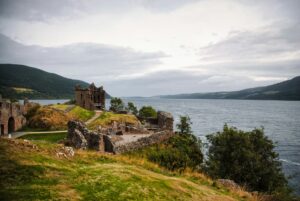
The fact that this crannog went unconfirmed for so long isn’t surprising, exactly. Shallow, murky freshwater lochs are notoriously difficult for standard underwater archaeology. The equipment that works well in clear ocean water, sonar imaging, and conventional photogrammetry, tends to produce blurry or incomplete results in the kind of brown, peaty water that fills Highland lochs. Previous surveys of sites like this had hit the same wall.
So the Southampton and Reading teams did something practical. They developed a new underwater photogrammetry technique using two small waterproof cameras mounted together to capture overlapping images, which were then processed into high-resolution 3D models of the loch bed. The cameras were small enough to work in shallow water. The overlapping images gave enough depth data to build a detailed picture of a site that had, until now, resisted being seen clearly.
That detail matters, and not just for this one loch. The same technique can now be applied to the hundreds of other crannogs that dot lochs across Scotland, many of which have never been properly examined. Smithsonian Magazine, reporting on the study, noted that Scotland contains a large number of crannog sites, most of them still holding whatever secrets their builders left behind. Loch Bhorgastail may be the most dramatic confirmation yet, but it is almost certainly not the last.
What the Pottery Changes

There’s a version of this story that focuses on the engineering, the scale of the platform, the layers of brushwork, and the long span of use. And that version is remarkable. But the pottery is what makes the place feel human.
A 75-foot wooden platform in the middle of a Scottish loch is impressive. Hundreds of pottery fragments, still faintly holding traces of whatever was cooked in them 5,000 years ago, are something else. You can look at a structural platform and admire the effort. You look at a broken pot with food residue on i,t and you think about the people. Who carried those pots out to the island? What were they cooking? Was it a celebration, a gathering of families, something more formal and ceremonial?
We don’t know. The record doesn’t go that far. But the fragments survived in the cold, dark water of the loch because the loch preserved them, and now they’re sitting in a laboratory at Southampton waiting to tell us more than they already have.
Scotland’s Hidden Archaeology

The Isle of Lewis is not an easy place to get to. It sits at the northwestern edge of the Outer Hebrides, roughly 200 miles from Glasgow, and its landscape, flat, treeless moorland, ancient stone and dark water, has a specific quality that makes things feel like they’ve been there forever. Loch Bhorgastail fits that landscape perfectly. The crannog looks like it belongs. That, in a way, is exactly what makes this discovery so striking.
How strange it is to remember now that what passed for an unremarkable island for generations was actually one of the older man-made structures in Northern Europe. And if one crannog in one loch on one island turns out to be 5,000 years old, how many others are out there, sitting in dark water, looking just like natural rock, waiting for someone with the right camera?
The answer, almost certainly, is more than anyone expects.
<h3>Sources</h3>
<ul class=”article-sources”>
<li><a href=”https://www.smithsonianmag.com/smart-news/this-island-in-scotland-is-actually-a-man-made-mini-landmass-resting-on-a-wooden-platform-new-discovery-shows-180988674/” rel=”noopener noreferrer”>Smithsonian Magazine, “This Island in Scotland Is Actually a Man-Made Mini-Landmass Resting on a Wooden Platform, New Discovery Shows”</a>, Primary news source for the May 2026 research findings</li>
<li><a href=”https://www.cambridge.org/core/journals/advances-in-archaeological-practice” rel=”noopener noreferrer”>Advances in Archaeological Practice (Cambridge University Press)</a>, Peer-reviewed journal where the original research was published</li>
</ul>
This article was researched, written, and edited by our human editorial team. AI tools were used in a limited research-assistant capacity. All claims were independently verified.