

In the ancient city of Jerash, Jordan, there is an abandoned hippodrome where chariot races once drew crowds from across the Byzantine world. The stone seats are still there. So are the dead.
A study published in early 2026 in the Journal of Archaeological Science confirmed that a mass grave discovered beneath that arena holds among the earliest biomolecularly verified victims of the Plague of Justinian, the outbreak that researchers at multiple institutions and other institutions now consider the world’s first recorded pandemic. For the first time, science has a confirmed address for where the plague announced itself in the archaeological record.
The Plague of Justinian swept through the Byzantine Empire between 541 and 750 CE, and is estimated to have killed up to 50 million people. That number is almost too large to hold. But the hippodrome at Jerash does something the written records cannot; it makes the dying specific.
What the Teeth Revealed
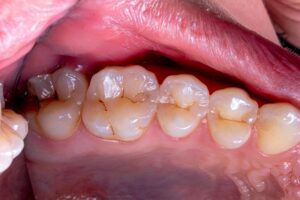
DNA extracted from the teeth of victims confirmed a single, uniform strain of Yersinia pestis, the same bacterium responsible for the Black Death that would devastate Europe seven centuries later. One strain. One outbreak. A community overwhelmed so fast that the old arena, long since emptied of its racing crowds, became the only space large enough to hold all the bodies.
Here’s what makes that detail strange. Oxygen isotope data from the same tooth enamel showed that these people did not all grow up in Jerash. Their bodies carried the chemical signatures of widely different childhood environments, which scientists can trace through the minerals that formed in their teeth during early life. Traders. Travelers. Pilgrims, maybe. People who had come from somewhere else entirely, drawn to a prosperous Byzantine city at the crossroads of the ancient world, and who never left.
The plague did not care where anyone was from.
A City Collapsing in Real Time
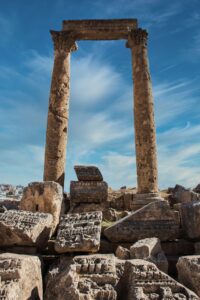
Mass graves from antiquity are not unusual. What is unusual is being able to confirm, through genetic and isotopic evidence together, exactly what killed a group of people and where those people came from. Jerash, ancient Gerasa, is among the first sites in the world where both of those things have been verified together for a Justinianic plague burial. It is, researchers say, an accidental snapshot of a city in the act of coming apart.
Anyone who lived through 2020 will recognize something in that image. The distinction between local and stranger collapses when there are too many dead and not enough days to bury them separately. Strangers get laid beside neighbors. The arena that once sorted people by status, patrician seats above, common crowds below, becomes, in the end, a common grave.
That resonance is not an accident of history. It is history’s most durable lesson: pandemics flatten the hierarchies that ordinary life maintains. The Byzantine traders buried at Jerash had no idea they were teaching us something. But the science extracted from their teeth, fifteen centuries later, confirms that they were.
Why This Matters Now
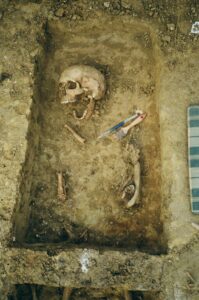
The Plague of Justinian has long lived in the shadow of the Black Death, which killed between 30 and 60 percent of Europe’s population in the 14th century. But the Justinianic outbreak was not a rehearsal. It was the original catastrophe, a pandemic that recurred in waves for roughly two hundred years, dismantling the eastern Roman Empire from within and reshaping the political geography of the medieval world.
Finding its ground zero matters because it gives researchers a biological baseline. The strain of Yersinia pestis at Jerash can now be compared against strains from later outbreaks, helping scientists trace how the bacterium evolved across centuries. That kind of longitudinal genetic record has real implications, not as a warning about the ancient world, but as a tool for understanding how plague-class pathogens change over time.
The hippodrome at Jerash was built for speed and spectacle. What it preserved, in the end, was something quieter. The specific, verifiable proof that a city once ended here, quickly, and that people came from far away to be part of it, whether they knew it or not.
How strange it is to remember, now, that we are not the first people to have lived through something like this.
This article was researched, written, and edited by our human editorial team. AI tools were used in a limited research-assistant capacity. All claims were independently verified.