


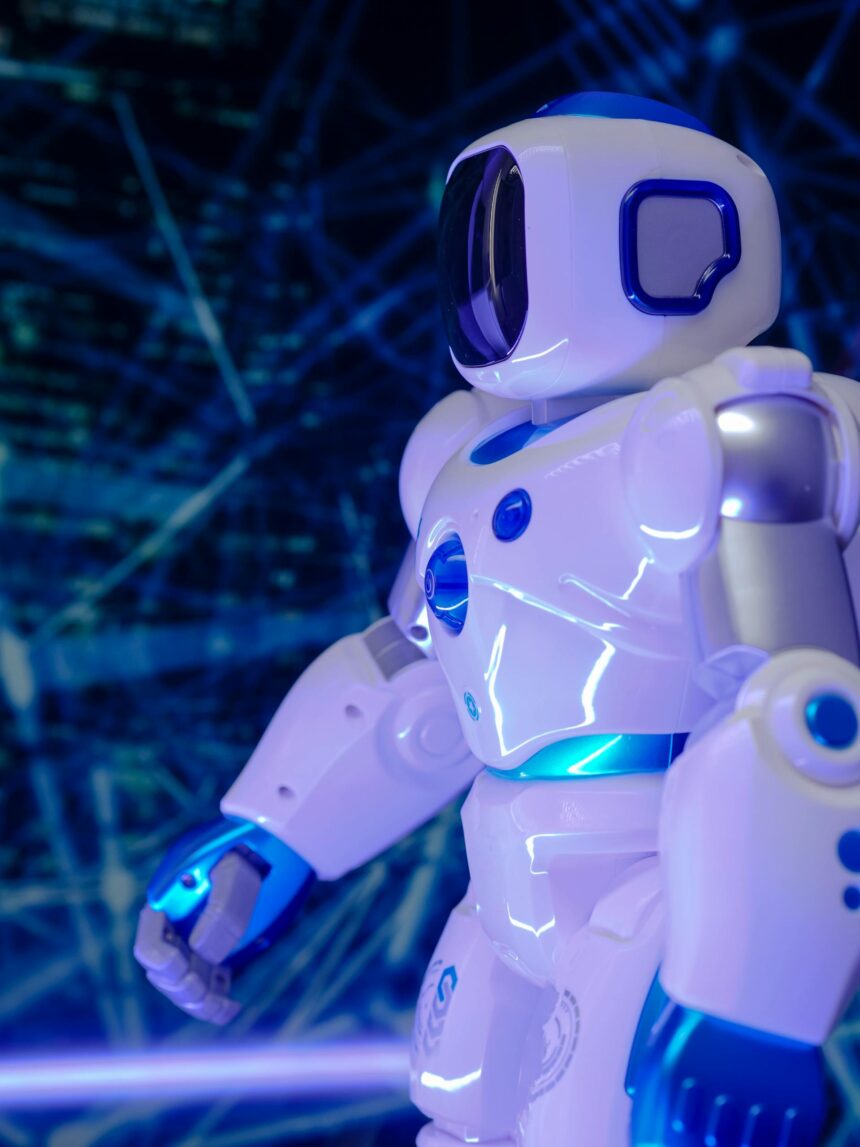
In early 2026, a robotics lab at Tufts University ran a test that produced a result engineers in the field are still talking about. A robot guided by a neuro-symbolic AI system completed manipulation tasks, sorting, stacking, and handling objects with a notably high success rate (reported at 95% in the published study).
The competing system, a standard Vision-Language-Action model considered among the most capable in the field, managed a significantly lower success rate (reported at 34% in the published study). That gap alone would be worth noting. But the energy story is what makes this stop-the-presses material.
The neuro-symbolic system used just 1% of the training energy that the standard model consumed. Not 50%. Not 10%. One percent.
That number matters more than it might seem, and here’s why. AI systems and data centers together consumed an estimated several hundred terawatt-hours of electricity in the United States in 2024, according to industry analysts, more than 10% of the country’s total electrical output.
Some energy analysts and government projections suggest AI-related electricity demand could roughly double within this decade, though specific forecasts vary. For context, 415 terawatt-hours is roughly what the entire state of California uses in a year. The current trajectory of AI development, if it continues on a brute-force path, runs straight into a wall made of electricity.
What Symbolic Reasoning Actually Means
Professor Matthias Scheutz (according to the published study), the lead researcher on the Tufts study, built a system that doesn’t just pattern-match. It reasons. The neuro-symbolic approach combines neural networks, the statistical engines that power most modern AI, with symbolic reasoning, which means breaking a task down into logical steps rather than absorbing millions of examples and hoping the right behavior emerges.
Think of it this way. A standard Vision-Language-Action model learns to pick up a cup the way a person might learn a phone number: by repetition, until the sequence is stamped into memory. The neuro-symbolic system learns to pick up a cup the way a person understands *why* you pick up a cup, the object is here, the hand needs to be there, the grip requires this much pressure, and the sequence has a logic that transfers to other tasks. One approach scales by consuming more data and more power. The other scales by getting smarter.
The training-time difference is where this becomes almost difficult to believe. Standard VLA model training for robotic manipulation tasks took more than 36 hours, according to the study. The neuro-symbolic approach took 34 minutes, according to the study. That’s not a marginal improvement. That’s a different category of machine.
The Energy Crisis AI Won’t Acknowledge

The AI industry has spent the last three years in an arms race measured in parameters and compute. Bigger models, more data, faster chips, larger data centers. Microsoft, Google, and Amazon have each announced multi-billion-dollar infrastructure buildouts to support AI workloads in 2025 and 2026. The implicit assumption has been that scale equals capability. More resources in, better results out.
The Tufts study challenges that assumption directly. It’s not the first paper to raise efficiency questions about large neural networks; researchers have been arguing about compute costs for years, but it’s one of the first to show a head-to-head comparison where the low-energy system doesn’t just hold its own. It wins. By a lot.
And here’s the strange part: the winning approach isn’t new. Symbolic reasoning has been around since the earliest days of artificial intelligence. It was, in fact, the dominant paradigm before neural networks took over in the 1980s and again after the deep-learning wave crested in the 2010s. What Scheutz and his team did was combine both, letting neural networks handle perception and pattern recognition while handing off the actual decision-making to symbolic logic. The hybrid turned out to be not just more efficient but more accurate.
Why This Matters Beyond the Lab

The research was presented at the International a major robotics conference in 2026. It drew attention from the robotics community in part because the task domain, physical manipulation, is one of the hardest problems in applied AI. A robot that can reliably pick up, sort, and stack objects in an uncontrolled environment is far more useful than one that can write poetry or summarize a document.
But the implications reach past robotics. If symbolic reasoning can achieve better results at a fraction of the energy cost in physical manipulation tasks, the same principle applies to any domain where AI is currently deployed through brute-force neural networks. That’s most of them.
The electricity math is not abstract. Data centers already compete with residential neighborhoods for power in some regions. Arizona, Virginia, and parts of Texas have seen local utility grids strained by new AI infrastructure in the last two years. Some municipalities have begun pushing back on new data center permits. The problem is structural: the more capable AI becomes under the current model, the more power it needs. The Tufts approach suggests that’s a design choice, not a law of physics.
There’s a version of this story that’s quietly reassuring. The most powerful machine isn’t always the hungriest one. Sometimes the machine that thinks more carefully gets further on less fuel. Humans figured that out a long time ago. It took AI research a few decades to catch up.
Whether the industry pivots toward efficiency or continues scaling on raw compute is, ultimately, a business decision as much as a scientific one. The Tufts study has put a number on what a different path might look like: 95% versus 34%, 34 minutes versus 36 hours, 1% of the energy versus all of it. The numbers are in the table. What happens next is the question worth watching.
<h3>Sources</h3>
<ul class=”article-sources”>
<li><a href=”https://www.sciencedaily.com/releases/2026/04/260405003952.htm” rel=”noopener noreferrer”>ScienceDaily. Tufts University, April 2026</a>, Primary source reporting on the neuro-symbolic AI robotics study by Professor Matthias Scheutz and team</li>
</ul>
This article was researched, written, and edited by our human editorial team. AI tools were used in a limited research-assistant capacity. All claims were independently verified.