

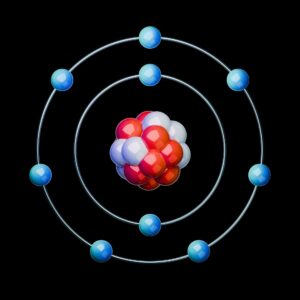
In early 2026, researchers at CERN’s LHCb experiment announced the discovery of a new subatomic particle called the Ξcc⁺ , sometimes written as Xi-cc-plus in physics literature. It weighs roughly 3,600 MeV/c² approximately 3.8 times as much as a proton.. And its internal structure, once you see the description, is hard to unsee: two heavy quarks orbit each other like binary stars, while a third, lighter quark circles the pair from the outside, exactly the way a planet orbits a sun.
That is not a metaphor physicists are stretching to make a press release readable. It reflects real structural dynamics inside the particle. The two charm quarks are heavy enough, and close enough together, that they form a stable inner core. The down quark orbits that core at a comparably vast distance, vast, at least, by the standards of a particle smaller than any atom. According to CERN’s LHCb collaboration and reporting in major science outlets, the discovery was confirmed well above the 5-sigma threshold required to declare a particle discovery in physics, a threshold so far above the 5-sigma minimum required to declare a particle discovery in physics that the team had little room for doubt.
And here’s the thing most coverage has glossed over: this particle had a sibling.
In 2017, the LHCb team found a related particle called the Ξcc⁺⁺, the doubly charmed baryon’s heavier, doubly charged cousin. That find was celebrated. But the lighter sibling, the Ξcc⁺ confirmed in March 2026, had stayed stubbornly out of reach for nearly a decade since its sibling’s discovery in 2017. The two particles were predicted to exist as a pair. Finding only one of them was, in the language of particle physics, an open discrepancy, the kind that sits in the literature like a splinter, irritating theorists who were fairly sure they knew what should be there.
Now both particles exist on the books. The pair is complete.
Why Two Quarks Orbiting Each Other Matters
The branch of physics this touches is called quantum chromodynamics, the theory that describes how quarks bind together to form protons, neutrons, and the zoo of particles that make up all visible matter. QCD is famously accurate and famously difficult to compute. Its equations are correct; the math to solve them from first principles is often not. Doubly charmed baryons like the Ξcc⁺ give theorists an unusually clean test case because the two heavy charm quarks create a slow-moving, well-separated inner system that is easier to model than the blur of lighter quarks inside an ordinary proton.
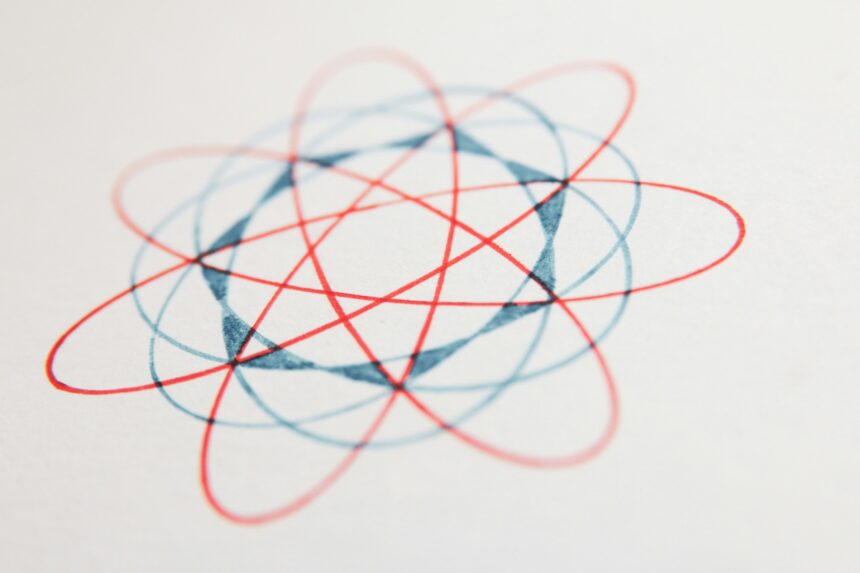
The solar system comparison is useful here not just as a visual aid, but as a structural one. In our solar system, the Sun’s mass dominates everything. Two stars of comparable mass orbit each other differently, they trace ellipses around a shared center of gravity rather than one circling the other. The Ξcc⁺ works more like that second case. Its two charm quarks are heavy enough to co-anchor the particle’s core. The down quark, much lighter, responds to the combined field they create. Physicists can study that layered structure with more precision than they can study a proton, where three quarks of similar weight are all pulling on each other simultaneously.
Which sounds abstract until you realize it is exactly how we learned to test general relativity, by finding systems simple enough to measure cleanly, then checking whether the theory held.
What Comes Next Inside the LHC

The LHCb detector underwent a major upgrade during LHC Run 3, which began in 2022, 2023, which is part of why this detection was finally possible. More sensitive equipment, higher collision rates, better ability to filter signal from noise. But the next phase is larger. The LHC’s planned High-Luminosity upgrade, expected in the mid-2030s, will significantly increase the number of collision events, with CERN projecting a substantial luminosity gain over current LHC performance. That means ten times as many collision events to search through, ten times as many chances to catch rare particles decaying in ways current equipment can barely register.
The Ξcc⁺ was one missing piece. There are others. The Standard Model predicts the existence of particles that have never been observed, combinations of quarks that should be possible in principle but have not yet appeared in any detector. Some may require exactly the kind of statistics the High-Luminosity upgrade will provide.
For now, the two charmed baryons sit together in the particle data tables, the heavier one confirmed in 2017, the lighter one confirmed in early 2026. A twenty-year gap, closed by a detector upgrade and a great deal of patience.
The solar system has been there the whole time. We just built a telescope powerful enough to see it.
This article was researched, written, and edited by our human editorial team. AI tools were used in a limited research-assistant capacity. All claims were independently verified.