

In early 2026, in a place where the temperature never rises above -52°C without any mechanical help, a group of scientists opened a library. No shelves. No books. Just 1.7 metric tons of ice, packed in insulated containers, carried 50 days by sea from Trieste, Italy, across the Mediterranean, the Atlantic, the Pacific, and the Southern Ocean to reach a snow cave at the bottom of the world.
The library, part of the Ice Memory project, is housed at a purpose-built sanctuary at Concordia Station. It sits at Concordia Station on the Antarctic plateau, at roughly 3,200 meters above sea level and about 1,000 kilometers from the nearest coastline. The cave itself was carved entirely from compacted snow 35 meters long, 5 meters high, and dug about 10 meters below the surface. There is no refrigeration system. Antarctica provides its own.
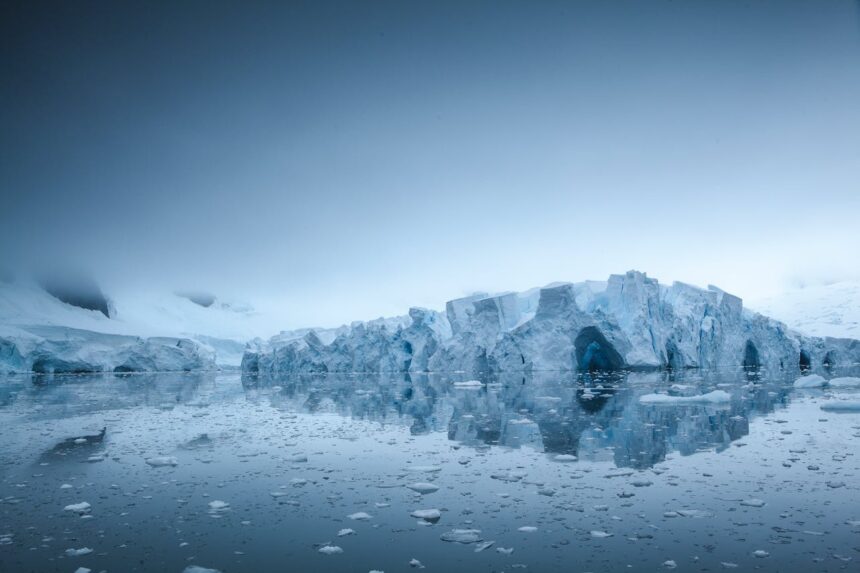
What the cave holds is not ordinary ice. It is ice pulled from some of the world’s most endangered glaciers cores extracted from Mont Blanc and the Grand Combin massif in the Alps, transported at a controlled -20°C for the entire sea voyage. Each core is a vertical record of the atmosphere above it: trapped air bubbles, dust particles, volcanic ash layers, and chemical signatures that accumulate over centuries, the way rings form in a tree trunk. They contain information about temperature, precipitation, pollution, and atmospheric composition going back hundreds, sometimes thousands, of years. And they are disappearing.
The Archive That Cannot Wait
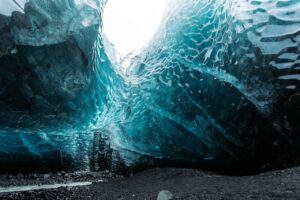
Since 2000, glaciers have lost significant portions of their ice depending on the region, with some mountain glaciers experiencing dramatic losses since 2000. That range sounds imprecise, but that’s the point: some mountain glaciers are in near-freefall. The Pamir glaciers in Central Asia. The tropical ice fields of the Andes. The high-altitude snowpacks of the Himalayas. Scientists have already identified a number of priority glacier sites worldwide as priorities for future ice core extraction. The problem is that extraction takes time, and the glaciers don’t wait.
Here’s the strange part. The data locked inside a melting glacier doesn’t degrade the way a paper document rots in a flood. It vanishes cleanly, completely. Once the ice melts and the meltwater runs into the sea, the atmospheric record it contained is simply gone. No reconstruction is possible. No partial recovery. The scientists racing to extract these cores are not preserving something fragile; they are performing a kind of rescue operation before the evidence is permanently erased.
This is why the Antarctic cave matters. Mountain glaciers in the Alps, the Andes, the Pamirs, and the Himalayas cannot be preserved where they stand. The temperatures at those elevations are rising too fast, and no local cold storage facility can replicate what Antarctica provides naturally. Concordia Station’s location on the East Antarctic plateau offers a stable, passive deep-freeze that scientists calculate will remain reliable for centuries, long enough for future researchers, using analytical tools that don’t yet exist, to extract information from these cores that today’s science cannot.
Tajikistan Sets a Precedent
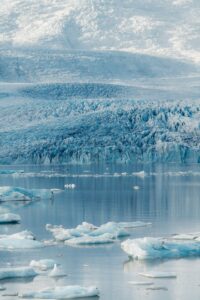
Among the nations to contribute a core to the sanctuary was Tajikistan. The donation: ice extracted from a glacier in the Pamir Mountains in the Pamir Mountains. One hundred and five meters of compressed atmospheric history, delivered to the bottom of the world to wait.
That detail matters diplomatically as much as scientifically. Ice core extraction requires access to sovereign territory. It requires cooperation between governments, universities, research agencies, and international logistics chains. Tajikistan’s decision to donate established something the Ice Memory Foundation is deliberately calling a precedent, a model it hopes other nations will follow as the project expands toward its identified target sites in the Andes, the Himalayas, and elsewhere. The sanctuary is designed not just as a scientific repository but as a framework for international climate cooperation, built around an object that is, by nature, fragile and irreplaceable.
The first cores arrived via the Italian icebreaker Laura Bassi. The crossing took 50 days. The ice was maintained at -20°C throughout, a logistical feat that required coordination across multiple shipping legs, customs inspections, and temperature monitoring systems with no room for failure. A single warm day in the wrong cargo hold would have destroyed records that took centuries to form.
What the Ice Actually Remembers
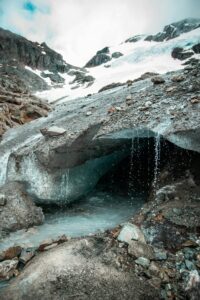
A well-preserved ice core is one of the more remarkable objects in science. At the surface level of a glacier, each year’s snowfall compresses the year below it. Dust blown in from distant deserts leaves a chemical fingerprint. Volcanic eruptions deposit sulfur layers that can be dated precisely. Industrial pollution shows up in the record starting around the mid-19th century, then accelerates sharply after 1945, a visible layer in the ice, the way a scar is visible in wood. Trapped air bubbles preserve actual samples of the atmosphere at the time of deposition. For climate scientists, these bubbles are the closest thing to a time machine available.
The ice cores from alpine and tropical glaciers are especially valuable because they cover time periods and geographic regions that the better-studied Antarctic and Greenland cores do not. A core from the Pamirs or the Andes captures climate signals from continental weather systems, monsoon cycles, and local human land use that polar ice cannot. Together, they build a global picture. Separately, each one is a data point that will be permanently lost if the glacier melts before the core is extracted.
The Ice Memory Foundation, a collaboration involving French, Italian, and Russian institutions, among others, launched the sanctuary project with that irreversibility in mind. The cave is not a temporary measure. It is meant to function as a permanent institution, a place where ice cores from around the world can be stored in stable conditions while the science of reading them continues to advance.
A Different Kind of Race Against Time
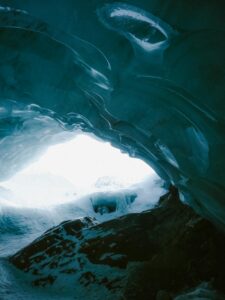
There is something worth sitting with in the logic of this project. The sanctuary preserves data that cannot yet be fully used. The analytical techniques that will eventually unlock the deepest information in these cores, isotopic ratios, microbial DNA sequences, and nano-particulate chemistry, are still being developed. Some of the researchers who will study these cores have not yet been born. The Ice Memory Foundation is not building an archive for today’s scientists. It is building one for scientists in 2075 or 2120, who will look back at a warming world and need to understand, in precise chemical detail, what the pre-industrial and early industrial atmosphere actually looked like.
That framing puts the project in unusual company. The Svalbard Global Seed Vault in Norway, which stores crop seeds against agricultural collapse, operates on a similar premise: preserve something irreplaceable now so that future generations have options. The Ice Memory Sanctuary is doing the same for atmospheric data. What the seed vault does for biodiversity, the Antarctic cave does for climate memory.
Tajikistan donated 105 meters of ice from a glacier most people have never heard of, and shipped it to a cave at the bottom of the world that almost no one will ever visit. The scientific community calls this an archive. It might be more accurate to call it a bet, a wager that someone, someday, will be glad this ice was saved.
<h3>Sources</h3>
<ul class=”article-sources”>
<li><a href=”https://phys.org/news/2026-01-sanctuary-antarctica-ice-samples-rapidly.html” rel=”noopener noreferrer”>Phys.org. Ice Memory Sanctuary inauguration, January 2026</a>, Primary news source for the sanctuary opening, shipment details, and Ice Memory Foundation background</li>
</ul>
This article was researched, written, and edited by our human editorial team. AI tools were used in a limited research-assistant capacity. All claims were independently verified.