

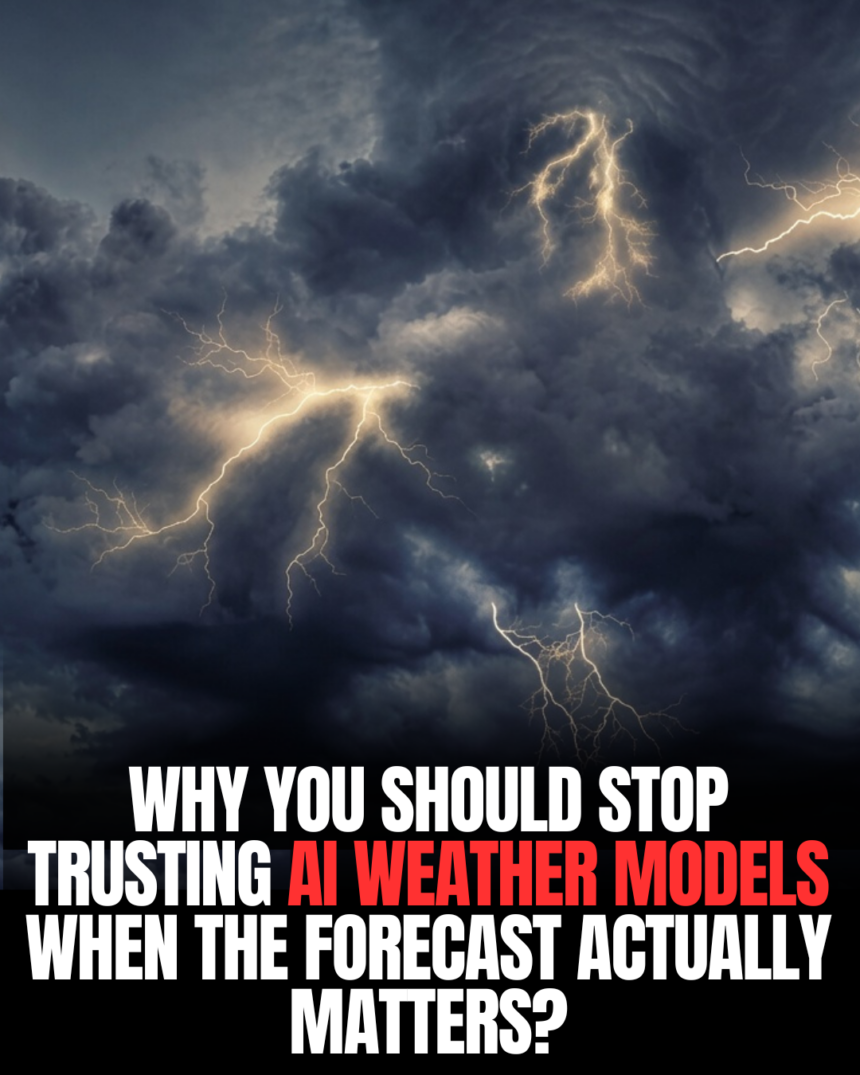
In early 2026, researchers at a European university published findings that should make anyone in emergency management uncomfortable. Their study, appearing in a peer-reviewed journal, tested the world’s leading AI weather models against thousands of real extreme weather events. The conclusion was precise and unsettling: AI is excellent at predicting ordinary weather. It struggles badly when the weather turns genuinely dangerous.
That distinction matters more than it might seem.
The 90% That Looks Like a Win
AI weather models, including GraphCast and Pangu Weather, have been hailed as a revolution in forecasting. The Geneva team confirmed part of that reputation. On the majority of routine weather metrics, AI outperforms traditional physics-based models. That’s a remarkable number. Meteorologists have spent decades refining numerical weather prediction systems, and these AI tools are beating them by a wide margin on most days.
Governments have noticed. Insurers have noticed. Some agencies have already started pulling back on human meteorologists in favor of automated AI pipelines. The cost savings are real. The efficiency is real. And for the roughly 90% of days when the weather is simply going to be warm, or rainy, or overcast, the AI does fine.
The problem is the other 10%.
Where the Models Break Down

The Geneva researchers tested AI systems against thousands of record-breaking events drawn from recent years of extreme weather data, extreme heat, deep cold, and severe windstorms. These weren’t garden-variety bad weather days. These were the events that triggered evacuation orders, overwhelmed hospitals, and showed up in insurance loss reports years later.
In those events, the AI models consistently underestimated both frequency and intensity. They saw the direction of the weather correctly, in many cases. But the magnitude, how hot, how cold, how fierce, fell short of what actually happened.
And here’s the part that makes this more than an academic concern: the performance gap was worse at shorter lead times. That means AI models struggled most when urgency was greatest. Not three days out, when there’s time to plan. In the final hours before an event hit, when emergency managers are deciding whether to open shelters and close roads, the AI was least reliable precisely when accuracy was most critical.
The study’s findings have been characterized as a cautionary signal against replacing traditional forecasting models with AI too quickly against replacing traditional forecasting models with AI too quickly. That phrase is doing a lot of work. A warning shot suggests something is coming. It suggests the people firing it know exactly what’s in the path.
Why AI Models Have This Particular Weakness

The explanation isn’t complicated, though it gets obscured in conversations about AI capability. These models were trained on historical weather data. They learned what typical weather looks like, the patterns, the progressions, and the averages. They became very good at predicting weather that resembles weather they’ve seen before.
Record-breaking events, by definition, don’t resemble what came before. A heat dome that pushes temperatures 15 degrees past any prior recorded high isn’t well-represented in the training data. A cold snap that breaks a century-old record is, almost by definition, outside the distribution the model learned from.
Traditional physics-based models don’t have this problem in the same way; they derive predictions from atmospheric dynamics and thermodynamics, not from pattern-matching against the past. When conditions go genuinely novel, the physics still applies. The pattern-matching fails.
Which sounds like a fixable problem. Train on more extreme events, add more data, tune the models. Maybe. But the harder version of this problem is that the most dangerous weather events are, almost by nature, rare. There isn’t that much training data for truly unprecedented events. That’s what unprecedented means.
The Replacement Risk
The Geneva findings land at a specific moment in how forecasting infrastructure is being rebuilt. AI weather tools have moved from research demonstrations to operational deployment faster than almost any comparable technology in the atmospheric sciences. GraphCast and Pangu-Weather aren’t academic experiments anymore; they’re being evaluated for potential use in, or in some cases piloted within, operational forecasting contexts.
The economic logic is obvious. AI forecasts are cheap to run. They scale. They don’t require the same institutional overhead as numerical weather prediction centers with supercomputers and large staffs. For budget-constrained national meteorological agencies, the case for AI is easy to make, especially when you can point to that 90% performance advantage on routine metrics.
But the 90% number is structurally misleading in one important sense. Weather forecasting isn’t valued equally across all days. The value of a forecast is heavily weighted toward the events that cause harm. A slightly imprecise prediction about tomorrow’s cloud cover costs almost nothing. A missed call on an extreme heat event that catches a city unprepared can cost lives and trigger disaster declarations. The 90% metric measures average performance. It doesn’t measure performance on the events that matter most.
That gap, between average accuracy and accuracy when stakes are highest, is what the Geneva study put numbers on. And the numbers aren’t small.
What Should Change

The study isn’t an argument against AI in weather forecasting. The researchers weren’t calling for a return to purely physics-based models. The 90% advantage on routine forecasts is real and worth keeping. AI tools offer genuine improvements in speed, coverage, and cost that matter for the majority of forecasting work.
The argument is narrower and more urgent: don’t dismantle the infrastructure that performs well on extreme events before you’ve solved the AI blind spot for those same events. Hybrid systems, AI handling routine forecasts, physics-based models maintained for high-impact scenarios, cost more than pure AI pipelines.
But the Geneva findings suggest the savings calculation currently being made by agencies and insurers is missing a term. The term is: what happens when the model fails on the storm that matters?
The researchers called it a warning shot. That framing implies the shot has already been fired. Whether anyone in the agencies making these decisions is listening is a different question, and one the study doesn’t answer.
This article was researched, written, and edited by our human editorial team. AI tools were used in a limited research-assistant capacity. All claims were independently verified.
Sources:
Should we trust AI to predict natural disasters?
Why I Don’t Trust LLMs to Decide When the Weather Changed