
On the Ides of March in 44 BC, a group of senators closed in on Julius Caesar thinking they were saving the Republic. In a matter of minutes, he was stabbed twenty-three times. History remembered the killing well enough. What it lost over the centuries was the precise location. For roughly 150 years of modern digging in Rome, the answer sat quietly beneath a structure the Romans themselves later used as a public toilet.
That’s not a metaphor. It’s either the most perfectly undignified footnote in Western civilization or a blunt reminder that ancient cities were living, messy places, not open-air museums.
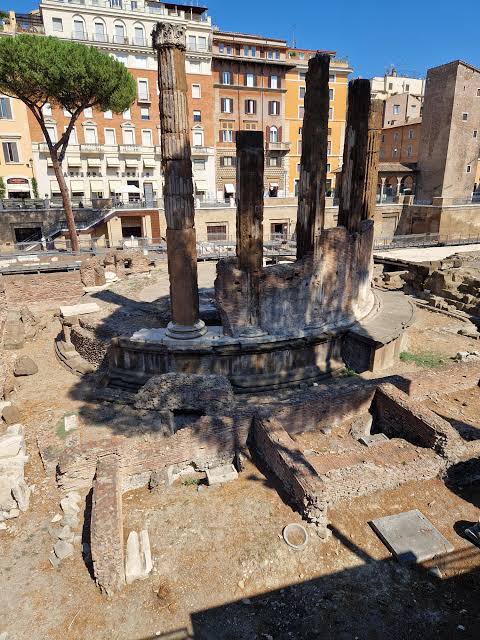
Researchers working at the Largo di Torre Argentina in central Rome have now put forward what they believe is the exact spot where Caesar fell. The area itself has been known and studied for decades. The breakthrough came from taking a fresh look at a plain concrete structure that earlier excavators had noticed, catalogued, and largely moved on from.
They had labeled it a later-period latrine. It turns out it was probably the base of the monument Augustus built to mark and seal the assassination site.
The Spot Beneath the Latrine
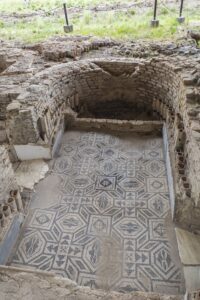
The Largo di Torre Argentina is one of those strange, sunken archaeological pockets in Rome. Several meters below street level, it feels less like a monument and more like an open wound in the city. You can look down from the surrounding sidewalks and see the remains of four Republican-era temples and the portico connected to Pompey’s theater complex.
It was in that portico, part of the Curia of Pompey, where Caesar met the Senate that morning. The assassins had chosen the spot deliberately. It offered privacy, away from the main crowds. This wasn’t a random street killing. It was planned.
After the murder, the spot was deliberately sealed off and memorialized. As Rome kept building and changing around it, the exact meaning of that patch of ground faded from everyday memory into abstract history. The sealing structure was later repurposed, covered, and eventually misidentified.
Why was the timeline huge

Two thousand years is a long time, sure. But the more interesting puzzle is why modern archaeologists, who have been actively working the site since the early 1900s, didn’t catch this sooner.
The truth is, archaeology moves slowly. Layers upon layers of history sit on top of one another in Rome. Republican foundations, imperial renovations, medieval reuse reading the stratigraphy right takes patience, meticulous records, and sometimes the courage to question old assumptions.
When the Largo di Torre Argentina was first properly excavated, the dramatic temples grabbed all the attention. They were visible, impressive, and easy to understand. The unremarkable concrete feature got logged as a “latrine,” filed away, and mostly ignored. It wasn’t hidden. It wasn’t suppressed.
It was simply mislabeled, and everyone after that accepted the earlier conclusion without much pushback. That’s how mistakes quietly survive in scholarship not through grand conspiracies, but through ordinary human inertia.
What the New Analysis Found
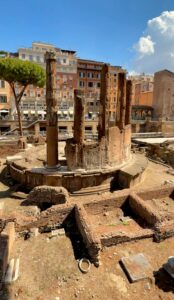
The new team built their case on the structure’s size, construction method, and exact position within the portico. A memorial platform meant to seal and mark such a politically charged spot would need to be deliberately placed and solidly built. A simple public toilet from a later era probably wouldn’t match those characteristics.
They also cross-checked the physical evidence against ancient written descriptions of the sealed area. The two line up convincingly. It’s not ironclad proof archaeology rarely is but it’s currently the strongest interpretation on the table.
What gets recorded, and why

There’s a quiet irony worth sitting with. The men who took power after Caesar chose to close the spot off rather than leave it open as a potential rallying point for grief or anger. They wanted control over what that place meant. Time did the rest. The memorial lost its original label and picked up the most mundane one possible: a bathroom.
For more than a century of modern study, one of history’s most famous political murders had its precise location effectively listed as a public toilet.
Excavations at Largo di Torre Argentina are still ongoing, and more work remains before everyone agrees this is definitive. Still, for anyone who has ever stood at the railing and stared down at those ruins, wondering exactly where it happened, the answer may have been right there in plain sight the whole time.
History has a funny way of keeping its best jokes buried in the most ordinary places.