
In the province of Badajoz, tucked away in a dry, unassuming corner of southwestern Spain known as Extremadura, the landscape feels like it’s been patiently waiting for someone to notice. The hills roll softly under a harsh sun. The scrub is thin and pale. The ground doesn’t give up its secrets easily. And for most of human history, it didn’t.
Then, early in 2026, a team of archaeologists from the University of Gothenburg’s Maritime Encounters program made a discovery near the town of Cabeza del Buey. They documented six previously unknown Bronze Age mining sites. It wasn’t just another find to add to the map. It quietly upended something we thought we already understood about the ancient world.
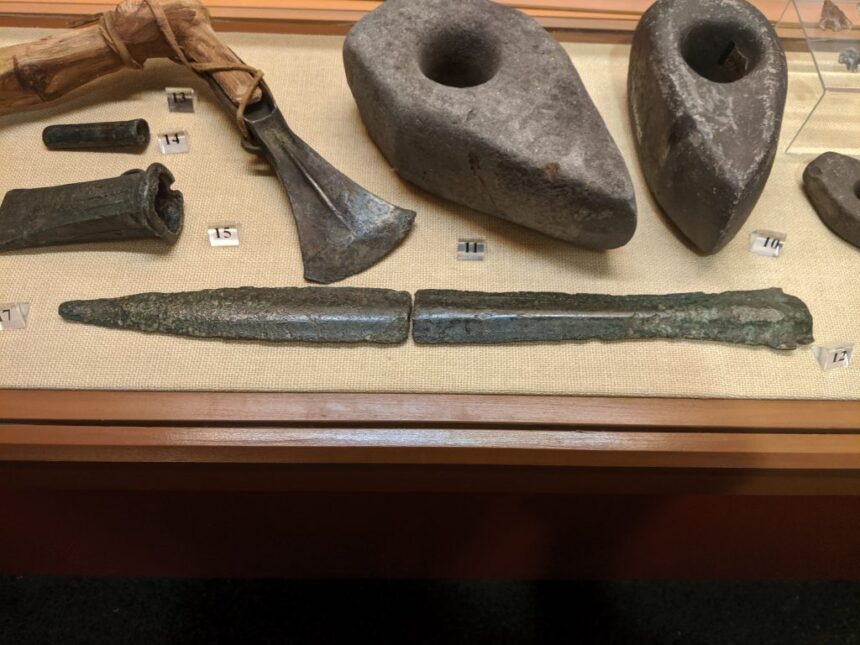
The bronze swords and axes we’ve long associated with the warriors of Scandinavia weren’t made from local metal at all. The ore that gave them their strength and shine came from these very hills in Spain—mines that had stayed hidden underground for roughly three thousand years.
The Ground Beneath Cabeza del Buey
Scientists had been circling this idea for a while, even before they found the physical evidence. Lead isotope analysis and other chemical tests on Bronze Age artifacts from Denmark, Sweden, and Norway kept pointing back to southwestern Iberia. The match was too exact to ignore, yet without actual mines to back it up, it stayed in the realm of strong suspicion.
Now that suspicion has a real address.
What they uncovered near Cabeza del Buey wasn’t small-scale digging. These were serious operations. In one site alone, the team pulled out dozens of heavy grooved stone axes, the kind used to crush ore. Eighty of them. That’s not a family workshop. That’s production on a scale that feels almost industrial for a time when the word didn’t even exist. The sites also showed evidence of copper, lead, and silver.
Professor Johan Ling, who heads the Maritime Encounters program, thinks these six spots are just the tip of the iceberg. He believes dozens, maybe even hundreds, of similar prehistoric mines could still be waiting across Extremadura and neighboring Andalusia. The dry hills, it turns out, are nowhere near done whispering their stories.
A Trade Network Older Than We Imagined
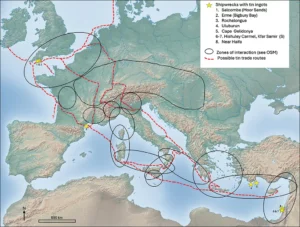
When you sit with what this actually means, it’s pretty staggering. Bronze Age Europe,e from around 3300 to 800 CE, wasn’t a bunch of isolated tribes scraping by in their own little corners. It was a connected world. People were moving raw materials across huge distances along the Atlantic coast in ways that still surprise us today.
Picture it: ore hacked out of a Spanish hillside, smelted, shaped into ingots, then carried probably by a series of boats and overland routes some 1,500 miles north. All that effort before it finally became a finished sword or axe in a Scandinavian workshop. Someone had to organize the mining, the smelting, the transport, the trade. Someone knew the routes and had the connections. And this was happening three thousand years before anyone was writing any of it down.
We usually think of the ancient world in terms of everything it didn’t have: ave no steel, no maps as we know them, no global economy. But the evidence from these mines shows something we often overlook: those people had a practical, working understanding of long-distance supply chains that stretched across a continent.
The metal didn’t stay Spanish. It traveled north through what we now call Portugal and France, feeding into Atlantic trading networks until it reached the hands of smiths who had never laid eyes on Iberia. Those craftsmen turned it into the beautiful weapons and tools we now admire in museums under labels like “Bronze Age Nordic.” The label tells part of the truth. It just leaves out the long journey that came before.
What the Swords Were Trying to Tell Us
There’s something quietly humbling about all this. The same people building Stonehenge, raising megaliths in Brittany, and paddling fragile boats along wild Atlantic coasts were tied together far more tightly than we once believed. Only now, through the silent testimony of ancient metal chemistry, are we finally hearing the full story. The ore didn’t lie. The swords always carried the memory of where they came from.
The chemical fingerprints had already traced the path. Finding the actual mines just confirms it beyond doubt. The Atlantic Bronze Age trade network wasn’t a vague possibility anymore nore, it’s real, and it was bigger than we thought.
And here’s the exciting part: Professor Ling’s estimate of up to 150 more undocumented mines in the region suggests this discovery is only the beginning. Somewhere under those same dry hills in Extremadura and Andalusia, more answers are still waiting. They’ve been there for three millennia. They can wait a little longer.
This piece of history didn’t just rewrite a few museum labels. It reminds us how much we still have to learn about the world our distant ancestors built one careful trade route, one loaded ship, and one hillside mine at a time.