

In May 2026, researchers published findings that quietly reclassified a stretch of southern Africa. published findings that quietly reclassified a stretch of southern Africa. What geologists had long written off as a dormant rift zone, a geological scar that went nowhere, turned out to be alive. Specifically, it was exhaling.
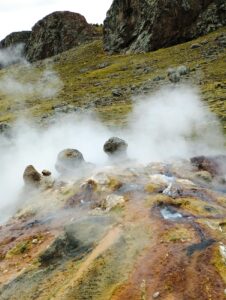
The study, published in 2026 in Frontiers in Earth Science, focused on the Kafue Rift in Zambia. The research team sampled gas from eight geothermal wells and hot springs. Six of those sites sat inside the rift. Two sat outside it. The difference in what came back from the lab drew a line that is hard to argue with: the six inside the rift showed helium isotope ratios consistent with direct mantle derivation, meaning the gas had traveled up from deep inside the Earth, through a crack in the crust, and straight to the surface. The two outside showed no such signature.
That might sound like a chemistry footnote. It isn’t.
What Helium From the Mantle Actually Tells Us
The Earth’s mantle sits roughly 18 to 35 miles below the surface under the continents, under enormous heat and pressure. For mantle-derived helium to reach a hot spring in Zambia, it needs a path. A continuous, open path. The fact that it found one, confirmed now in a peer-reviewed study, means the crust in this region isn’t just cracked. It’s actively separating.
The study’s lead researcher at the University of Oxford led the research. Ann independent researcher who reviewed the findings, who was not part of the study team, reviewed the findings and called them “a strong confirmation of direct mantle-to-surface fluid flow through a newly forming rift zone.” That phrase, newly forming, is the one worth sitting with. Not a rift that formed. A rift that is forming. Present tense.
The Kafue Rift is part of a larger geological structure called the broader rift system in southern Africa (sometimes referred to in the literature as the East African Rift’s southwestern branch), a zone running through eastern and southern Africa, from Tanzania in the northeast down through Zambia and into southern Africa. It has been observed and mapped for decades. What it hadn’t produced until now was geochemical evidence that the mantle was actively involved, the specific confirmation that separates a passive geological feature from one with somewhere to go.
The Slow Physics of a Continent Coming Apart
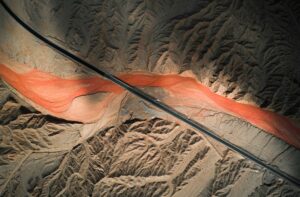
Here’s the strange part: this process is so gradual that no human alive today will see its end result. Continental rifting operates on timescales that make civilizations look like a blink. The East African Rift, the more famous cousin of the Southwest African Rift System, has been pulling apart for around 25 to 30 million years. The eventual result, tens of millions of years from now, would be a new ocean forming between the fragments of what is now a single continent.
That’s not speculation. It’s geology. The same process that once separated South America from Africa, opening the South Atlantic, began with rifts that looked, at their earliest stages, something like this.
The mechanism works in steps. First, heat from the mantle weakens the crust from below. Then the crust thins and begins to stretch. Hot springs and volcanic activity appear along fault lines. Eventually, given enough time and continued stress, the crust breaks entirely and the sea floods in. The Red Sea is a rift that has already reached that stage. The Gulf of Aden is another. Both began as dry continental cracks.
The Kafue Rift has not reached that stage. Not remotely. But the Oxford study’s finding matters because it confirms the process has started, that the mantle is already in contact with the surface through this crack, which is the necessary condition for everything that follows.
Why Geologists Had Written This Rift Off
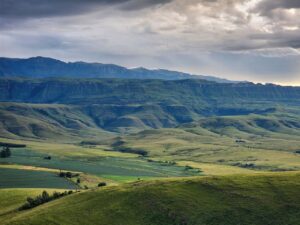
For most of the 20th century, the Southwest African Rift System received less attention than the East African Rift, which runs through Ethiopia, Kenya, and Tanzania and shows far more surface drama: active volcanoes, dramatic escarpments, the kind of visible geology that draws funding and headlines. The southwestern branch looked quieter. Slower. Less active.
That quietness, it turns out, was partly a measurement problem. Helium isotope analysis, the technique at the heart of the Oxford study, requires sampling geothermal fluids directly and running precise geochemical tests. It’s not the kind of work done by satellite or from a distance. Getting to Zambia’s geothermal wells, pulling gas samples from eight sites, and running the isotope analysis takes resources and focus that weren’t historically directed at this region.
The result was a decades-long gap in the evidence. And in the absence of evidence, the assumption held: this rift is probably inactive. The new paper doesn’t just challenge that assumption. It replaces it with data.
A New Ocean, Eventually
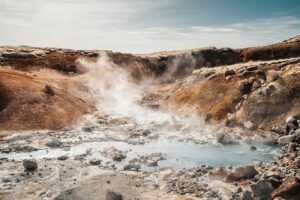
None of this changes anything about the ground beneath Zambia in any human-relevant timeframe. The rift is widening, but it widens by millimeters per year, the same pace at which fingernails grow, roughly. The hot springs that provided the evidence are not about to become anything more dramatic than hot springs.
But the finding shifts how geologists will map this region going forward. If the mantle is confirmed to be actively driving this rift zone, it changes the priority placed on monitoring seismic activity along the 2,500-kilometer belt, the interpretation of volcanic features in the area, and the longer-term models of how southern Africa’s geology will evolve. It also, in a quieter way, confirms something that geology has always argued: the continents are not finished moving.
Africa was once part of the supercontinent Gondwana. It separated from South America roughly 130 to 140 million years ago, and from Antarctica somewhat earlier. The South Atlantic Ocean is the result. The process that Oxford’s team just found evidence for in Zambia is, in geological terms, the same category of event. The same physics. Just earlier in the sequence.
The ocean that might eventually form along the Southwest African Rift System has no name yet. It may not exist for 50 million years. But somewhere along a 2,500-kilometer line from Tanzania to Namibia, in hot springs that smell of sulfur and bubble quietly through the scrubland, the Earth is doing what it has always done.
It’s pulling itself apart. Slowly. Deliberately. One millimeter at a time.
<h3>Sources</h3>
<ul class=”article-sources”>
<li><a href=”https://phys.org/news/2026-05-tectonic-plate-boundary-zambia-scientists.html” rel=”noopener noreferrer”>Phys.org. Tectonic plate boundary, Zambia, scientists (May 2026)</a>, Primary news report on the Frontiers in Earth Science study; source for study date, researchers, and key findings</li>
</ul>
This article was researched, written, and edited by our human editorial team. AI tools were used in a limited research-assistant capacity. All claims were independently verified.