


In April 2026, researchers at a Japanese university fired a beam of positronium through sheets of graphene and watched it do something no one had ever seen antimatter do. It produced a diffraction pattern. Bands of light and dark, arriving at a detector in exactly the arrangement that wave physics predicts.
The same signature Richard Feynman once called the central mystery of quantum mechanics. Coming from ordinary matter, a result like that would be interesting. Coming from antimatter, it changes what experiments are even possible.
That matters more than it might sound. Because sitting underneath this result, patient and unresolved for decades, is one of the biggest gaps in all of physics: we still do not know whether gravity pulls on antimatter the same way it pulls on everything else.
What Positronium Actually Is
Positronium is not an atom in the usual sense. There is no nucleus, no proton, no neutron at its center. Instead, it is two particles locked in a brief, doomed orbit — an electron and a positron, which is simply an electron with the opposite electric charge. They are mirror images of each other, equal in mass, opposite in charge, and when they finally meet, they annihilate completely, converting their combined mass into a burst of gamma rays.
That annihilation happens fast. Positronium survives for less than a microsecond. In some configurations, it lasts a few hundred nanoseconds. In others, under two nanoseconds. Either way, it is not the kind of thing you get to study at leisure. Every experiment with positronium is, in a sense, a race against its own self-destruction.
That fragility is why the Tokyo result is difficult to appreciate without knowing what it took to produce it. To observe a diffraction pattern, you need a beam of particles that travels far enough and with enough coherence to show wave behavior.
Positronium, which exists for less time than it takes light to cross a room, is not an obvious candidate. And graphene, a sheet of carbon just one atom thick, is not a conventional diffraction grating. The researchers had to work at the edge of what the materials and the timing allow.
The Double-Slit Experiment, With Higher Stakes
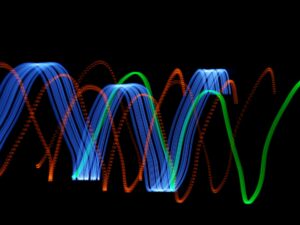
Most people who took a physics class at some point encountered the double-slit experiment. Fire particles at a barrier with two narrow gaps, and instead of two bands of impact on the wall behind it, you get a pattern of many bands, an interference pattern that only makes sense if the particle is also, simultaneously, a wave. The experiment works for photons, for electrons, for atoms. It is one of the foundational confirmations that quantum mechanics is real and not just a mathematical convenience.
The Tokyo team’s graphene diffraction produced the same signature. And here’s the thing that makes it significant: positronium is made half of antimatter. The positron in that orbiting pair is the electron’s antimatter partner. When the team saw wave behavior from positronium, they were seeing quantum mechanics operate on an object that is, by composition, partly from the other side of the matter-antimatter divide. That is a first.
Physics has long assumed that antimatter obeys the same quantum rules as ordinary matter. The theoretical framework says it must. But assumption and measurement are two different things, and in fundamental physics,s the distance between them has occasionally turned out to be very large.
The Gravity Question

The deeper implication of the Tokyo result sits at the intersection of quantum mechanics and general relativity, two theories that describe the universe at different scales and that have never been fully reconciled with each other.
General relativity describes gravity. Quantum mechanics describes the behavior of particles. Both work extraordinarily well within their own domains. But they do not fit together cleanly, and physicists have been looking for cracks at the seam for most of the past century.
One of those cracks is antimatter. The standard model of physics predicts that antimatter should respond to gravity exactly as ordinary matter does. It should fall down. The universe, by that account, is symmetric in this respect: a positron dropped from a height would fall toward the floor just like an electron would.
But this has never been directly confirmed. The measurement is genuinely hard to make because antimatter is difficult to produce, difficult to contain, and tends to annihilate on contact with the ordinary matter that makes up every container you might use to hold it.
Positronium is harder to work with than most. Its lifespan rules out many of the techniques used to trap and measure other antimatter particles. But the Tokyo team’s result suggests a path. If positronium can be made to behave as a quantum wave, if its properties can be measured with enough precision, then it becomes possible, in principle, to ask how gravity influences that wave behavior.
A particle falling under gravity should accumulate phase, a subtle shift in its wave function that an interferometer can detect. For ordinary matter, this kind of gravitational phase measurement has been done. For antimatter, it has not.
That is the door the April 2026 result opens. Not a measurement of antimatter gravity, not yet, but evidence that positronium is controllable enough, wave-coherent enough, to make such a measurement imaginable.
Why the Answer Isn’t Obvious
The assumption that antimatter falls down is well-founded. CPT symmetry, a deep principle of physics holding that the laws of nature look the same if you flip charge, parity, and time simultaneously, strongly implies that antimatter and matter should respond identically to gravity. Violating CPT would be a major discovery on its own terms.
But some theoretical frameworks do allow for small differences. And some physicists have pointed out that if antimatter were gravitationally repelled by ordinary matter, if it fell up, it would offer a potential explanation for why the observable universe is made almost entirely of matter rather than a roughly equal mix of both. The Big Bang, by current theory, should have produced matter and antimatter in equal amounts. Almost all the antimatter is gone. Where it went is one of the genuine open questions of cosmology.
The Tokyo result does not answer that question. It is not designed to. What it does is establish, for the first time, that the quantum wave properties of positronium are measurable, that this brief, self-destructing hybrid of matter and antimatter can be coaxed into producing the kind of interference pattern that precision experiments require. That is a technical achievement with a long theoretical shadow.
Most breakthroughs in fundamental physics arrive not as single definitive answers but as new capabilities. A new tool. A new method. A new confirmation that something thought too fragile to measure can, in fact, be measured. The positronium diffraction result is that kind of advance, the moment when a question that was previously unanswerable moves into the category of questions worth trying to answer.
Whether gravity treats antimatter differently from ordinary matter is a question that has been sitting in the physics literature for decades, generating theoretical papers and experimental proposal,s and not much in the way of data. The team at Tokyo University of Science just handed the next generation of researchers something they did not have before: a reason to believe the data might be coming.
This article was researched, written, and edited by our human editorial team. AI tools were used in a limited research-assistant capacity. All claims were independently verified.