


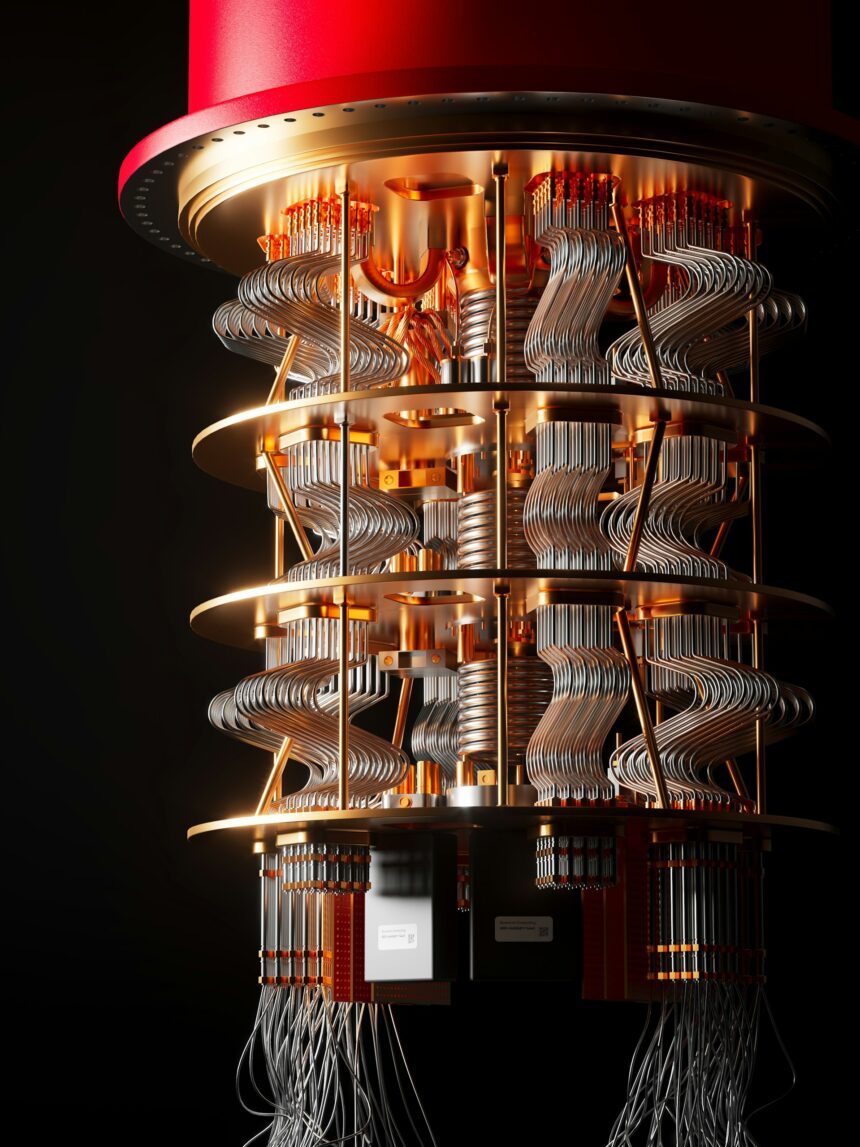
In December 1947, three physicists at Bell Labs held a small piece of germanium with two gold contacts pressed into it and watched it amplify an electrical signal. The transistor worked. Nobody in that room knew it would eventually replace every vacuum tube on the planet, shrink a computer from the size of a gymnasium to the size of a fingernail, and make the modern world possible. They just knew it worked.
A paper published in the journal Science in early 2026 argues that quantum computing is now standing in that exact spot.
The paper, co-authored by researchers from the University of Chicago, MIT, Stanford, and several European institutions, reviewed the state of six distinct quantum hardware platforms: superconducting qubits, trapped ions, spin defects, semiconductor quantum dots, neutral atoms, and optical photonic qubits. Each works. Each has demonstrated what researchers call “quantum advantage” — the ability to solve specific problems faster than any classical computer could. What none of them has done yet is scale.
That’s the transistor problem. And here’s the thing: the transistor problem wasn’t a science problem. It was an engineering and coordination problem. The physics was solved in 1947. The civilization-changing part took twenty more years of manufacturing, standardization, and industrial investment to arrive.
Six Platforms, One Crossroads
The Science paper doesn’t crown a winner among those six hardware approaches. That’s a deliberate choice, not an oversight. Each platform has genuine strengths. Superconducting qubits, the approach favored by IBM and Google, operate at near absolute zero and can be manufactured using modified semiconductor techniques. Trapped ions are slower but hold quantum states longer. Neutral atoms have shown promise for error correction. Optical photonic qubits can operate at room temperature, which would eliminate one of the field’s most persistent engineering headaches.
The honest read is that nobody knows yet which platform will become the silicon of quantum computing. In 1947, germanium was the transistor material of choice. Silicon won later, for reasons that had as much to do with manufacturing economics as physics.
The Wiring Problem Gets Solved

One of the clearest signs that the field is moving from lab demonstration to engineering problem: Fermilab and MIT Lincoln Laboratory announced that they had successfully controlled ion-trap qubits using in-vacuum cryoelectronics. That may sound like jargon, but the implication is concrete. Current quantum computers require a rats’ nest of cables running from cryogenic chambers — operating near absolute zero, to room-temperature control electronics outside. As you add qubits, you add cables. The system becomes unscalable fast. The Fermilab-MIT approach moves the control electronics inside the vacuum chamber itself, operating at cryogenic temperatures. Fewer cables. Cleaner signals. A path toward machines with thousands or millions of qubits instead of hundreds.
That’s an engineering breakthrough of the kind that doesn’t make headlines the way a new speed record does. But it’s the kind of breakthrough that makes speed records possible.
The Market Has Already Decided Something
The global quantum computing market has grown substantially, with some analyst projections placing it in the multi-billion-dollar range. The United Nations designated 2026 the International Year of Quantum Science and Technology. These are not scientific milestones. They’re coordination signals, the kind of institutional momentum that tells engineers, investors, and governments which direction to run.
The most concrete evidence of that shift: Microsoft and startup Atom Computing plan to deliver an error-corrected quantum computer to the Export and Investment Fund of Denmark and the Novo Nordisk Foundation in 2026, the first commercial deployment of a so-called level-two quantum system. A working, error-corrected quantum computer, outside a lab, in the hands of an end user. That’s not a demonstration. That’s a product.
What the Transistor Analogy Actually Means
The transistor analogy is useful precisely because most people know how that story ended. What they tend to forget is how long the middle part took and how uncertain it looked at the time. In 1955, eight years after the Bell Labs demonstration, computing was still the province of governments and universities. The integrated circuit wouldn’t arrive until 1958. The personal computer was three decades away.
The researchers aren’t claiming quantum computers will follow the same timeline. They’re claiming the phase has changed. The question is no longer whether quantum systems work. It’s whether the industrial and institutional machinery can be built around them fast enough to matter.
The transistor didn’t change the world the day it worked. It changed the world the day someone figured out how to make a million of them cheaply.
That problem is now on the table.
This article was researched, written, and edited by our human editorial team. AI tools were used in a limited research-assistant capacity. All claims were independently verified.