

In 2016, a star thousands of light-years away started blinking. Not in any regular pattern. Just irregular dips in brightness, three of them over several years, so that didn’t match anything well understood. By around 2021, the star, catalogued as Gaia20ehk and located near the constellation Puppis, had become infrared-bright in a way that visible light simply couldn’t explain.
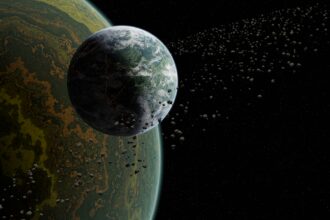
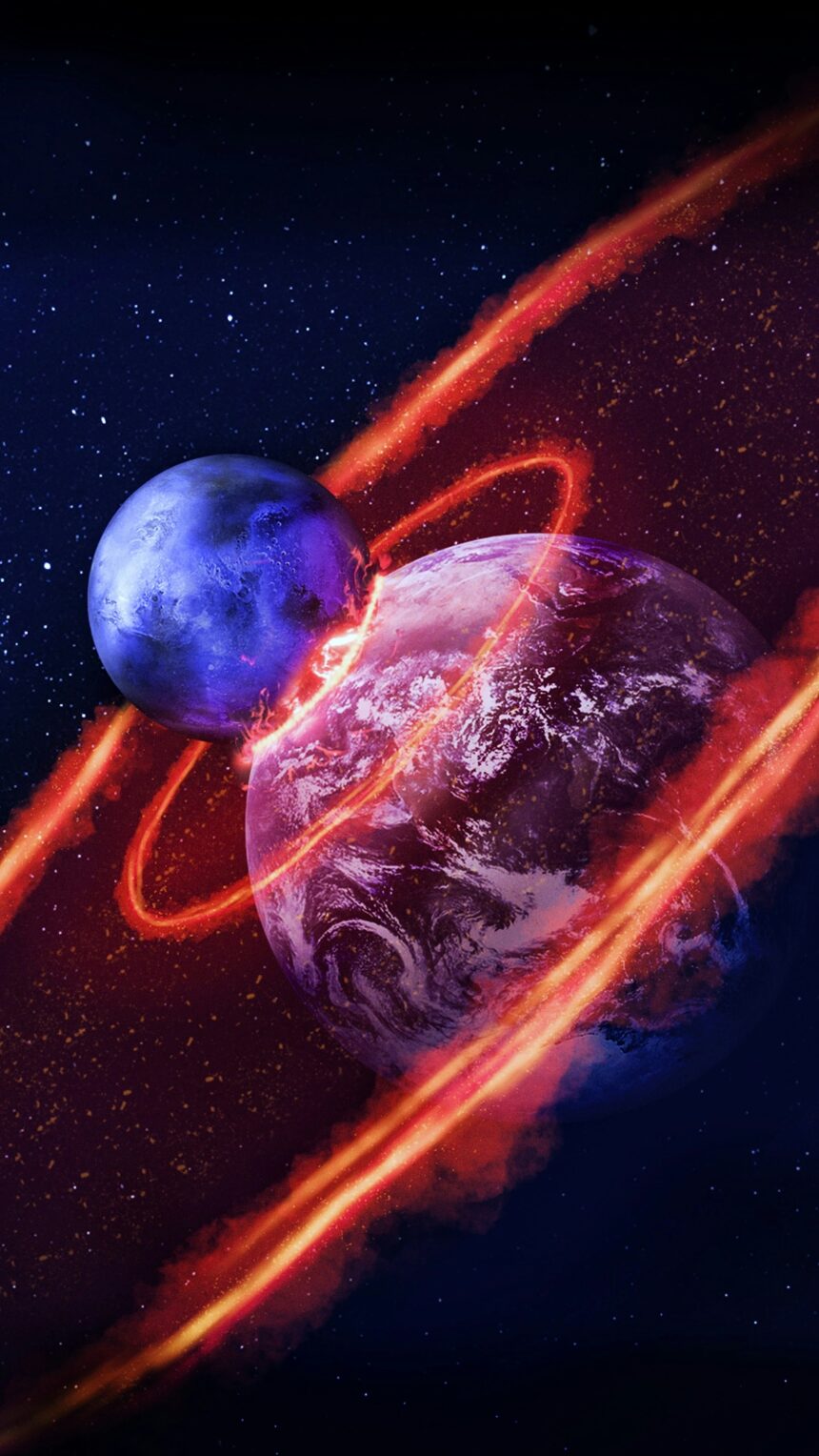
Astronomers at the University of Washington eventually pieced together what happened: two planets had collided. Not drifted apart, not dimmed from a passing cloud. Smashed into each other at a scale that generated a debris field still radiating heat years later.
Their findings appeared in early 2026 in The Astrophysical Journal Letters.
What the Light Was Actually Saying
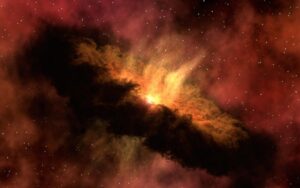
The signature was specific. As visible light from the star dimmed, infrared brightness spiked, the classic pattern of extremely hot debris absorbing and re-emitting energy. The dust temperature in the collision cloud was estimated at hundreds of Kelvin. The debris cloud orbits Gaia20ehk at a distance comparable to Earth’s distance from the Sun, the same distance Earth sits from the Sun. And it has stayed infrared-bright for several years.
Four years of glowing aftermath. That’s not a flicker. That’s a catastrophe on a timescale humans can actually watch.
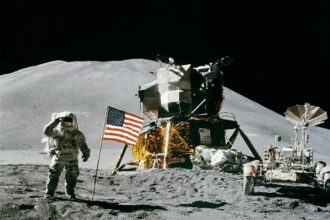
Lead author Anastasios Tzanidakis of the University of Washington noted that the event resembles the impact thought to have formed Earth’s Moon roughly 4.5 billion years ago. The working model for that ancient collision, sometimes called the giant impact hypothesis, involves a Mars-sized body striking the early Earth, throwing enough material into orbit to eventually coalesce into the Moon. What Gaia20ehk appears to show is something in the same category: two rocky worlds, meeting at speed, generating heat and debris that lingers long after the moment of impact.
And here’s the strange part. The three earlier brightness dips, going back to 2016, may have been the precursor, gravitational interactions pulling the planets toward each other before the final collision. Astronomers are still working through that interpretation, but the sequence of events is consistent with a slow-motion gravitational tragedy playing out over years.
Why This One Is Rare
Planetary collisions are thought to be common in the early life of solar systems. The math of planet formation almost requires them: too many bodies in too small a space, too much gravitational chaos, too many close encounters. But catching one in progress, with enough data to actually reconstruct what happened, is something else entirely.
Most of what astronomers know about planetary collisions comes from the aftermath. The Moon itself is an aftermath. The tilt of Uranus, likely the result of a massive ancient impact, is the aftermath. The heavily cratered face of Mercury is the aftermath. Gaia20ehk is one of only a handful of events where astronomers have watched the evidence accumulate in something close to real time.
The debris field won’t last forever. Dust disperses. Heat fades. In a few thousand years, Gaia20ehk will probably look, from a distance, like an unremarkable star with a slightly unusual history, the same way our own Sun looks to anyone who doesn’t know what happened here 4.5 billion years ago.
What It Means for Here
That’s the part worth sitting with. The violence that made Earth habitable, the collision that produced the Moon, which stabilizes Earth’s axial tilt, which makes the seasons regular enough for life to persist, was not a gentle process. It was a planetary demolition. Two worlds ended so that one could survive in something like its current form.
Gaia20ehk, 11,000 light-years away, near a constellation most people have never looked up to find, may be doing exactly that right now. Whether anything survives in that system long enough to matter is a question that won’t be answered for longer than human civilization has existed.
The debris cloud is still glowing at 900 Kelvin. The evidence keeps accumulating. Whether what forms from it resembles anything like what formed from ours is the question that makes the data worth watching.
This article was researched, written, and edited by our human editorial team. AI tools were used in a limited research-assistant capacity. All claims were independently verified.