

There are fishing nets that have pulled up mammoth teeth from the floor of the North Sea for over a century. Trawlermen kept finding them. Mostly they tossed them back. Nobody thought much about what that meant — that somewhere beneath the cold grey water between England and the Netherlands, an entire world had gone under.
That world has a name. Doggerland. For most of the twentieth century, archaeologists treated it as a footnote: a low, marshy corridor that Mesolithic people crossed to reach Britain before the sea swallowed it, roughly 8,000 years ago. A land bridge. Useful, then gone. Not worth mourning.
A study published in early 2026 in a peer-reviewed scientific journal suggests that picture was almost entirely wrong.
What the Seabed Actually Remembered
Researchers from a UK university analyzed hundreds of sedimentary DNA samples pulled from dozens of marine cores drilled along what was once the Southern River — a waterway that ran through the southern part of Doggerland that ran through the southern part of Doggerland. The DNA they found didn’t belong to a bleak marshland. It belonged to a forest.
Oak. Elm. Hazel. These were temperate woodlands, and the evidence suggests they were growing there thousands of years earlier than scientists previously believed plant life of this kind could have established itself in northwest Europe, thousands of years earlier than scientists previously believed plant life of this kind could have established itself in northwest Europe.
And here’s the part that stopped researchers short: among the DNA signatures was Pterocarya, a tree related to the walnut family, thought to have disappeared from northwest Europe around 400,000 years ago. It was still there. Hiding in pockets of sheltered ground, surviving in what scientists call isolated refugia, long after everyone assumed it had vanished for good.
That single finding quietly upends the story of how life recovered in this part of the world after the last ice age.
A World That Survived Longer Than Anyone Thought
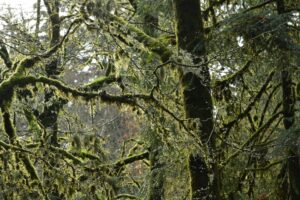
Moving through those forests, if you could have stood there, say, 10,000 years ago, you would not have been alone. The animal DNA pulled from the same cores included large mammals including wild boar, deer, and other species consistent with Mesolithic European fauna, the massive wild cattle that appear in cave paintings across Europe and went extinct in the 17th century. This was not a marginal, barely-habitable strip of land. It was a functioning ecosystem, rich enough to support Mesolithic hunter-gatherers over many generations.
We tend to think of those early people as migrants passing through. What the DNA record suggests is something quieter and more significant: that Doggerland may have been where they lived, where they raised children, where they buried their dead. The ancestors of the first Britons might not have crossed Doggerland. They might have come from it.
Then, around 8,150 years ago, a massive underwater landslide off the coast of Norway triggered what geologists call the Storegga tsunami. The wave that reached Doggerland would have been catastrophic. But parts of the landmass survived even that. The study suggests some portions of Doggerland remained above water until several thousand years after the Storegga tsunami, meaning people may have lived there for thousands of years after the wave, on a shrinking island that the sea was slowly reclaiming.
What the Fishing Nets Were Telling Us
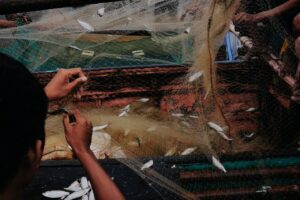
How strange it is to think that the trawlermen were right all along. The mammoth bones they pulled up weren’t curiosities. They were postcards from a drowned country.
The implications here run deeper than archaeology. If Doggerland was genuinely a forested heartland, sheltered, fertile, ecologically complex, then the people who lived there carried a cultural memory of a homeland that no longer exists. When the sea finally took it, they moved to higher ground. Some of them, presumably, ended up in Britain.
The DNA under the North Sea doesn’t just tell us about trees and animals. It tells us that British prehistory begins somewhere we can no longer visit, somewhere cold and grey and 100 feet underwater, where oak trees once grew and aurochs drank from a river that has no name on any map.
The mammoth teeth the fishermen kept finding were not the strange part. The strange part is that it took this long to listen.
This article was researched, written, and edited by our human editorial team. AI tools were used in a limited research-assistant capacity. All claims were independently verified.