



There was a time in America when a man could work a full week in a coal mine, hand over his labor to a company worth millions, and receive in return not a single dollar he could spend anywhere he chose. He’d get scrip a paper or metal token printed by the company, redeemable only at the company store, at prices the company set often reported by historians as substantially above what workers could find elsewhere, though markups varied widely by company and era. It was legal. It was widespread. And in some industries, it lasted well into the 20th century.
The practice had a name: the truck system. And the companies that used it weren’t fringe operations. They were foundational American industries: coal, steel, lumber, textiles, operating in the open, often with the quiet approval of state governments that depended on their tax revenue. Understanding how it worked, and how long it lasted, says something uncomfortable about the distance between labor and power in this country.
The Mechanics of a Closed Economy

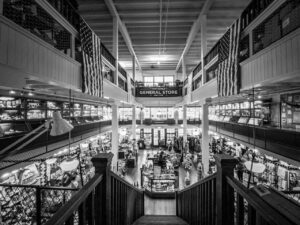
The basic structure was simple. A company would establish a town, housing, a general store, a church, sometimes a school, and pay workers in currency that only worked inside that town. The company store (often called the “pluck me” by workers who understood the arrangement clearly) sold food, clothing, tools, and household goods at markups that could run significantly higher than outside market prices. Workers who tried to leave before settling their debts, often accrued through rent, equipment fees, and store credit, found themselves legally bound to stay.
It wasn’t slavery. But it wasn’t freedom either.
Coal mining companies in Appalachia built entire communities on this model through the late 19th and early 20th centuries. A miner might live in a company house, send his children to a company school, worship at a company-subsidized church, and bury his dead in a company-adjacent cemetery, all while his wages circulated back to the same ledger they came from. The system was self-sealing.
The Companies That Built Towns to Control Paychecks
Pullman, Illinois, stands as perhaps the most studied example. George Pullman, who made his fortune manufacturing railroad sleeping cars, built an entire town south of Chicago for his workers in the 1880s. Every structure was company-owned. Rent was deducted directly from wages.
The company store was the only store. When a severe economic downturn hit in the early 1890s, Pullman cut wages but not rents. Workers struck. Federal troops were eventually called in. The town’s model, held up just years before as a paternalistic ideal, became a national symbol of corporate overreach.
The Pullman Strike of 1894 didn’t end the practice. It just made it politically toxic in certain circles.
Textile mills across the American South, particularly in the Carolinas, Georgia, and Alabama, ran similar systems well into the mid-20th century. Mill villages housed workers, and company stores extended credit against future wages, a structure that kept families perpetually in debt. Children sometimes worked alongside parents, and the store debt could pass informally between generations. There was no dramatic moment of enforcement; the economics did the holding.
Lumber camps in the Pacific Northwest and the upper Midwest operated on a seasonal scrip model. Workers in remote forests had no practical alternative to the company commissary. Scriptp issued for the season expired at season’s end, which meant any unspent balance evaporated. The incentive to spend, and to spend at the company’s prices, was built into the currency itself.
And here’s the part that tends to surprise people: some of these arrangements weren’t considered particularly scandalous at the time. The company-town model was promoted by certain industrialists and some economists as a form of welfare capitalism, a way to provide stable housing and access to goods to workers in areas where no private market existed. The moral framing shifted over decades. The economy stayed the same.
When Congress Finally Paid Attention

The Fair Labor Standards Act of 1938 set a federal minimum wage and restricted how employers could pay it, but enforcement was spotty, and the exemptions were enormous. Agricultural and domestic workers, who were disproportionately Black and immigrant, got cut out of key protections for years. Scriptp didn’t vanish because a law was passed. It faded because union organizers, federal inspectors, and the postwar economic boom together made the company-town model too expensive and too visible to sustain.
The United Mine Workers of America spent decades fighting scrip practices, specifically, making the elimination of company store requirements a recurring demand in contract negotiations. Progress was slow and often reversed when commodity prices dropped and companies needed to cut costs without technically cutting wages.
Some industries found subtler substitutes. Migrant agricultural workers in certain states were paid in a combination of cash and goods, housing deducted, transportation deducted, and equipment fees deducted, which functioned economically like scrip without using company currency. Courts spent years sorting out which arrangements violated wage laws and which didn’t. Some still are.
What Script Actually Costs
Here’s the thing. The financial damage is hard to pin down because company records from this era weren’t built for transparency. But labor historians who’ve Historians who have studied company store ledgers from Appalachian coal towns have found that effective wage rates, after store purchases and rent deductions, fell well below posted pay. company deductions, could fall far below the posted pay.
A miner might walk away with a fraction of his posted wages in real purchasing power once the company’s markups did their work.
That gap, between what the company said it paid and what workers could actually buy with it, was the engine of the system. Script didn’t just pay workers less. It extracted the difference invisibly, through prices rather than wages, in a way that was harder to organize against and harder to legislate away.
The Long Tail
The last formal company script systems in major U.S. industries were mostly dissolved by the mid-20th century, but the underlying logic didn’t vanish. Some analysts point to modern equivalents: gig economy platforms that pay in proprietary credits redeemable only within their ecosystem, or employer-issued debit cards that charge fees for certain withdrawal types. Whether those comparisons hold legally and economically is genuinely contested.
What’s not contested is that the original truck system, scrip, company stores, and closed-economy wages persisted in recognizable form for roughly a century after its ethical problems became obvious. It outlasted the Gilded Age, two world wars, the New Deal, and multiple waves of labor reform.
It didn’t end because companies decided it was wrong. It ended because enough countervailing force, legal, political, and organized, made it impractical.
The song “Sixteen Tons,” recorded by Tennessee Ernie Ford and a massive commercial hit in the mid-1950s, put the company store into the American vernacular: “I owe my soul to the company store.” By then, the worst of the formal script systems were already fading. But the phrase stuck. Phrases tend to outlast the conditions that produced them, which is either reassuring or not, depending on how closely you look at the conditions that replaced them.
This article was researched, written, and edited by our human editorial team. AI tools were used in a limited research-assistant capacity. All claims were independently verified.