

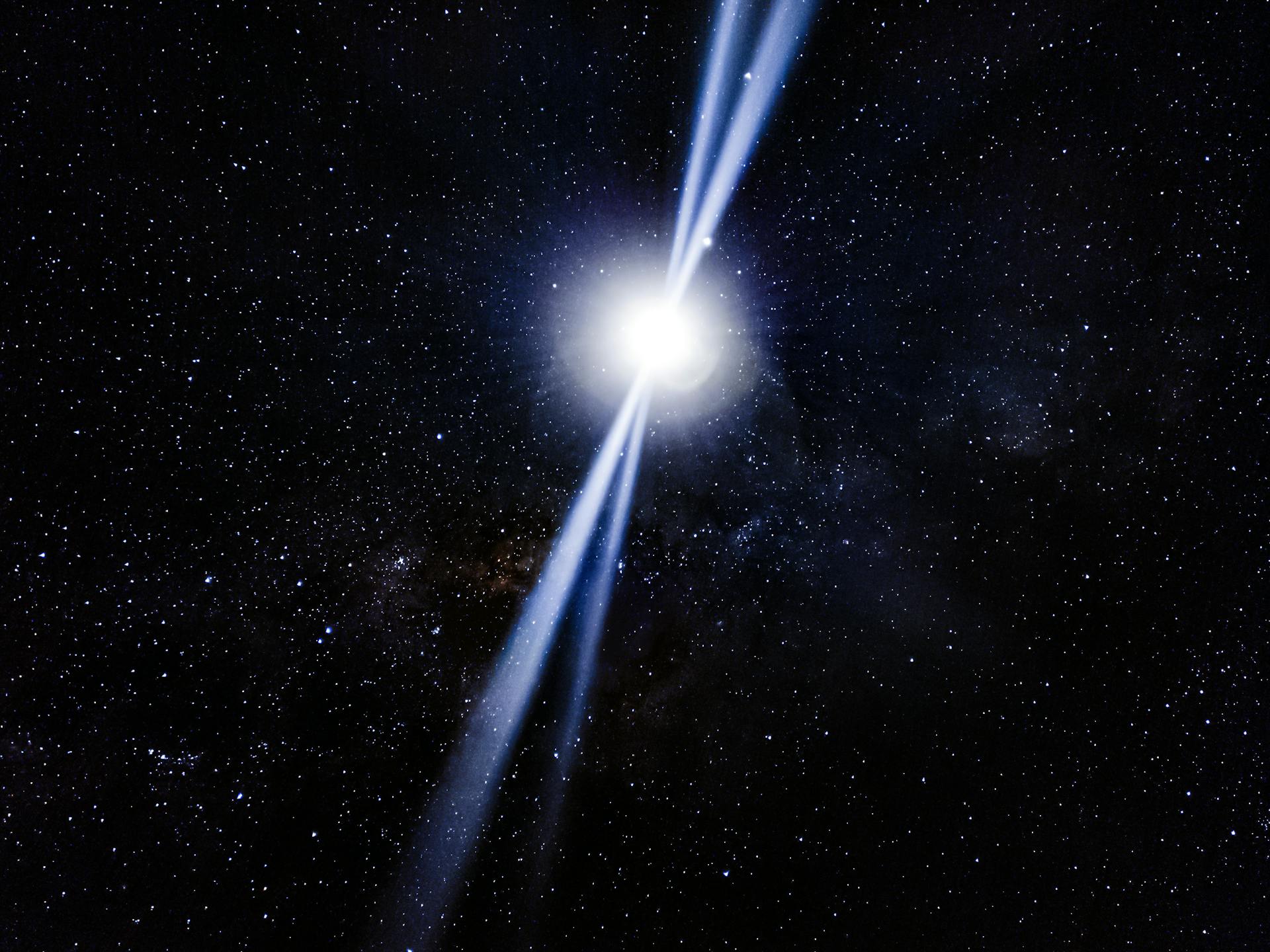
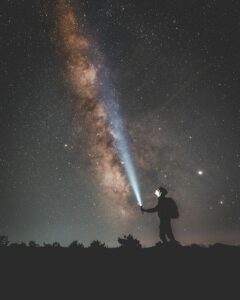
The natural state of the night sky becomes invisible to you when you observe it. You are seeing it as it was in some cases, before Earth existed. Before the Sun existed. The light entering your eye from certain stars and galaxies left its source so long ago that the object producing it may no longer exist at all. Scientists consider the operational time delay as their research limitation, but they actually use it to study time travel according to their research methods.
The logic needs a moment of reflection because its understanding requires deep thought. Light travels at roughly 186,000 miles per second. At that speed, it still takes about 4.2 years to reach us from the nearest star beyond the Sun. From galaxies near the edge of the observable universe, the journey takes billions of years. Astronomers use telescopes to study distant celestial bodies because they need to examine space from past times instead of present conditions. The deep past sends them a signal that contains information about the light source’s chemical makeup through its different light wavelengths.
The content reaches its most unusual point in that final section.
The Fingerprint No Fire Can Fake
Every element in the periodic table absorbs and emits light at specific, predictable wavelengths. Hydrogen does it one way. Helium another. Iron, carbon, oxygen, each has a signature as unique as a fingerprint. When starlight passes through a spectrograph and gets split into its component wavelengths, the resulting pattern is a readout of what that star is made of. This technique, called spectroscopy, has been in use for well over a century. But what it’s revealing now, with modern instruments, is something the original pioneers of the method could not have anticipated.
The oldest stars in the observable universe, the ones whose light has been traveling the longest, are almost chemically bare. They contain hydrogen. They contain helium. Almost nothing else. That’s not a quirk of those particular stars. That’s the signature of a universe that hadn’t yet built anything heavier. In the first moments after the Big Bang, the cosmos produced hydrogen, helium, and trace amounts of lithium. That was the complete inventory. Every other element on the periodic table, the carbon in your cells, the iron in your blood, the calcium in your bones, had to be manufactured later. Inside stars.
Where the Heavy Stuff Comes From
This is one of the more humbling facts in all of science, and it tends to land differently once you actually let it settle. The atoms that make up a human body were forged in stellar interiors over billions of years, then scattered across space when those stars died, sometimes violently, in the explosions astronomers call supernovae. The universe had to run through multiple generations of stars before the raw materials for rocky planets, oceans, and biology even existed.
Ancient starlight confirms this directly. When scientists study the spectra of progressively older stars, using redshift to determine how far away, and therefore how far back in time, the light originated, they can watch the universe’s chemical inventory grow. The earliest stellar light contains almost no metals, in the astronomical sense of the word. Astronomers use “metals” to mean any element heavier than helium, which sounds insane until you realize it’s exactly how the field has always worked. Newer stars, like our Sun, are comparatively metal-rich, meaning they formed from material that had already been through the stellar recycling process at least once.
The Sun, by this measure, is a third-generation star. It formed from the debris of earlier stars that lived and died before it. And the light from those earlier stars, some of it, is still reaching us.
What the Most Distant Light Is Actually Carrying
Space telescopes operating today can detect light from galaxies so remote that the light left before our solar system existed. The spectral data coming from those sources is being parsed for chemical composition, for temperature, and for motion. Each piece of information is a data point in a much larger picture: a reconstruction of how the universe’s chemistry evolved, step by step, from a nearly empty periodic table to one capable of supporting life.
That reconstruction matters for a reason that goes well beyond academic interest. One of the central questions in astrobiology, the study of life’s potential across the cosmos, is whether the conditions that produced life on Earth were rare or common. The chemistry had to be right. The right elements had to be available in the right proportions. Ancient starlight is helping scientists map when and where in the universe those conditions first became possible. Some regions of the galaxy appear to have reached the necessary chemical complexity billions of years before others. Which raises a question that no telescope has yet answered: if the ingredients were ready elsewhere first, what else might have had time to form?
The light is old. The question it’s raising is older still, and the answer, if there is one, is still somewhere out there, traveling toward us.
This article was created with AI assistance and reviewed by the author. The review included fact-checking, clarity edits, references, and sourcing of images