



Seven locations on Earth behave in ways that make physicists, geologists, and biologists genuinely uncomfortable. Not “interesting anomaly” uncomfortable. More like “we’ve published papers and we still don’t agree” uncomfortable.That distinction matters.
Every list of “mysterious places” on the internet is packed with tourist traps, optical illusions dressed up as paranormal phenomena, and folklore that got laundered into science writing. This list is different. These are locations where something measurable, reproducible, and genuinely strange is happening and where the scientific consensus either remains incomplete or is actively contested.
Here are seven of them.
Lake Natron, Tanzania: The Calcifying Waters

Source : https://www.flickr.com/
Lake Natron in northern Tanzania has a surface temperature that can exceed 60 degrees Celsius and a pH close to that of ammonia. Animals that land on the water or drink from the wrong area are sometimes found preserved calcified, posed in an almost lifelike stillness that made photographs of them go viral years ago. The chemistry is understood in broad strokes:
the lake is saturated with sodium carbonate and other minerals, and the alkalinity acts as a kind of natural preservative. But the speed of mineralization in some documented cases, and the specific conditions that produce complete calcification versus simple death, are still being studied. The lake is also the primary breeding ground for nearly the entire global population of lesser flamingos, a species that somehow thrives in water that kills most other life on contact.
The Hessdalen Valley, Norway: Unexplained Lights Since the 1930s
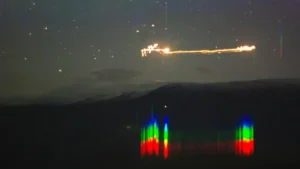
Source :http://imaggeo.egu.eu (CC BY-NC-SA 3.0)
In the Hessdalen Valley in central Norway, floating lights have been observed and documented by residents since at least the 1930s. They’re not faint. Witnesses describe bright, slow-moving orbs that can linger for up to an hour. Scientists have been studying the phenomenon since the 1980s, deploying sensors, radar systems, and cameras.
Several hypotheses have been proposed: combustion of gases released from geological faults, piezoelectric effects from quartz-rich rocks under pressure, even plasma formation triggered by electrical charges in the valley’s unique mineral composition.
And here’s the strange part, none of these explanations has been ruled out, and none fully accounts for all documented observations. The lights are still appearing. The sensors are still running.
The Bay of Fundy, Canada: Tides That Defy Intuition
The Bay of Fundy, between Nova Scotia and New Brunswick, has the highest tidal range on the planet. The water rises and falls up to 16 meters, roughly the height of a five-story building, twice a day. The cause is a resonance effect: the bay’s length and shape create a natural oscillation period that nearly matches the rhythm of the tidal force itself, amplifying it the way a pushed swing amplifies with each nudge.
Source : flickrUnderstood in principle. Genuinely strange in practice. What researchers are still working through is the exact feedback between the tidal bore, the sediment behavior, and the long-term geological reshaping of the bay floor. The system is dynamic in ways that make precise long-range modeling difficult.
The Boiling River, Peru: Heat With No Obvious Source

In the Peruvian Amazon, a river flows that is genuinely, dangerously hot, reaching temperatures near boiling in its deepest sections. A geoscientist named the site formally after years of working with local communities who had known about it for generations. The heat is real and measurable.
The puzzle is the source. The nearest active volcano is hundreds of kilometers away. The standard explanation, geothermal activity, requires either a fault system or a volcanic source, and neither has been definitively mapped for this location. Current research suggests the heat may travel along deep fault lines from a distant source, but the pathway has not been traced to a confirmed origin. Boiling river. No volcano nearby. Still heating.
The Magnetic Hill Zones: Gravity Hills Worldwide

Magnetic Hill in Moncton, New Brunswick is probably the most famous of what scientists call “gravity hills”, places where a slight downhill slope creates a visual illusion that makes vehicles appear to roll uphill. The Ladakh region of India has a well-known one.
So does a stretch of road in Ariccia, Italy. The physics is understood: the surrounding terrain misleads the eye into misreading the slope. What’s less understood is why certain locations produce the illusion so reliably and so dramatically, while geometrically similar locations do not.

The visual cortex is doing something specific here that isn’t fully mapped. Neurologists and perception researchers are still publishing on the mechanisms.
The Movile Cave, Romania: Life With No Sunlight, No Surface Connection

Movile Cave in southeastern Romania was sealed off from the surface for an estimated five million years. When it was opened in 1986, researchers found a functioning ecosystem, bacteria, spiders, leeches, water scorpions, living in complete darkness, in air with almost no oxygen and high concentrations of carbon dioxide and hydrogen sulfide.
Source: FreepikThe bacteria at the base of the food chain were not photosynthetic. They were chemosynthetic, deriving energy from sulfur compounds. This was already known to occur in deep sea environments. it in a sealed cave on dry land, supporting 48 species found nowhere else on Earth, rewrote assumptions about where complex life can persist. Some of those species are still being described and classified. The cave’s full microbial diversity is not yet catalogued.
The Taos Hum, New Mexico: A Sound Only Some People Hear

Since the early 1990s, a subset of residents in and around Taos, New Mexico have reported hearing a persistent low-frequency hum. Not everyone hears it. Conventional recording equipment has repeatedly failed to capture it. Investigations involving the federal government, university researchers, and acoustic specialists have been inconclusive.
Source : FlickrProposed explanations include industrial equipment, seismic microactivity, infrasound from geological sources, and a phenomenon where the inner ear generates its own oscillations under certain conditions. No single source has been confirmed. The hum is still being reported. The thread running through all seven of these places is the same. Science doesn’t say “we don’t know” easily or often. When it does, that’s the signal worth paying attention to.
This article was created with AI assistance and reviewed by Charlotte Dayes, author at NewsDailys. The review included fact-checking, clarity edits, and sourcing of images.