

At the bottom of the trench, the pressure would be about one thousand times what it is here where we stand. The water temperature would be slightly above freezing, and sunlight would have no meaning there. The water pressure would crush any known structure in seconds. According to every scientific criterion used to determine the limits of living things, there should be nothing alive at all.
And still.
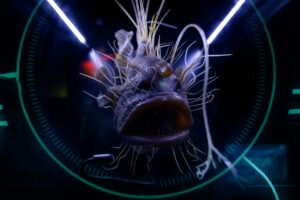
Evidence has been surfacing over the years that the hadal zone, which is defined as that part of the ocean below 6,000 meters and was thus named after the Greek underworld of Hades, is far from being barren. It is, indeed, brimming. Not in the same way a reef brims, full of activity and vivid life. But in ways that are slowly but surely destroying all the preconceptions the field of biology has come to accept over time.
The Zone That Shouldn’t Have Any Life
But first of all, let us explain what makes up this hadal zone. The seafloor is not smooth and level everywhere; sometimes it goes down in trenches, large and narrow gaps in the seafloor caused by the friction of tectonic plates scraping against one another. The most extreme example of these trenches, the Mariana Trench, stretches in the western Pacific Ocean, going just above 11,000 meters at its lowest depth. That is, more than twice the height of Mount Everest. There is also the Tonga Trench, the Philippine Trench, and the Kermadec Trench, among others.
At those depths, the pressure becomes almost impossible to describe in familiar terms. The physics of what happens to cells, to proteins, to the basic molecular machinery of biology, changes. Enzymes don’t fold correctly. Cell membranes, which depend on a certain flexibility to function, behave differently. The chemistry of life as we understand it is built around conditions nothing like these.
Which is exactly what makes the organisms living there so strange.
The Creatures That Rewrote the Rulebook
Here’s the part that still catches researchers off guard: the animals found in the hadal zone aren’t just surviving in spite of these conditions. Some appear to be thriving because of them. Amphipods, small crustaceans that look something like shrimp, have been found in enormous numbers at the very deepest points, scavenging with an efficiency that outpaces their shallow-water relatives. Snailfish, soft-bodied and translucent, have been filmed at depths that would have been considered impossible for vertebrates not long ago. Microbes have been found not just existing in the sediment at these depths but metabolizing actively, processing organic material that drifts down from the sunlit ocean thousands of meters above.
And this is what’s weird about it. Not only do the adaptations they’ve acquired nullify the stress, but they rely on it as well. Some of the microorganisms in the hadal zone release chemical stabilizers known as piezolytes or pressure-protective solutes. Their performance is optimized by the extremely high pressure of the surrounding environment. Take them out of the water and expose to normal conditions, and some won’t fare so well. Pressure isn’t something that’s been overcome. It’s become their natural environment.
This shouldn’t be happening according to the traditional model of adaptation. Adaptation should be about surviving in an inhospitable environment. But now even the hadal zone seems to prove that marginal environments can be the most favorable ones.
What Gets Recycled in the Dark
One of the more quietly significant findings in hadal research involves what the deep actually does for the rest of the ocean. The trenches aren’t just passive containers. They function as collection points. Organic carbon, dead plant matter, dead animals, biological debris, sinks from the surface and accumulates in the trenches at concentrations higher than in the surrounding deep ocean. The microbes and scavengers living there process this material, breaking it down, cycling nutrients back into the system in ways researchers are still working to quantify.
In other words, the deepest places on Earth may be doing meaningful work for the broader ocean ecosystem. Not decoration. Not footnotes. Active participants in the chemistry that keeps the planet’s oceans functioning. The hadal zone may be one of the stranger carbon-processing environments on Earth, and we’ve barely sampled it.
The sampling problem is real. Most of what we know about hadal biology comes from a remarkably small number of expeditions, a handful of landers and remotely operated vehicles capable of reaching those depths, and the contents of nets and traps that bring back only what survives the journey up.
The Pressure Is the Point
What the hadal zone has quietly done to biology is force a reckoning with the word “extreme.” Scientists use it to mean far from the conditions that most life on Earth experiences. But from the perspective of a snailfish filmed at 8,000 meters, the surface is the extreme environment. Your living room would kill it. The categories we built to describe where life can and cannot go were built from a very narrow sample of the planet.
There are roughly 33 known hadal trenches on Earth. Detailed biological surveys have been conducted in a small fraction of them. What that means, practically, is that the rulebook isn’t just being rewritten. It’s still being written for the first time, in a place we’re only beginning to visit.
If the deepest, most pressure-crushed, light-starved regions of our own ocean can sustain ecosystems this active, the question researchers are starting to ask out loud is what that implies for life elsewhere, on ocean worlds like Europa or Enceladus, where liquid water exists under ice and sunlight never reaches at all.
This article was created with AI assistance and reviewed by Charlotte Dayes, author at NewsDailys. The review included fact-checking, clarity edits, and sourcing of images.