


There are stories that should be famous and somehow aren’t. The smallpox outbreak that struck New York City in 1947 is one of them. Not because it killed thousands, it didn’t. But the reason it didn’t kill thousands is a story about exactly how close things can get before someone in the right place, at the right moment, recognizes what no one else has seen yet.
It started, as these things often do, with a traveler. A man arrived in the city carrying the virus without knowing it. By the time anyone understood what they were dealing with, he had already moved through hotels, hospitals, a bus trip, and the ordinary machinery of a city going about its day. Smallpox doesn’t announce itself immediately. The early symptoms, fever, aching, a creeping sense that something is wrong, look like a dozen other things. And in a city of millions, a dozen other things are what everyone assumes.
What changed everything was a nurse.
Her name, the specific hospital ward, the exact moment she looked at a patient and felt something shift in her thinking, those details live in the public health archives of that era. But the shape of what she did is not disputed. She had seen smallpox before, or been trained to recognize what others had long stopped worrying about. By the mid-twentieth century, smallpox felt like a solved problem in American cities.
Vaccination had been common, then mandatory, then gradually assumed. The disease had retreated so far into the past that a generation of medical staff had never actually seen a case in person. Which is exactly the kind of quiet institutional forgetting that turns a manageable crisis into a catastrophe.
She didn’t assume. That’s the part worth sitting with.
In a hospital culture where smallpox wasn’t on anyone’s mental checklist, she looked at what was in front of her and called it what it was. Or at minimum, raised the alarm that made someone else look harder. And here’s the thing most people miss about that moment:
the courage it takes to say “I think this is something serious” in a setting where the default assumption is that you’re wrong, where the disease you’re naming hasn’t appeared locally in years, where raising the alarm means disrupting an entire institution and possibly being embarrassed if you’re mistaken.
She raised the alarm.
When the City Had Forty-Eight Hours to Decide

What followed was one of the most striking public health responses in American urban history. New York’s health commissioner at the time launched a city-wide vaccination campaign that, within weeks, reached millions of residents.
Think about what that actually means in practical terms. No internet. No smartphones. No centralized database of who had been vaccinated and who hadn’t. The city mobilized through phone calls, newspaper announcements, neighborhood clinics set up in schools and firehouses, the physical infrastructure of a mid-century American metropolis turning on a dime.
People lined up around the block. They waited for hours. There were reports of minor vaccine complications, as there always are with any mass medical intervention of that scale. But the number of actual smallpox cases stayed small, a handful of confirmed infections, and a small number of deaths. Given how contagious the disease is, given how many people the index case had already contacted, the outcome was, by any measure, extraordinary.
The outbreak was contained. And then, quietly, it became history.
What Gets Remembered and What Gets Lost

Here is the strange thing about this story. The 1947 outbreak appears in public health literature, in epidemiology textbooks, and in the archival records of New York City’s health department. Specialists know it. People who study pandemic preparedness cite it. But it never became the kind of story that parents told their children, the kind that makes it into the general cultural memory the way Typhoid Mary did, or the 1918 influenza.
We remember disasters. We do not remember the times disasters were stopped, because a stopped disaster leaves no ruins and takes no photographs. The 1947 outbreak was, in a precise sense, too successful to be famous.
And part of it is who was at the center of the story. Nurses don’t get the headlines that commissioners and mayors do. The person who sounds the first alarm rarely ends up in the history books. The infrastructure that allows someone to sound that alarm, the training, the institutional memory, the willingness to take an unusual concern seriously, almost never does.
We remember the fire. Rarely does the person who smells the smoke.
Why This Particular Moment Still Matters
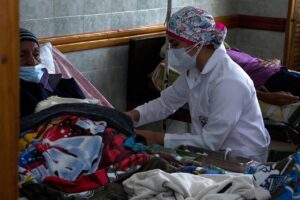
Smallpox was officially eradicated in 1980. The last naturally occurring case appeared in 1977 in Somalia. The U.S. ended routine smallpox vaccination in 1972. So if you were born after that, you have no immunity. None. The virus exists today in two approved labs under international controls, one at the CDC in Atlanta and one in Novosibirsk, Russia.
What happens if it gets out, accidentally or not, is not a fringe worry. Public health agencies plan for it. Every one of those plans assumes the same thing: someone has to recognize it early, before the lab confirms it, before the protocols start, in that window between first symptom and first diagnosis.
That gap is where the 1947 story lives.
A city of millions was protected not by a policy or a system or a piece of technology, but by one person who knew what she was looking at and said so. The systems that followed, the vaccination campaign, the public communication, and the logistics of reaching millions of people in weeks, were extraordinary. But they only worked because someone opened the door.
It is hard not to wonder, looking back on that spring in New York, how many times something similar has happened without anyone ever knowing. A case caught early. An outbreak that never became an outbreak. A name that never made the history books because history, in that particular instance, didn’t happen.
That nurse, whoever she was, whatever her name turns out to be in the archives, stopped something. In a city that was too busy and too confident to think it needed stopping.
That seems worth knowing.
This article was researched, written, and edited by our human editorial team. AI tools were used in a limited research-assistant capacity. All claims were independently verified.