


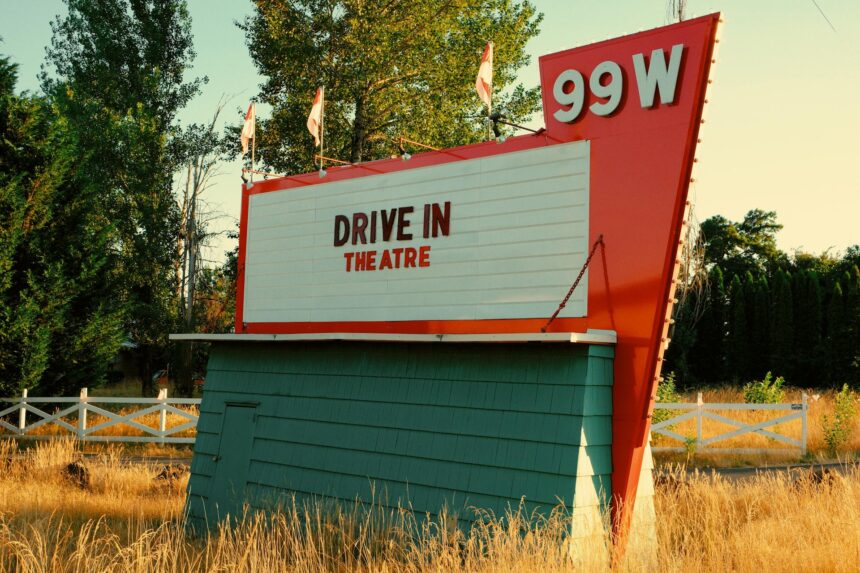
There is a particular kind of field at the edge of American towns that older residents still recognize. It’s flat, strangely wide, and cleared in a way that farmland isn’t quite cleared the grading too deliberate, the access road too intentional. Sometimes a rusted pole still stands near the back. That’s where the screen was. That’s where, on warm Friday nights sometime between the late 1940s and the early 1980s, a few thousand people would sit in their cars and watch a movie under an open sky.
What most of those people didn’t know, and what most histories of the drive-in theater still gloss over, is that the land they were parked on was the whole point. The movie was almost secondary.
The drive-in theater boom that swept postwar America wasn’t primarily a story about entertainment. It was a story about cheap land, favorable zoning, and a specific moment in American tax law that made owning a large undeveloped parcel at the edge of a growing suburb quietly profitable in ways that had nothing to do with ticket sales.
The Land Play That Built an Industry
The economics worked like this. In the years following World War II, American cities were expanding at a pace no one had seen before. Developers and investors understood that land on the suburban fringe cheap today, would be worth significantly more within a decade as housing tracts pushed outward. But raw land sitting idle generated no income and attracted property taxes. It needed to be doing something.
A drive-in theater was close to ideal. You needed a screen, a projection booth, a snack bar, and a lot of gravel. That was it. No foundation, no permanent walls, nothing that would cost real money to tear down later. The whole operation sat lightly on the land, which meant the land could be sold or developed later without much demolition expense.
And in the meantime, the theater brought in enough money to cover its own costs, chip away at the property tax bill, and give investors a reason to be patient with a vacant lot that needed another decade to appreciate.
Some operators were straightforward showmen who loved the movie business. But a meaningful share of the drive-in expansion in the late 1940s and through the 1950s was driven by people who were, at their core, land speculators. The theater was the placeholder. The suburb was the payoff.
This is the part that the nostalgia tends to skip. We remember the double features and the speaker boxes and the cold Coke from the concession stand. What we don’t tend to remember is that the whole apparatus was sitting on land that someone expected to sell.
When the Math Changed

The scheme worked beautifully for a while. Drive-in attendance climbed through the late 1950s and into the early 1960s, and the land under those screens appreciated more or less as expected as the suburbs pushed outward. Operators who had bought on the fringe found themselves, a decade later, surrounded by subdivisions and strip malls. The land was worth real money.
And that’s exactly when the theaters started to close, not because people stopped going, but because selling the land had become more profitable than running the theater.
The first wave of closures came in the 1960s and into the early 1970s. Simple math. An operator who had held a ten-acre parcel since 1951 could sell to a shopping center developer and retire on the proceeds. Why run a seasonal business with weather risk and a payroll when the exit was right there, standing in a suit, holding a checkbook?
What followed was a feedback loop. As the most strategically located drive-ins sold off, the ones that remained were increasingly on land that hadn’t appreciated as expected, too far out, in the wrong direction from growth, or in regions where the suburban expansion had stalled. These operators couldn’t sell their way to a windfall. They were just running a drive-in theater, which, stripped of its land-speculation logic, was a harder business than it looked.
Then came the conditions that made a hard business nearly impossible. The energy crisis of the 1973-1979 raised the cost of running a car for two hours in a parking lot. Daylight saving time, extended in the mid-1970s to conserve energy, pushed sunset later, which meant drive-in operators couldn’t start their first showing until well into the evening, cutting into the family audience that had always been their core. Cable television arrived in living rooms. Then the VCR. The reasons stacked up.
But here’s the strange part: the financial logic that had originally built the drive-in industry was also the reason it couldn’t adapt. The operators who might have reinvested, upgraded projection equipment, expanded concessions, added screens, often didn’t, because the long-term plan had never been to build a permanent entertainment business. It had been to hold land. When the land-hold thesis stopped working and the ticket-sale business started struggling at the same time, there was nothing underneath to fall back on.
What 3,000 Closures Actually Looked Like
At the industry’s peak, somewhere around four thousand drive-in theaters operated across the United States. By the mid-1990s, fewer than a thousand remained. The collapse happened across roughly twenty years, which sounds gradual until you realize that most of the closures came in concentrated bursts, a bad summer, a development offer too good to refuse, an owner reaching retirement age with no succession plan.
The screens didn’t fall down dramatically. They were just taken down, or left standing until they rusted out, while the land underneath got rezoned and sold. Across the country, the footprint of the drive-in became the footprint of whatever came next: a Walmart, a subdivision entrance, a storage facility, a car dealership. The grading that had made the lots so useful for parking thousands of cars made them equally useful for any flat-pad commercial construction. The land, in other words, did exactly what its original owners had expected it to do.
Here’s the thing. What was lost wasn’t just a form of entertainment. It was one of the only public spaces in mid-century American life where a family in a used Ford and a family in a new Cadillac paid the same price and watched the same movie. Same screen, same distance, same sky. Not egalitarian by design. Egalitarian because the land scheme ran on volume, and volume required a low door.
A few hundred drive-ins survive today, most of them in the hands of operators who own the land outright and have no particular desire to sell, or who have found that the nostalgia market justifies the effort. Some of them have been running continuously since the 1950s. They tend to be in smaller towns, in regions where the suburban expansion never quite reached them, on land that no developer has yet decided is worth more than a summer movie night.
They are, by accident, exactly what they always were: a good use of cheap land at the edge of somewhere.
How strange it is to remember that the thing we miss most about them, the sense of open space, the unhurried evening, the families spread across acres of summer dark, was never really the point at all.
This article was researched, written, and edited by our human editorial team. AI tools were used in a limited research-assistant capacity. All claims were independently verified.