


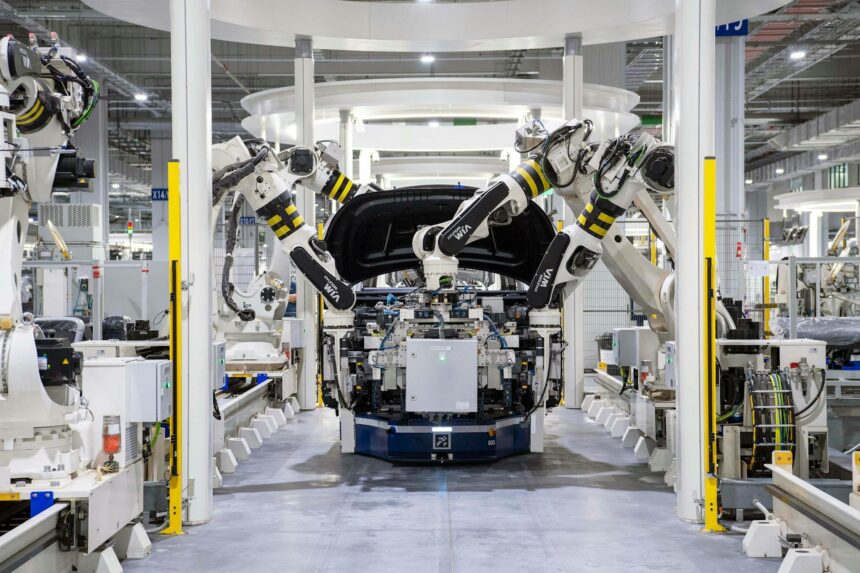
Early on a weekday morning in Spartanburg, South Carolina, two robots reported for work.
Not metaphorically. Two Figure 02 humanoids, standing roughly human height with human-shaped arms, walked onto the floor of BMW’s Spartanburg plant and started loading sheet metal components. They ran extended weekday shifts. They did it again the next day. And the day after that. For eleven months.
By the end of the deployment, those two machines had accumulated thousands of operational hours (per KraneShares Research) and loaded tens of thousands of sheet metal components (per KraneShares Research). The BMW X3 vehicles, which they helped build thousands of them (per KraneShares Research), rolled off the line and into dealerships. No asterisk. No controlled demo. No press event with a robot doing one trick for a camera.
This was a job. And the robots showed up.
From Pilot to Production
That distinction matters more than it might seem. The history of humanoid robotics is thick with impressive demonstrations that fell apart the moment they met a real factory floor. Boston Dynamics has been showing off athletic robots since the early 2010s. The demos are extraordinary. The gap between “extraordinary demo” and “loads 90,000 components without incident over eleven months” is where most robotics projects quietly disappear.
BMW’s Spartanburg deployment, documented by KraneShares Research, is different in kind. The plant already builds more vehicles than any other BMW facility in the world. It operates under real production pressure, real quality standards, and real timelines. When two humanoids ran continuous shifts there for nearly a year, they weren’t guests. They were on the clock.
And here’s the thing that changes the calculus going forward: the question is no longer whether humanoid robots can perform controlled tasks in a structured environment. They can. The question BMW is now asking, and the rest of the automotive industry is watching very carefully, is whether they can handle the work that’s genuinely hard to automate.
EV battery assembly is the work.
Leipzig and the Battery Problem
In early 2026, BMW announced plans to expand the humanoid program to a European facility (reported as its Leipzig, Germany plant, verify against BMW press release), targeting high-voltage EV battery assembly. A full-scale pilot is planned for later in 2026 (per KraneShares Research).
The choice of task is not arbitrary. Traditional industrial robots, the fixed-arm kind that have populated auto plants since the 1980s, excel at repetitive, high-precision work in defined spaces. Welding the same seam 10,000 times. Placing identical bolts. But battery assembly for electric vehicles involves handling components that vary, working in tight configurations, and performing steps that require something close to dexterity. It’s exactly the kind of work that has resisted automation and pushed automakers toward offshore supply-chain partners who use human labor.
That’s the trillion-dollar implication buried in the Leipzig announcement. If humanoid robots can handle EV battery assembly reliably, automakers gain the ability to bring outsourced supply-chain work back in-house, with machines rather than overseas labor. The economics of that shift, if it holds at scale, would be significant enough to reshape where cars get made and how much they cost to build.
That’s a large “if.” But it’s a smaller “if” than it was twelve months ago.
The Compute Problem Gets Its Own Chip
What’s happening in Spartanburg and Leipzig doesn’t exist in isolation. The infrastructure required to run humanoid robots at ian ndustrial scale is being built around it, in real time.
Qualcomm announced a processor designed specifically for humanoid robots (verify product name and launch date against Qualcomm official announcements), a processor designed specifically for humanoid robots. Qualcomm has been reported to be working with Figure AI (verify against current partnership announcements) and Neura Robotics (verify Qualcomm partnership against official announcements) to define the compute architectures that factory-floor humanoids will actually need, not the architectures that work in a lab, but the ones that can process sensor data, maintain balance, execute precise motor control, and adapt to variable conditions across a 10-hour shift without overheating or failing.
That’s a different engineering problem than building a fast chip for a phone. The Dragonwing IQ10 represents the industry’s recognition that humanoid robotics needs its own compute stack, purpose-built, not adapted. When chipmakers start designing silicon for a specific application, it usually means the application is no longer a science project. It means it’s becoming an industry.
What the Numbers Actually Say
Pause on 90,000 components for a moment. That’s not a rounding error. Two robots. Eleven months. Ninety thousand load operations. In manufacturing terms, that’s a number that speaks directly to reliability, because a system that fails unpredictably doesn’t accumulate numbers like that. It gets pulled off the floor.
The fact that BMW is now expanding the program, rather than quietly shelving it after the pilot, is a signal worth reading. Companies don’t move humanoid robots to EV battery lines, one of the most sensitive and technically demanding production environments in automotive manufacturing, because a pilot was mediocre.
The Spartanburg deployment is not proof that humanoid robots are ready to replace assembly-line workers at scale. It’s proof that they can survive a real factory floor long enough to be useful. That’s a shorter sentence than it sounds. For most of the past decade, the honest answer to “can humanoid robots work in an actual plant?” was “we don’t really know yet.”
Now BMW knows. And in summer 2026, Leipzig will find out whether the answer holds when the work gets harder.
Whether the rest of the industry is ready to follow depends on what happens next in Germany, and on a question that nobody in manufacturing has fully priced in yet: if the machines can do the hard work too, what does that mean for where the hard work gets done?
This article was researched, written, and edited by our human editorial team. AI tools were used in a limited research-assistant capacity. All claims were independently verified.